- Not only are Mandalorians paper tigers, only alive because the Jedi are too nice to annihilate them, but they're also belligerent nomads who historically made most of their living stealing and slaving, and yet they inexplicably get treated as some kind of noble warrior. They're space Kurds.
Or space Spartans (except nomadic), who only had a c. 48.5% win-rate, almost exactly 50% win-or-draw, no better than any other Greek city-state, despite their absolutely nightmarish child-soldier childrearing, and had a population something like 80% slaves. (For comparison, Rome was c. 30–40% slave.) Okay that might be slightly unfair to the Mandalorians; you can be adopted into them, you couldn't even rejoin the Spartan citizen class if you, or an ancestor, were ever rejected from it.
And "this is the Way" is the most irritating meme since "winter is coming". It's a bit less grating in the show proper, though. (But it's too bad The Witcher is now outperforming The Mandalorian. I guess "same premise but with T&A" wins every time. Or that putting something on Disney+ hurts its ratings. Both?) - Aside from how Arataka Reigen is proof that a rogue can absolutely be lawful good, we know his specific rogue archetype—clearly he calls his sneak attack "self-defense rush". He's probably in my top five favorite characters in all of fiction.
- It occurs to me that the elves, dwarves, and gnomes of my setting have yet another advantage over humans: their mounts all have darkvision. You can't use cavalry at night, horses being as diurnal as we are (the tapeta lucida notwithstanding)—and a lot more likely to die if they trip on something in the dark. People who ride magic animals that have the same night-vision as elves and dwarves have no such limitation. The riders of such creatures can also sleep in the saddle much more safely, and the mounts can stand watch and rest at the same time—I crunched it, if they have the same senses as the mundane animals they're based on, their Perception score while asleep is the same as an average, NPC-class human's is, wide awake.
Somewhat relatedly, rather than breed special chargers from Equus ferus, the rural-settled culture of my humans will, instead, have domesticated Equus giganteus. Seem like a logistical problem, since chargers can't survive on grazing and have to be fed in stalls? (Presumably charger-sized mustangs would starve.) Nope. In an ice age, plains are dominated by C3 grasses like wheat, rice, and rye, rather than C4 grasses like corn, millet, and sorghum. They have much higher protein content—the shift from C3 grasses to C4 ones, when the glaciers melted, is thought to have been a factor in E. giganteus going extinct (though humans probably played a role too). The other human cultures, and people who aren't super-heavy cavalry in that culture, ride regular old Equus ferus, though.
(And no, it's not weird to domesticate more than one species of horse; the Tibetan wild ass is semi-domesticated, along with the fully domesticated African one, i.e. the donkey.) - Speaking of logistics, I mentioned my dwarves doing their farming with piped-in lighting—they also might use something like a Dawnflower's light, obviously minus the Sarenrae branding. But the "high" elves also pose some issues, since they live above the treeline (except where their sacred tree is concerned, because the World Tree doesn't care about elevation), meaning most plants won't grow in their cities. They also have a sharp limit on their arable land, living at mountaintops.
They're also (the dwarves are too, but their space isn't as constrained since they have whole caverns to raise herds in) mostly carnivorous, though they only raise small things like poultry and squirrels domestically. I think a lot of it can be done with Dawnflower's light hydroponics and druidic magic (e.g. plant growth) increasing agricultural yields, to grow more fodder for the domestic animals that are the main thing they eat. Like the dwarves, their farms are underground. - Epithet Erased is freaking amazing, though I do admittedly weight "heroine cuteness" excessively. There isn't a single character in it that I don't like or that the writers mistreat to no purpose, two rarities in animated works. About the worst I can say about it is that while the swearing scene in like the third episode is funny, it does prevent it being recommendable to parents, who are hard-up for things that will entertain their children and aren't terrible. Anyway, the first season's over now and they need you to go subscribe to VRV or donate to the Patreon.
- As I think I mentioned before, I watched Chivalry of a Failed Knight on Youtube, because I didn't want to spring for Hulu. Well, I got Hulu for Christmas, and was all set to rewatch it on the up-and-up. But then I discover that some slavering beast, forgotten of God and man, wholly foreign to all decent people and right reason, had decided that that series should only stream dubbed. "Well, you can finally get this wine that wasn't sold in your country, but the only supplier pees in every bottle."
Oh well. It's still got Weakest Undefeated Bahamut—subbed not dubbed—which, while fundamentally just a standard magic-school harem series, is extremely solid in terms of setting and characters. And pacing—nary an episode happens where you don't think "oh wow the end credits should be by any time now"…and then the eyecatch comes, because that was just the midpoint. Besides, standard magic-school harems are a breath of the sea air off the Grey Havens compared to isekai. - Turns out it's actually really simple for my nonhuman races to use their talking critters as mounts or companions. For ordinary purposes, of course, they just ride them; the talking critters don't usually fight beside them, but, for instance, watch the humans' horses while the humanoids are all down in a dungeon. But for purposes of class features like paladin or cavalier mounts or ranger or druid companions, they have to wait a bit and spend a feat to get Monstrous Mount. Since none of the mounts are quite as OP as griffons, they don't have that kind of prerequisite; the ones that paladins ride may have an unusual alignment relative to the rest of their races, of course, but there isn't an alignment requirement for the rider like on a worg.
Of course in practice this might mean nonhumans are likely to choose the other option that doesn't involve a mount or companion—the other version of paladin's divine bond or ranger's hunter's bond (honestly does anyone actually still take paladin mount in Pathfinder, now they have the other option?). I also think druids will still much more likely take actual animals as their animal companions—elf and gnome druids are also more likely to take plant or fungus companions anyway (and either might just take a domain, instead). For cavaliers, I think the nonhumans are more likely in the first place to take archetypes that replace the mount class feature with something else, like green knight, esquire, or musketeer. "Animal trainer" is kinda humans' "hat", after all.
Still gotta work out what the prerequisites for having these guys as mounts are, and what Monstrous Mount Mastery lets you do with them. But it speaks to the elegance of Pathfinder that there was already a rule in place for what I wanted to do. - Decided that I'm not going to use the aboleths as the illithid stand-in of my setting; that's the role they play in Golarion, after all. Instead, thought I'd just have the kraken do it. It makes perfect sense for evil quasi-squid to be the origin of a bunch of fish-races like skum and sahuagin, after all, and be the things the gillmen ("gill people"—"gill man" being, by the way, what The Creature from the Black Lagoon is known as, to the cognoscenti). Might restat them as aberrations (just involves shifting around some hit-dice, saves, and so forth).
Perhaps relatedly, since my outsiders and aberrations are ultimately the same thing, thought I'd have my elemental spirits—I might have to retool some things from core Pathfinder to get enough of them—also follow the "winged humanoid" theme the celestials and fiends do. Only, bird and bat wings are already taken. So how about pterosaur wings? Works well with a sort of more "primal" theme elementals generally have (presumably the fiends have bat wings because mammals' attempt at flight is an abrogation of the natural order that succeeds only through sheer perversity).
It's odd that there isn't really a hierarchy of elementals like there are for fiends, celestials, proteans, inevitables, and aeons. (Which I'll insist on calling "planeborne", berk.) - I know I've mentioned that the "can't stop the signal" tagline for Serenity is dumb. As I said at the time, actually you can stop signals, it's called jamming, and since they released that "signal" while a space battle was happening overhead, it would very likely have been choked off from the get-go. (You mainly use jamming in space battles because missiles are the chief weapon.)
But the stupidity of this is perhaps illustrated by something else. Now, we all expect something like Halo to know you'd jam enemy communications as a prelude to attack. That's Halo, like the definition of military science fiction. But do you know who else know that comm-jamming is inextricable from an attack, in technological war? The Star Wars prequel trilogy, that's who. In both Phantom Menace and Attack of the Clones, people—the Naboo in the first one, the Separatists in the second—know they're about to be attacked because someone is jamming them. When Star Wars—all of whose militaries would be deeply outclassed by a few lances of Grunts with no Elite leadership above Minor (since Grunts, unlike clones, battle-droids, or stormtroopers, are acquainted with grenades)—understands science fictional warfare better than you, it's flat-out shameful.
Everything wrong with the Star Wars sequels, incidentally (at least that isn't Rian "Taken King" Johnson's detribution), is partly Joss Whedon's fault. Aside from how he helped make the MCU's early installments successful, helping Disney to Take Star Wars, the deeply unfitting snark that disfigures dialogue in The Force Awakens really became a thing in pop culture because of his influence.
Showing posts with label Firefly. Show all posts
Showing posts with label Firefly. Show all posts
2020/01/21
De romanicorum theoriarum XV
Speculative fiction thoughts, a lot of 'em about Pathfinder.

2018/02/21
De romanicorum physicalium 12
This would have been out sooner but as it turns out, Destiny is basically only technically an MMORPG. The Ms are mostly optional and the O is largely a technicality. Take those letters off and you have one of my favorite kinds of game, especially since this one is also an FPS instead of a click-fest.
SF thoughts.
SF thoughts.
- If I could single out one piece of cant that makes a mess of too much worldbuilding, it would be the idea (arising from Marxist dogma) that it's elites that mistreat minorities. Overwhelmingly, the elite protects minorities, and the majority abuses them. I know, blasphemy, the idea that the masses are not the locus of all virtues. But while the masses can rein in the excesses of demagogues (the popular conception of that is also exactly backwards), it's generally the masses' own excesses being reined in by their non-revolutionary elites.
Often the elite isn't protecting the minority out of the goodness of its heart, of course. Many times the minority makes useful cat's paws, to do things the elite doesn't want to dirty its hands with—members of the disaffected group having fewer potentially-troublesome ties to the masses the elite needs trodden down. (Then when the pitchforks and torches come out, the minority can be thrown under the bus: "I had no idea he was doing that! I only knew what he told me!") Generally, when the elite abuses the minority, it's as a piece of populist pandering. - You may recall my possibly unseemly speculation that Firefly's sanitized version of prostitution might be related to the fact the good guys are the Space Confederacy. Now, I was being facetious; but my sister did point out that the Companions are basically a "coon song" version of prostitution. That was the sub-genre of blackface minstrel song that had to do with an idealized, whitewashed version of Antebellum plantation life, capitalizing on the self-pitying nostalgia of the losing side in a war. The Companions are the same thing applied to an industry that may well challenge communism and total war for its efficiency in producing human strife and unhappiness.
- I don't think I've mentioned this before, but even if I have, it bears repeating: a lot of people criticize the hive-mind trope in science fiction, as well they should, but they seldom mention the little fact that a hive is not a society at all. It's a family; the "queen" would more properly be termed the "mother". (In termites, there is also a father; they don't mate once and then have the male die, like the order Hymenoptera.) All the other members of a colony are siblings, each other's sisters (and brothers, in termites). Once you understand that, that a hive of eusocial creatures is a huge nuclear family, most of the tropes based on them are revealed to be even worse than you hopefully thought they were. (Okay some species of termite have multiple breeding pairs, often sisters I think, so presumably the members are sometimes cousins instead of siblings. All that means is they're an extended instead of nuclear family.)
I was reminded of this by the CinemaSins of Ender's Game—which movie, to say something nice(?), doesn't seem to be any worse than the book. But that was especially stupid, because in that, the "Formics" die (or at least go unconscious) when their queen is killed. Which is totally what happens in eusocial species! Oh, right, that would be idiotic: one of the workers just takes royal jelly and becomes the new queen. (I'm unclear how exactly this works in termites, who need a breeding pair to produce eggs—surely getting both from the same hive is genetically counterproductive? Though then again the drone that fertilizes a Hymenopteran queen is typically her nephew, hatched from an unfertilized egg laid by one of her sisters.) Certainly the need to establish the new breeding female or breeding pair and re-organize the colony around its new breeding-caste would make them vulnerable, but the death of a queen wouldn't kill them. Card should probably be embarrassed that the undead zooplankton witches are more realistic than his aliens... - Arrival, aside from being one of those sci-fi movies where the plot hinges on the Power of Love™, is also one of those sci-fi movies with intellectual pretensions that still somehow can't resolve things without time-travel. (Interstellar, too—is the Power of Love™ some kind of space-time warping thing, like an Elder Scroll?) Admittedly Arrival has more right to its intellectual pretensions than most sci-fi movies, though I question some of their assumptions about linguistics—and find the nigh-literal StarfishAliens fairly uninspired.
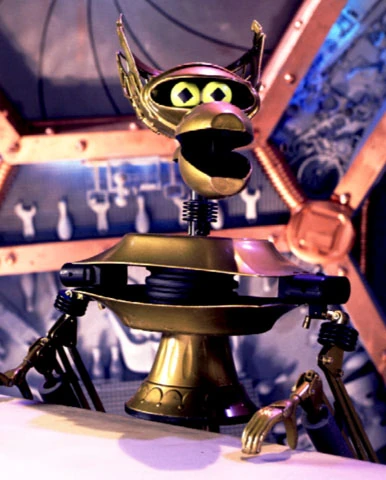
But seriously, time travel is a scourge. As I think I've said, I largely tolerate it only in fantasy. (Which fantasy can be set in space; the Vex are among the best examples of how to do time-travel writing, like a decentralized skinwalker Skynet...although their resemblance to Crow T. Robot rather undercuts their menace.) Time travel is too, well, weird, and involves math almost nobody knows, scientifically speaking; its inclusion in science fiction is thus very, very iffy. And unless the entire plot hinges on it, explicitly, like Back to the Future, its inclusion is almost certainly lazy writing. - I also watched the CinemaSins of Lucy and Valerian and the City of a Thousand Planets. As it turns out, The Fifth Element is Besson's most intelligent work.Because Lucy is bottomlessly stupid (we knew that, of course, but I hadn't realized how much so). Not only does it repeat the "ten percent of your brain" thing, it has "dolphins are smarter than humans" too (their sonar isn't even better, as the movie also asserts). It also has the person who's using the more than ten percent (and not rapidly losing bowel-continence and having her breathing, swallowing, blinking, balance, and eyeball-tracking disrupted) become a pointlessly amoral psychopath. And be able to read all languages instantly, because languages aren't conventional, you can just figure out what their symbols mean, from first principles. Yet curiously she can still only speak English. Her ability to predict others' actions—and read their minds!—comes and goes purely "because plot". Then because it wasn't stupid enough, it has "evolving into pure energy" and a form of time travel!

Valerian isn't quite as overtly contemptuous of its audience's intelligence—but it does sub in some typical European ethno-cluelessness, in the form of the obviously-based-on-idealized-Africans Pearls of the planet Mül, who "lived in harmony with the elements" before the mean old humans came along, and the rest of the Noble Savage foofarah. (Except they have light skin, which I actually attribute to light colors being easier to design around but which I'm certainly not going to stop anyone from attributing to less noble motives, because Besson has forfeited my charity.) The two main leads are as poorly-cast for the roles as they are weird-looking and unappealing in themselves; the plot is pure childishness involving behavior nobody would put in a story after their age reached double digits. Reading a number upside-down is a plot complication a six-year-old would include; vowing to kill someone who has a gun to your head is asking him to shoot you.
To say something nice, Besson wasn't the worst filmmaker whose works I watched CinemaSins about. That laurel is for the brows of the war-criminals behind Maleficent and The Fault in Our Stars. - It may perhaps come as little surprise that I don't have much regard for the Turing test; being able to pass as a thing is not being the thing. Apparently it's worse than that—apparently the test requires that the people the AI has to fool have no background in psychology, anthropology, or computers. Which is like saying "if it can convince people with no background in metallurgy that it's gold, it is gold." There's...there's actually a mineral that takes its name from that, you know? The name also involves reference to fools? Just sayin'.
- There's this assumption running around that a big alien, or an "uplifted" animal, will necessarily have a deep voice. (Destiny notably averts it; the Cabal make high-pitched piggy sounds.) But actually, humans (and felids) have unusually deep voices, for communicating. Yes, felids too, and not just the big ones; compare the sound a housecat makes to the sound a comparably-sized dog makes. A horse, too, makes some pretty high-pitched noises—if you've ever heard an angry one, it sounds like a bear bellowing in falsetto. (I think bears might also have the modified voices you see in felids and humans.)
Now, of course, aliens might've gone a similar route to humans, voice-wise; certainly zledo have deeper voices than humans, in my stuff. But they don't necessarily have to have; dog howls can carry pretty far, so you don't need to have chosen that particular method for improving your communication-abilities. But things like Planet of the Apes apes should have surprisingly high-pitched voices. It doesn't have to be ridiculous (though it would take deft handling); Charlemagne had a high-pitched voice despite being big enough to occasionally grab an unsuspecting courtier and toss him in the air like a baby. - With all the "diversity" and PCnikstvo in the Disney Star Wars installments, it's interesting that they've actually been drastically decreasing the diversity in one key way. Namely, species. Where the original trilogy had a lot of aliens (Chewie, Akbar, Nien Nunb, etc.), and even the sequels had, if anything, more (Newt Gunray, Jarjar, Darth Maul, Watto, Dexter Jettster), the sequels and other Disney installments have lots and lots of humans.
Akbar is utterly squandered in The Last...One You'll See in Theaters; there is exactly zero reason that DJ, for example, had to be human, and in either of the previous two trilogies he wouldn't have been. One of the two Whill monks in Rogue One could easily have been an alien. Personally, I call it "apewashing". There really is no reason, except creative bankruptcy, to make a character in something like that a mangy monkey, when they could be something interesting.
I honestly do not care what breed of mangy monkey you're giving me, if you're substituting that mangy monkey for something more interesting. As I've said before, quoting Penny Arcade, "A universe of possibilities, and you're fixated on the local flavor."



2015/02/18
De romanicorum theoriarum IX
Speculative fiction thoughts.
- Has anyone ever considered that maybe what they like about the laughable drivel that passes for worldbuilding in Firefly is that there's nothing there? And thus they can project their own personal prejudices into it? Or you explain how so many right-wingers managed to think a Joss Whedon work was not a very long-winded personal attack on them, specifically.
Or put another way, Firefly's setting is the worldbuilding equivalent of Bella Swann. Its "flaws", after all, are about as realistic as her alleged clumsiness and unpopularity—in this otherwise fascistically exploitative setting, we have a form of squeaky-clean sanitized prostitution that never has nor ever could exist (let alone in a totalitarian society), because Whedon wants to fantasize about dignified "spiritual" whores. Just like how Bella is supposed to be so clumsy and dorky and gawky, and yet four guys practically ask her out in the first chapter, because Meyer's audience wants to fantasize about turning down lots of suitors before they get Mr. Right.
But at least Twilight is a bleached-britches bodice-ripper where all the bodices are ripped offstage; nobody expects coherence. What's Whedon's excuse for whitewashing prostitution, the most efficient means of producing misery the human race has ever invented? A less charitable person might suggest a common origin between Firefly's paeans to the beauty of the sex-trade and the fact its good guys are the Space Confederacy. (The charitable explanation—that the Browncoats lack the moral ambiguity of the Graycoats merely because Whedon and Minear are too unintelligent and immature to grapple with the moral complexities of the Civil War—is also the one that fits the facts, namely that Whedon and Minear are a pair of rock-stupid adolescents.) - There are exactly two types of birds with cheeks, I discover. Parrots (most noticeable on the largely bare-cheeked macaws), and the california condor. And there are no muscles in the condor's cheeks, they're just an extension of its dewlap. Aside from the interest of this to paleo-artists (because exactly two extant dinosaurs have cheeks, and they almost certainly developed them quite late), is its interest to science fiction writers. Do your aliens have cheeks? Now would be a pretty good time to consider it.
Zledo have cheeks, and indeed lips much like mammals (though more like a cat's than a human's, hence why they can't say "F"), but the flesh, its keratins being in β-sheets, probably looks a bit more like that of macaws (except a different color, and at no point giving way to beak). Khângây don't have cheeks, they have only as much "lip" as lizards, and produce sounds that other species perceive as "labial" with their extremely complex vocal apparatus, the same way birds do. (They also don't have teeth, they have cutting-surfaces like armored-jawed fish.)
...I just decided right now that thoikh don't have cheeks or lips, meaning when they talk it looks unsettlingly like their face splits in half...and their teeth, which are onyx-colored, fold backward when their mouths close, like a snake's (although they look more like a crocodile's). They also, I think, have a second row of teeth in the roof of their mouth, again like a snake. (I imagine that they pronounce "labial" sounds through clenched teeth, instead—presumably you can still get some air through when your teeth fold against each other—which sounds a bit like a V. That might be what khângây languages do, actually, although their vocal apparatus also lets them mimic the sounds people with lips make.) - Hey, here's a wild idea: stop teaching the same stuff in English class that was taught 100 years ago. No, this isn't a "dead white men" argument; it's a "let's teach a new set of dead white men" argument. A hundred years ago we were already teaching, or at least encouraging students to read, Dickens, in schools. But Dickens? Pot-boiling pulp magazine writer.
Do you know who we should be reading in school now, or at least encouraging students to read? Burroughs (Edgar Rice, not William S.); Howard (Robert E.); Lovecraft; Smith (Clark Ashton). The whole Campbell SF stable, too. For literary quality, although not vastness of scope, I'll put any of those dudes (maybe not Lovecraft or the Campbell guys) up against Dickens any day of the week. And hey, you want kids to learn about existentialism in literature? Well cupcake, where you think they'd rather learn it from, Waiting forthe Frigging Play to End AlreadyGodot by Samuel "Black Lotus" Beckett...or Conan the Cimmerian? - You may or may not recall that in 1st and 2nd Edition D&D, elves had level-limits. (They also "do not die" at their final age-category, but departed via not-the-Grey-Havens-at-all, which tended not to make much sense in most campaign-settings.) And then there's the stick-in-the-mud ultraconservative portrayal, mostly a caricature by stupid people who don't know the difference between "chaotic good" and "lawful neutral". But it occurred to me, there's another way to model elves. Ravens are only playful and curious for the first three years of their lives. After that, around the time they usually mate (they are physically mature at a year old but don't usually mate till three), they become strongly neophobic, hating new things and having a lot of trouble adapting to new locations or conditions. What if your elves were the same way, only desiring new experiences until they hit their middle-age category, and then becoming strongly averse to anything different from what they're accustomed to?
It's not exactly how I'm doing it in my campaign, although I think elements of it will be, but it is an interesting idea. It's also a lot less stupid than "people who live a long time must be really boring", never mind that "boredom" is only a part of your emotional repertoire because your life is so short (and thus you can't afford to waste much of it). Elves, having so much more time to kill, are probably endlessly fascinated by things you barely even notice (hey, why'd you think they have a bonus to Spot checks?), and continue to find joy in their pleasures long after humans would become jaded and sated. (That part, that they don't get bored as easily as humans, is definitely something I think my elves do; I might have humans shocked by how much they enjoy things that humans usually outgrow. "Ancient yet seemingly childlike" is often an aspect of the portrayal of elves, after all, and Chesterton actually points out the connection between that and the fact boredom is due to human weakness, I think it's in Orthodoxy.) - Zledo, at this point, are only "felinoid" very broadly speaking. You could also call them "long-armed tyrannosaur-apes", and they've got frog-feet and shark-pupils in bird-eyes, and a dental arrangement not found on Earth, and their "fur" is equally well-described as "really simple feathers" (and some of what their fliers got, you can cross out those first two words).
And I decided quite some time ago actually, their jaw anatomy, at the back of the jaw, isn't like humans, cats, or tyrannosaurs—it's like pygmy hippos. Go look up their skulls: on the back of a hippo's jaw is a deep rounded "bowl", for holding giant muscles. I think zledo have this (which gives them a rather heavy, tyrannosaur like jaw, although their big eye-sockets and braincase make it less noticeable) because I don't think I can swing a sagittal crest anymore, not considering they have a brain volume like a slightly scaled-up Neanderthal. - In my D&D world—where, recall, elves mostly use axes and dwarves seldom do—I decided, the gnomes' weapons are martial versions of the sickles they use to harvest mushrooms (which are the basis of their material culture; fungi are made of chitin, not cellulose, so they can breed mineralized forms to approximate metals, like the hard parts of bugs). I use the stats for (Small-creature versions of) the khopesh and its relatives (like the sapara and kukri), although a real khopesh's cutting-edge is on the outside, because they actually derive from axes, not sickles. (Gygax was probably misled by the kopis, the Greek sword-sized kukri.)
I also give the gnomes the sling as their main missile weapon, which is implied by the Arms and Equipment Guide (which I just got), since gnomes are alchemists (although that book also seems to think gnomes are tech-guys, and they aren't, except on Krynn and in space). Likewise, I gave my halflings (a subrace of humans in this setting) blowguns instead of slings and rocks, and gave them a partial protection from poisoning themselves when using poison darts; they don't regard the use of dart-poison as evil, although they do regard using poison in food as not only evil but as flat-out diabolism. Nomads regard hospitality as sacred, after all.
Incidentally, you may be aware that the only reason D&D druids use scimitars is that Gygax didn't want to bother coming up with stats for sickles (never mind a sickle is for all intents and purposes somewhere between a knife and a hand-axe). But really, it makes perfect sense for D&D druids to use scimitars, because, um..."machete". Kinda a natural fit for people who spend a lot of time in dense plant-life, you know? - Researching the previous post, I came across quite a bit of information on bats and birds that didn't make it in. Bats, basically, are the helicopters to birds' jets. They have superior maneuverability in certain regards, like being able to hover, but they're much slower, can't go nearly as far, and have a hard ceiling on how high they can fly (although unlike helicopters, it's less a matter of physics than of anatomy—mammal lungs are simply inferior).
Another interesting point is, because of how bats' wings are set up, they function in many ways more simply than bird wings. See, a bat's wing is all connected, so (like helicopters) they can't change the shape of their flight surfaces (and can't glide), and have to do all their maneuvering by how they beat the air. A bird's wing, on the other hand, because it's not a continuous tissue but many independently articulated feathers, can be controlled like the elevators, ailerons, and so on of an airplane.
Had a thought, in studying that: what if a species evolved flat, flipper-like arm-wings, that didn't fuse their fingers, but instead turned each finger into an independent flight-control surface? I think that's what the main fliers of the khângây homeworld will do.
2015/02/07
All I Survey III
Thoughts.
- It's almost shocking how naïve many science fiction theorizers are. For instance, people often wax lyrical about the advantages of sci-fi "stunners"—how if something goes wrong, you just stun people; if there's a riot, the cops just stun everyone; if the cops abuse their power, everyone else just stuns 'em. I suppose that kind of vie-en-rose optimism was permissible in the 1970s, since everyone else was also doing it. Now, though? "Oh, great idea, a long-range date-rape drug that doesn't show up in toxicology." Fortunately, a convenient, "point and click" stun-gun, that doesn't stand a good chance of killing the target, is probably impossible. The only thing I could think of that seemed realistic, for my setting (it's an action story, people being unconscious without dying is a necessary plot-device), was medical-nanobot darts. Those show up in a screening—indeed, they would probably log who used them.
Everything else I considered was unlikely to produce convenient unconsciousness, without a significant chance of killing or permanently incapacitating the person they're used on. Plus, I mean, something that'll reliably incapacitate humans would probably just annoy zledo—which "less lethal" weapon designed for use on humans would you like to take with you, to deal with a jaguar?—while things that would reliably incapacitate zledo would be likely to kill humans. Medical nanobots, though they're probably not quite as tidy as I have them, are at least a lot more precise than any of the alternative methods. (It's kinda funny, to me, by the way, that "less lethal" tech is all, pretty much, some variation on the blackjack or the cattle-prod—think about what rubber bullets and "active denial systems" actually are. Hell, even the nanobots are pretty much just a high-tech Mickey Finn.) - The discussion of those who wish to introduce shari'a law into the governance even of some portion of some Western community, is usually not accurate. The trouble is not "states within the state"; that is the same as "Common Law" (you might've noticed "states within the state" is a phrase originating from the Huguenot controversies, i.e. not in a Common Law jurisdiction). Did you know that Navajo religious law is recognized in the United States? Yeah, because Common Law asks "what is your custom?", and when you decide inheritance disputes for the Navajo, the custom bears the name of the goddess Changing Woman.
But Changing Woman's Law is recognized by the Navajo as pertaining only to them, and not to those who did not receive that law (from Talking God, not Changing Woman, despite the name). Hence why its other name is "Our Grandmother's Law", the "we" being the Navajo. Shari'a, on the other hand, is very different from any other law-code recognized in the Common Law, because shari'a acknowledges no other law, and claims authority over all—Muslim, 'Ahl al-Kitab, and mushrikûn/kaffir—alike. (Shari'a doesn't actually even acknowledge a distinction between civil and criminal law, although they're hardly alone in that.) That would be the problem of allowing the incorporation of shari'a into the law of some community, if there is one—Islam can be considered to deny the authority of non-Muslims to adjudicate even in terms of shari'a. No rational state deliberately delegitimizes itself.
Of course, in Common Law, there is precedent for it—Spain and the Crusader Kingdoms adjudicated for Muslim subjects with no problems. So...it may not actually be a problem. Rather (given what circumstances generally motivate the suggestion of incorporating shari'a), it's probably, under current conditions, a symptom of a problem. - Tom Simon, the Superversive, at one point denies the existence of "pro-drop" languages, based on the fact that Spanish verbs actually include their subject "argument" in their inflections. Well and good, but you've really only demonstrated Spanish isn't one. Japanese and Korean? They are. They are languages that can omit the subjects of their verbs, when it's (ostensibly) clear from context, and yet in which the only thing any subject can inflect a verb for is register—and that, only in relatively few contexts (the humble/honorific dichotomy, as a component of business/service speech).
Until you have seen a speech obviously (from context) about the person doing the speaking, i.e. first-person, translated as in the third person and about a member of the opposite sex—as I saw in a fan-sub just a few months ago—you may not appreciate just how explicit Indo-European languages are, in terms of little things like "who is the subject of this sentence?". (On the other hand, until you have seen a character convey that they were born as the daughter of a samurai house, and regard human beings as individual servings of food—an example I made up just now, I dunno, she's a vampire or something—simply by their choice of first-person pronoun and how they inflect numbers, you may not appreciate that there are, in fact, things that even the most highly-inflected Indo-European languages actually leave to "context".) - More and more I am convinced that there are only two things that would really spur large-scale interstellar colonization, since the "Earth is used up" thing would really only spur space-habitat colonization (aside from requiring ever more far-fetched handwaving to justify). No, the only things that can really motivate humans to leave this star, are ambition and fear—either "because it's there", and humanity, as such, is a thing with the right to spread to every corner of the universe (at least that someone else isn't already at first); or "because they're there", and "they" are at least a potential threat, so we need to expand beyond our one star-system.
That second one requires that the "they" be themselves interstellar—and intelligent. All unintelligent risks are either predictable and manageable in the long term (yes, even stars going nova...which we won't have to worry about for the time-frame it is not a joke to plan for, anyway), or just motivate, again, moving to space-habitats (asteroid impacts being the obvious example—leaving to one side that with a few rockets and the world's nuclear stockpiles, we can move asteroids that are on collision courses with Earth).
In my book, I use both—initially humans expand to other stars for ambition, but then the thoikh kill 2% of the human species in practically no time at all, with the explicitly stated goal of annihilating all of them (depending on the result of a test humans don't know they're taking). Humanity responds (after the thoikh stop their attack, the test having been—barely—passed) by a new wave of colonization, motivated by the desire to spread out their population base, making it harder for a single attack to wipe out the whole species. Between the zledo being a lot stronger than the UN—and thus people the expanded population-base can hide behind—and piggybacking on zled infrastructure saving money (losing 2% of the species causes a recession), the places they choose to colonize are all worlds already inhabited by zledo. This, of course, leads to the friction that causes the UN-Imperial War. - If you—perhaps doing the Lord's work in pointing out that Firefly ain't all it's cracked up to be—say that Cowboy Bebop was a space-western, well, congratulations, people like you are the reason they put mining in the film of Enemy Mine. Were you really confused about how there are no dogs in Straw Dogs?
Cowboy Bebop is, full-stop, in terms of its actual plot (which takes up about six episodes), a space yakuza movie, or at least a space HK-style Triad film. Please, what element, other than television Indians and the mere word "cowboy", does it actually have in common with westerns? Other than the things Westerns have in common with basically the entire "gun action" branch of fiction, I mean.
If Bebop is a Western, please, what Blaxploitation movie isn't a "modern-day Western"? (Shaft in Africa? No, Quigley Down Under was still a Western, and it was in Australia.) Because Bebop has a lot more in common with Blaxploitation than it ever did with Westerns. - I don't think mankind would use much beef in space-colonies (pace Firefly and their "space cattle-drives"). Now, it might be different if your colonial effort comes after having to abandon the Earth—you'd be bringing all the animals, and cattle only exist because we eat them, wild cattle are extinct. But colonizing because you have to abandon the Earth is, as I said, a stupid premise; so you can pick and choose, and what you're gonna pick is less resource-intensive than cattle. In my books, people raise ostriches in the colonies. If you don't like your steak well-done (and if you do, "I'm sorry, but please leave"), it's not much different from beef, and it's much more efficient. Ostriches produce half again as many young as cattle (it takes them one-fifth the time to get them: 42 days incubation vs. 200 days gestation means 30 chicks a year vs. 20 calves), take 63% as long to get to slaughtering weight (407 days vs. 645), and use, from what I can tell, 1/6 of an acre per head compared to the 2 acres per head that seems to be a typical minimum for cattle.
I assume that people prefer the texture and structure of "real" meat, that actually comes from an animal; currently, in-vitro meat makes "pink slime" look like filet mignon. The "ethical" considerations of vegetarianism are, frankly, BS unless you're a Buddhist (and thus don't kill plants for your food, either). But it is possible, I suppose, that a society that can 3D-print organs for medicine, can also 3D-print in-vitro meat to give it a texture and structure like real meat—although it would be pointlessly expensive and complicated. Moral grandstanding is the main motive of Western vegetarianism; while "have your supposed moral superiority while indulging all your appetites" is certainly an impulse, and one that people will pay extra in order to indulge, vegetarianism specifically has just spent the last 200-odd years attacking the eating of meat, as such, along with the slaughter of animals for the purpose. So I figure it's slightly more reasonable to suppose that people will continue to either eat meat or be moral-posturing vegetarians, than to posture morally about slaughtering animals, while 3D-printing their meat. - It occurs to me that a lot of what's called "Freudian" analysis (though to be fair, Freud himself wasn't quite that stupid) is a "correlation/causation" error. E.g., the old leftist-peacenik bromide about weapons being phallic—when it's actually that the shapes of both guns and penises share a common origin. Namely? They're both designed to shoot stuff. Bullets into animals to end life, sperm into ova to begin it—point is, they look the same because they do the same thing. Likewise, the "phallic" shape of missiles? Aerodynamics. Not to get graphic but both missiles and penises are designed for smooth forward motion. I hate to break it to you, but that principle predates sexual reproduction itself; there are unicellular organisms that reproduce by fission, and are streamlined and thus "phallic". (That's also why swords are "phallic", come to think of it.)
When tall buildings are supposed to be phallic, on the other hand, you just have raw, undiluted idiocy. Right, the only reason to build defensive watch-towers or high-rise apartments in crowded cities in a tall, thin shape, is a sublimated obsession with the penis—there certainly can't be any other reason. (Interestingly, it occurs to me, the watch-tower and the high-rise have their shapes for opposite reasons. You make a watch-tower thin so it can be tall and still minimize the amount of material you have to move and manipulate to build it, whereas you make a high-rise tall so it can be thin and still fit all the population you need to house. The watch-tower one is also the reason most realistic rocket-ship designs are long and thin, even if they don't have to be aerodynamic, since you usually want your habitat and electronics a good space from the rocket nozzle, and yet need to minimize the mass.) - Watched some of Tokyo Ghoul with my brother; apparently the second season not only goes off the rails, but completely departs from the manga, too. Personally, though, even before the derailment the whole thing strikes a discordant note, for me—because there is absolutely no justification for ghouls, which live on human flesh and can breed (albeit usually unsuccessfully) with humans, to have the physical capabilities they're depicted as having. I mean, it hunts humans, and go look up what kind of large predator does that—it's not exactly even the junior varsity squad.
Plus, if it's made from the same kind of tissue as other terrestrial life (and it has to be, to eat our flesh or breed with us), then it ought to be as easy to kill as terrestrial life is. Admittedly, that can easily mean much tougher than a human, but this "you can only take them down with weapons made from them" is bullshit. I would forgive all of this if they were actually supernatural—this series was pretty much a by-the-book Vampire: The Masquerade campaign anyway—but if you're going to give me science-y technobabble, then unfortunately, you're required to run things by those rules.
2014/12/14
De Romanicorum Theoriarum VIII
Speculative fiction thoughts.
- It occurs to me, there is one kind of spiritual insight you could get from space-travel. And it would let Hollywood make the "no don't go it's too dangerous don't look there are things man was not meant to know" kind of quasi-horror space-movies it's been making this last decade, e.g. Europa Report. Namely, Shugendo. Shugendo is a weird Buddhist sect in Japan that believes enlightenment can be achieved by exposure to physical hardship and emotional crises, especially near-death experiences. In being literally on the brink of death, they believe, one sees that death and life alike arise from Emptiness.
Of course, not a lot of yamabushi buying movie-tickets—and the ones who do, you gotta factor in the money turning back into leaves later. Maybe can use Existentialism, though—Heidegger's, at least, was not unlike Shugendo (minus the Nazism, anyway). Which reminds me, of course, of Nietzsche, whose thought presaged much of Existentialism, especially Heidegger's, and whose "when you look long into the void, the void looks back into you" is something space-writers have gotten more work out of than its actual meaning really permits. They should really be facing a suit in labor-court for non-payment of overtime and asking work other than the contractually specified jobs. - That in turn reminds me of the Reavers, in Firefly, of whom it was said they "got out to the edge of the galaxy, to that place of nothin', and that's what they became". Which is Joss "Letztemenschlein" Whedon being very petulant about other people noticing the ethical implications of atheism (as is his get-Tinkerbell-to-come-back-to-life "not necessarily in God, but you have to believe in something" drivel). The moralizing tone of all of Whedon's works is just his "veritably awe-inspiring demonstrations" of his "moral fanaticism", come to think of it—"the penance they pay" among Anglos, for "every little liberation from theology".
Also? However assiduously its vacant-eyed cultists may scrub all references to it from the article on TVTropes, that line proves that Whedon is the poster-boy for "SciFiWritersHaveNoSenseOfScale". Edge of the galaxy, Whedon? Really? Nobody in your setting can go there; how could they? Certainly not and get back in time to be Reavering in your main setting. Then again, despite the series' much ballyhooed lack of FTL, they still have FTL communications—conversations, at distances nobody pretends are even as close as the Moon is, that happen in real time; watch Serenity. They don't even happen in real-time on the Moon, there's 1.3 seconds of delay between calls (which, as anyone trying to Skype on iffy internet can tell you, is just long enough to be infuriating). - Decided to use elk, Large-sized, rather than Medium-sized deer, for my elves' mounts. Still use the war-beast template, for the bulls. Got their stats by taking the Huge-sized Dire Elk from Masters of the Wild (and Monster Manual II) and applying the Large-to-Huge monster advancement rules in reverse. Gave the non-dire version 3 hit dice, 4 if it's a war-beast; the Dire Elk had 12 and the dire versions (when markedly larger, unlike e.g. Dire Lions) often have 3 to 4 times the HD of the normal ones. It occurs to me that the Large-to-Huge advancement rules, applied in reverse, could also let you make a sheep much more simply—just apply the Medium-to-Large rules in reverse, to the "bison". (You could also apply them to the rhino-stats to make smaller rhinos, or tapirs.)
Wasn't sure what I'd do for the hobgoblins. A Large-size worg has 7 hit dice, and a dire wolf has 6; that seemed like a lot of animal for a race that ordinarily has 1-3 hit dice (my campaign's "bugbears" are just the biggest and most dominant hobgoblin males, basically silverbacks). But then I thought, the typical human warrior with one d8 hit die and a 4-HD warhorse is in much the same boat—and regular goblins ride worgs with the same HD as horses, though being Magical Beast types they're d10s instead of the d8s Animal types use. (In my day, all monsters had d8 hit dice, and they were glad to have 'em.) Increasing the worg to 7 hit dice also only increases its CR by 1. So I think how it'll work is, the ordinary hobgoblins just don't ride at all. Maybe the ordinary hobgoblin is more likely to use chariots pulled by pairs of regular worgs, and either shoot from the back (two-man driver and archer teams), or else their warriors are dropped off to fight on foot, like the Celts (see below). (If dog-sleds are any indication, worgs can pull chariots for periods and over ranges that would flat-out kill horses.)
The big hobgoblins (i.e. bugbears), then, are the only ones who ride (7HD) worgs, one at a time; presumably when a very powerful chief can get together a bunch of dominant hobgoblins at once, they act as heavy cavalry, but are light cavalry horse-archers the rest of the time. - I cannot be the only one who sees parallels between "dark fantasy" and Regietheater, can I?
- Another reason Interstellar is silly: you don't have to schlepp multiple lightyears to let humanity flee your snowball's-chance-in-hell apocalypse scenario (and seriously, "plant-life dying off because of organisms that can metabolize nitrogen" is about one step removed from "the heart is made up of a single cell for all practical purposes"). O'Neill Cylinders at the Moon's Lagrange points. Or at least Stanford Toruses (the latter hold fewer people, but do have the advantage of better theme music).
Traveling through wormholes to find new places to live, when we know that space-colonization is essentially possible using 1970s technology, is, to use a Japanese expression, "applying eyedrops from the second floor".
Nope, sorry. You're gonna have to give us a better reason for interstellar travel being necessary. If you're not going to at least acknowledge that there's something to the idea of humanity simply spreading out to live in other places, as good in itself and worthwhile without Earth being unlivable for no good reason...then I hate to tell ya, you're gonna have to give us aliens, and not from another dimension. If schlepping to another star is necessary, then what's at that other star damn well better be important—and I mean in itself, not because of some mumbo jumbo that Zeon Zum Deikun would call far-fetched. - I think (you know of my obsession with fictional material culture, or "production design" as it's known in visual media) that my setting's equivalent of a USB plug gets around the "have to turn it over" inconvenience (you would not believe how many people seem to consider that a near-fatal flaw in the USB design) by being something like an audio jack. Just like how stereo jacks have more contacts than mono ones, I imagine a "bus" jack might have twenty contacts, like Thunderbolt connectors, or only eight, like Lightning.
Or possibly like the original intent for Thunderbolt, it might combine fiber-optic data-transmission with (probably metal) electrical conduction so devices can be powered; then again it's the 24th century and people don't seem likely to plug most things in to power them anymore, so it might be purely optical (and probably less fragile than our fiber-optics). Maybe it'll look something like TOSLINK connectors, which are mostly used for audio (specifically that clear one, because it's awesome-looking), and have no visible contacts.
Not sure if zledo and khângây are also gonna go the optical-fiber route (the khângây might, since they prefer analog media and you can probably use optical fiber to transmit laser-scans of analog optical media with relatively little distortion). Whatever they use to transmit data, I think the zledo might favor some sort of short round plugs—like UHF connectors, in keeping with their stuff looking more primitive than it is—probably with something like a bayonet connector, since those are designed to keep things from coming loose when you don't want them to, and their society is much more military-minded (although it's also a concern just 'cause they're so big—in a society where the average woman weighs 97 kilos/214 pounds, and the average man is 50 kilos/110 pounds heavier, just tripping over a cable can easily yank almost any plug out, if it's not secured). - It turns out that Tolkien's use of elves to make political points, and indeed also the moronic SJW Post-colonial Studies narrative in Dragon Age, are part of a long tradition in Romantic fiction. Indeed, one that predates Romanticism, because the Faerie Queene predates Romanticism by 200 years. (Arguably also Jonathan Swift, predating Romanticism by about 80 years—what are Lilliputians and Brobdingnagians if not dwarfs and giants used to make satirical points?) Here I would also point you to the treatment of Tengu in Japanese literature, from the Konjaku Monogatari to the manga "Japan Tengu Party Illustrated".
- Along with the ordinary hobgoblin-on-the-street (that would be a short installment of Watters World) using chariots pulled by (regular) worgs, I think my elves also use light mobile infantry on chariots pulled by (smaller than elk) deer. The Celts used chariots not only as a platform from which to attack, via bow or javelin, but also as a means of dropping off infantry. That actually seems to have been the main way the Gauls used it—it sounds stupid (mounted infantry is an often-disparaged concept, even though it makes up the vast majority of modern forces...or what did you think "mechanized" meant?), but that's because we tend to think of infantry as being able to run at the enemy.
But it really can't. Those movies where guys run across fields, swords in hand? Brought to you by the people who gave you the handheld Gatling gun. In real life, infantry generally didn't move faster than a brisk walk (though the fact his marches were up-tempo compared to his opponents was a key to a couple of Napoleon's early successes). If your heavy infantry ran at the enemy lines, it would be too exhausted to swing its weapons by the time it got there.
That was part of why cavalry remained important long after the development of pikes and guns—it could go places in a timely manner. Nobody ever took out artillery with infantry that didn't sneak up, only cavalry had any hope of getting close enough to do anything without being blasted to ribbons (it doesn't always work even for cavalry, although in cases like e.g. the Light Brigade the enemy had located their batteries so they could defend each other). And go look up how dependent every military in World War II, even the American one, was on horses (and mules, for which apparently our forces in Afghanistan were clamoring).
2014/10/28
Baibun no Jinsei 2
Writing thoughts.
- I hate portmanteau words. I'll grandfather in an exception for the ones Lewis Carroll actually made up, but otherwise—aside from how they sound like, again, a third-string Japanese comedian's C-game, is the fact that English does not form compounds that way. No language does, really, since half the time the part of the second word that's used is a meaningless inflectional affix. Now, Carroll never claimed to be a linguist and he was kidding anyway, but others, especially recently—I've mentioned the portmanteau fetish among Transhumanists—mistook the joke for a serious word-formational principle. As in so many things, the trouble comes from Carroll having written in English—a language whose speakers shortened "omnibus" to "bus", which makes precisely as much sense as shortening "arboretum" to "tum".
There actually are rules for how you form compounds in English; they were described by the grammarians of Vedic Sanskrit, probably around the time they first wrote it, if not earlier, because they're the rules that govern all Indo-European compounds, and quite possibly those of every language. The three big ones are dvandva ("father-son"; in English we only do them as adjectives), bahuvrihi ("redhead"), and tatpurusa ("god-given", "battlefield", "woman-hating", "pit-spawned", "doghouse"—there's one for each of the Indo-European cases except maybe nominative; the first half of each of those compounds functions as instrumental, genitive, accusative, locative, and dative, respectively).
The quintessential example of portmanteaux being abominations, is the British journalese neologism "nomophobia", which is the fear of being without ('no') one's mobile devices ('mo'—despite nobody calling mobile devices that). Only...we name phobias in Greek. "Nomophobia" would mean "fear of rules, laws, or customs". "Fear of being without a mobile device" would be "akinitophobia", given the Greek for "cell(-phone)" is κινητό (τηλέφωνο), pronounced "kinito (tilefono)" in Modern Greek—yeap, they literally just say "moving phone". (Phobia names, by the bye, are accusative tatpurusa compounds, but if you refer to someone as e.g. "a herpetophobe"—a person afraid of snakes—it's probably a bahuvrihi.) - If you do not happen to have your main character deeply changed by his experiences in your story, you will probably feel—because of the relentless thrust of practically every work about writing currently available—that it's a failure as a writer. But it isn't. It's just that everyone thinks that's the only way to write a story, and as a website I found points out, it's partly Joseph Campbell's fault.
In reality, not every main character does have to change. And—brilliant piece of insight, wish I'd written it—a hero who doesn't change still grows, it's just by standing their ground in the face of escalating challenges. That, I think, is probably why the so-called "static" hero is more common in action stories—"escalating challenges" is kinda the definition of action stories. - You know a trope I hate? The "this person is good at chess, they can do the same thing in the real world" thing. The only possible proper way to portray a character like that is, when they say something in real life (as a character did in something I was reading just now) like "I'll beat you in four moves", the other person has to take out a gun and shoot them right in the face. "Throwing the board on the floor" is arbitrarily excluded from the list of possible moves in chess; it is very much not excluded from the possible moves in real life.
Did you ever wonder why the world's militaries don't kidnap chess grandmasters to force them to plan military strategies? It's because your enemy in a war has more than sixteen pieces, and they can move to more than sixty-four places in more than eleven ways (six types of piece, and kings and rooks have one special way to move, while pawns have three). Also you don't see your enemy's pieces at the beginning of a war, and they aren't always arranged the same way every time. - The reason "its" gets confused with "it's" is because "its" is the only instance of that that English will let you spell properly. You did know English was still inflected for case, right? It has two. One is nominative, accusative, and oblique compressed into a common case; the other is the genitive. No, there is no such thing as a possessive. Given that, like many languages, English's genitive ends in "-s", it is a misspelling to put in the apostrophe ("-'s" ought to be an assimilated "is", and nothing else).
Apparently we put in the apostrophe because moronic 16th and 17th century grammarians (there were another kind?) thought the genitive was a contracted "his", because I guess someone told them English doesn't have cases, or something. Then in 1762 an Anglican vicar of subnormal intelligence named Robert Lowth, who was also the origin of not ending sentences on prepositions, felt himself free to rename the case from "genitive" to "possessive". This, of course, led to the halfwitted sub-literate non-rule that you can't apply that ending to inanimate objects, since they cannot "possess"—you have to say "the leg of the chair" rather than "the chair's leg". (If we'd just acknowledged that we were inflecting for the genitive case, that unintelligence would've been avoided—since even a Grammar Nazi knows "of" is the genitive.)
Wait (you doubtless say), doesn't the "possessive" being the genitive mean that English inflects for two cases? Whereas all the Romance languages only inflect for one (not counting Romanian, which has three). Uh-huh. English isn't much more deflected than most Romance languages, it just deflected differently, more in the verbs but less in the nouns. (It also has a subjunctive, by the way, although only in the copula and it looks like the plural past indicative—that's why you say "if I were you" instead of "if I was you".) - I understand, of course, why people think you should write and read about unlikable protagonists—they consider wanting a likable protagonist to be childish, and like all children they are absolutely terrified of that. But what I don't understand is why anyone falls for it, if they are not themselves children wanting desperately to sit at the big kids' table.
I can't conceive of reading books about things you can actually do in real life, except purely for information (to help you do the thing yourself, or understand how you do it, better). And, not to put too fine a point on it, but everybody's real life already gives them lots of practice at sympathizing with a protagonist who's often pretty unlikable.
So why does anyone want to read about that? Fiction is play; it is a break from the business of real life. Asking that all protagonists be as crummy and annoying as real people are is like asking that authors meticulously describe every time a character poops: you're not mature if you want that, you're mentally ill. - Make sure, when you use a piece of jargon or slang, that you know how it's used. This thought is occasioned by a Superman comic I was reading (written by J. Michael Straczynski, who ought to know better). A fighter-pilot says, as he fires a second missile at the Parasite (who's flying over Metropolis after a few sips of Kryptonian), "BOHICA, baby." This is spelled out in a footnote—"Bend over, here it comes again"—and identified as slang, which it is.
But...BOHICA is never said to an enemy. Like, ever. Well, very rarely. Because BOHICA is a term of commiseration or complaint, a synonym for "same shit, different day", and means, "oh lovely, we're getting screwed again"—pretty much verbatim. It often has an implication of being screwed over by your own bureaucracy (see also the Marine expression "Big Green Weenie" and its synonyms in other branches, most of which are less polite, which phenomenon I suspect is unique in USMC history). - I was thinking, maybe the reason writing in "genre" fiction (which is kind of like saying "ethnic" people) is better, generally, than the empurpled gobbledygook of "literary" fiction, is that literary's readers have incentives other than enjoyment to read it. And also, relatedly, that genre, to be commercially successful, probably has to worry about actually pleasing the customers, because they're all competing for a slice of a relatively small pie.
It's an example both of how markets actually do ensure quality, and yet also of how the "rational actor" doesn't actually exist. The idea that a rational economic agent, actuated solely by the quality of the goods, would actually buy something by Updike or Franzen or, God help us, Guterson, is laughable. "Literary" fiction survives solely based on snobbishness and ghettoization. The situation could've been constructed as a hypothetical reductio ad absurdum—Socrates couldn't have picked out the irony any better—of all extravagant claims made for the "invisible hand". - And seriously, Guterson needs to be punished. The ironic-punishment imp that lives in my soul says he should have Edward Said's Orientalism—unabridged—tattooed onto his entire body. I mean, every once in a while, you come across some piece of communication that makes you scoff just a little less at PC talk about "othering" and the rest of it, and Snow Falling on Cedars is one of those pieces.
The quintessential example is that sex-scene, the one Myers quotes in the original "Reader's Manifesto" article? The one that ends with the guy saying "Tadaima aware ga wakatta", which is supposed to mean "I understand just now the deepest beauty"? Yeah, well, it doesn't mean that (it means "just now, pathos has understood"—the ga makes aware, which means "pathos" not "beauty", the subject of the sentence; it'd be something like "utsukushisa wo wakatta"). And more importantly...nande ya nen?! What kind of poseur douchebag says something like that right after having sex, even if it did mean what he thought?
The answer is, well, there was an Asian person involved, so of course Guterson felt he had to go for something faux spiritual (see also the Buddhist temples inside brothels, in Firefly). You know what would actually be really culturally appropriate to say then? "Daisuki da yo." Know what it means? "I love you." You know, just like anyone else would say, in that situation. You wouldn't say "I understand beauty", anyway, even if that was the idea you wanted to express; cultures that never had Descartes or Kant are less locked up inside their own heads, so in Japanese you'd most likely just say "utsukushii", which means—because Japanese adjectives are actually "stative verbs"—"(it's/you're/we're/etc.) beautiful". That, you might realistically say in that situation.
2014/01/18
Blastoff Is My Favorite Combaticon
Well, he's tied with Vortex and Swindle and, really, I guess, all of them; but this is a post about space, and they're not rockets. I love that he's tsundere—he pretends to hold non-space capable Decepticons in contempt, but he's actually just trying to console himself about being all alone up there. And hey, he probably saved them all, when Bruticus got knocked off the Ark.
Anyway, space thoughts. Oh, I also changed the blog font. I was getting tired of having letters with non-ASCII diacritics show up in Times New Roman.
Anyway, space thoughts. Oh, I also changed the blog font. I was getting tired of having letters with non-ASCII diacritics show up in Times New Roman.
- One issue with the Firefly episode "Out of Gas" that I didn't get to, is that they realistically wouldn't need their main power to keep the air. If your tech is remotely up to it, you'd use passive systems to recycle your air, precisely so you wouldn't have problems like that—some kind of engineered algae in the vents is a popular SF choice. Since these people can terraform multiple planets to Earthlike conditions in less than 400 years, they can build passive air-recyclers. (They can also move the seventh moon of Saturn, but shhh, how dare you suggest that the physical requirements for a physical process are knowable!)
You might still need fans going to circulate all your air through the passive recycler system, admittedly, but they really would have the fans on their own independent power supply (along with, probably, water purifiers). Again: spaceships are not cars. They are nuclear submarines. A breakdown doesn't mean "stranded", it means "dead, in any of several horrible ways", so "redundancy" and "failsafe" are two components of the name of the game (the game has a long name, like a Spanish aristocrat). - What is the deal with people just randomly taking a traditional fairy-tale, kaidan, or mythological plot, and re-labeling the fairies, yokai, or gods as "aliens"? Space isn't magic. While you could just barely get away with "these 'aliens' are actually descended from ancient humans/hominids harvested from earth by another species", a lot of people seem to think you can have actual aliens that can pass for human in good light. You can't. You want to tell stories about fairies, man up and tell stories about fairies. You want to have aliens, then while "approximately humanoid" isn't terribly unlikely, "can wear our clothes other than hats and sarongs" is.
As I think I've mentioned before, Japan, for some reason, is the worst about this. Their aliens are either giant-monster wholly incomprehensible Eldritch Abominations (which, again, are demons with the VIN numbers melted off) or just humans with maybe funny ears or forehead tattoos. Then again their supernatural fiction also often posits that the yokai are products of the human heart, and that's crap, except for a certain category of ghosts and things-sorta-like-ghosts. Phenomenological anthropocentrism is odious; why do people have such trouble with the idea that there can be things in the world that are like us, but are not related to us?
It might be related to the fact that Japan, while they'll often surprise you with their knowledge of foreign cultures, will just as often shock you with their provincialism. Fundamentally, deep down, it kinda seems like they don't believe the rest of the world is real. (New Yorkers and English people seem to suffer from the same ailment, both with much less excuse—Japan is the only place its language is spoken, for example, that's not the case for Manhattan or Britain—so it might be an "island-dweller" thing.) - Saw Europa Report. It has a very good portrayal of space-travel, although I wonder about some details of their setup (and their total lack of propellant tanks). But the plot has some glaringly silly choices. E.g., a 2159 space mission is not going to be using inflated pressure suits, they're going to be using mechanical counterpressure suits—that guy whose suit gets cut will have a frost-bitten hickey, rather than having to scrub the whole EVA. Also RE: that scene, we're already investigating replacements for hydrazine, like 2-dimethylaminoethylazide or hydroxylamine nitrate, and besides, as someone on a forum put it, "hydrazine is poisonous, but it isn't VX nerve gas." Getting some on a spacesuit means "you might have some acid burns and respiratory scarring", not "we have to lock you outside the ship to suffocate".
Also, if the radiation from Jupiter is of such concern (although, again, 2159 spacesuit designers don't have any new ideas?), why not go punch the ice on the far side of Europa? You guys do know Europa is tidally locked, right? One side of it always faces its planet, just like Luna, so if you're afraid of the planet's radiation, put 48 quintillion tons of, well, Europa, between you and that radiation. You only have to wait a quarter of a week for the sun to rise, rather than half a month, Europa's period is 3.5 Earth days. And why do they not have any rovers, either of the "schlepping us around" variety or of the "remote-controlled and can examine things" variety?
Actually I know the answer to those questions: Rule of Scary, because Europa Report is a horror movie (maybe, being very generous, Rule of Melodrama). Why do science fiction movies have to be horror (that you might generously describe as melodrama)? When did we all decide that all our movies about space must be about how it's too dangerous and horrible up there, and only a fool would go (admittedly only a fool would do it the way they do it in this movie)? Paying lip-service to discovery means nothing when the actual emotional import of your film is "No don't look! There are Things Man Was Not Meant to Know!" Especially not when you express your lip-service in terms ("Compared to the breadth of knowledge yet to be known, what does your life actually matter?") that sound like something Josef Mengele might ask, shortly before he starts reminding us how he got his nickname. - An interesting facet of writing aliens is, if they have different senses or sensory acuities from humans, aspects of their science change. For instance, in my own fiction, zledo have as good of night-vision as cats (an average of seven times as good as human)—which means they can see apparent-magnitude 8 with the naked eye (humans can only see 6). That means, among other things, they would've known about Neptune before the invention of the telescope. They also saw a lot more stars, although I'm not sure how that would effect their conception of the cosmos. E.g., the oft-repeated idea that Australian Aborigines' constellations are the dark areas rather than the light, because they see so many stars, is simplistic—they actually just sometimes list dark areas of visible nebulae as "constellations" (or more correctly "sky objects"), rather than just stars. (So did the ancient Eurasians, by the way, that's why we have a sky-object called the Milk Circle, Silver River, or Sky-Road of the Warriors, in Greece, China, and Hungary, respectively. Hungary totally wins.)
Khângây can see near-UV, so their astronomy probably developed very differently from ours—for one thing, it's a lot harder to make lenses out of quartz, so all their early experiments in optics would probably involve, from their point of view, red-tinted images, since glass chops off half of the hundred-nanometer near-UV range (it can show 400-350 nm, but not 350-300 nm). They probably also would've discovered "Wood's glass" a lot sooner, though, so maybe they incorporated it into telescopes and avoided the red-tinting problem? I've been having a hard time finding out what would be different if you could see near-UV with the naked eye, because most discussion of ultraviolet in astronomy is about far-UV, which atmospheres of Earthlike planets are opaque to (good thing, too), so you need orbital cameras, most of them attached to telescopes, to view it.
- A really cool concept in astronomy, although not as cool as its name, is a "peak of eternal light" (and relatedly, a "valley of eternal darkness"). What is this fantastical-sounding thing? It's exactly what it sounds like. A peak that's always in the light, or a valley that's always in the dark. You only find them near the poles of bodies with nearly no axial tilt.
The Moon has a couple mountains that are close, although not quite (they spend 85% of the time in light, not counting the occasional eclipse by the Earth). Mercury might also have them, although we haven't mapped it well enough to be sure; if it does, they would never experience darkness, there's nothing to eclipse Mercury.
I wonder if it also has to be tidally locked, like Mercury and the Moon are. Maybe not, the Moon has a day-night cycle (we call it the phases), because it's tidally locked to Earth, not to the Sun. Maybe a surface-structure qualifies as a PEL if some part of it is always in the light, rather than the whole thing? A perfectly conical mountain at a planet's rotational pole would probably qualify. - I've mentioned that space-communications are more likely to involve text than audio, since time-lag gets in the way further out than about Lunar orbit (1.28 light-seconds). Think how annoying even a 1.28 second delay between responses would be, for phones. Hell, most people text more than they call anyway, and social media has become a cornerstone of communication in just under a decade (c. 2006 or so); space-communications are likely to involve a somewhat more-formal version of Facebook status updates and comments.
I say more formal because, again, realistically, spaceship crews will be government employees. The communications of civilian colonists will pretty much be Facebook, with all that that entails, but they'll probably be semi-segregated from the official communications. I think in my own work I might have people call that kind of communication "weibó", the genericized trademark from a Chinese site that's like a cross between Facebook and Twitter—maybe they use it as a verb, e.g. "We weibó once in a while but we haven't spoken in person in a long time." Actually, that only goes for in-system communication. Between systems, due to the limited number of FTL transmitters and the cost of bandwidth on them, people keep in touch by (e)mail, since even a huge mail service involves vastly less server-load than social-networking does. - Another thing brought to my attention by watching "Out of Gas" is that I very strongly dislike plot-points that only happen because of the writers' liberties with reality. Because a major factor in their air-supply issues, is a fire that started on the engine, and which they had to vent into space (taking much of their non-burned-away air with it). Bully for them, knowing that fire and air-supply are closely related things, and that a fire in a space environment can result in suffocation as well as burns. Give yourselves a big pat on the back.
...Of course, the whole thing would never have happened if they'd just designed the Serenity realistically. A major factor in realistic spaceships, the reason their engine and habitat sections are separated by a half-mile of truss-frame (generally with the propellant tanks attached to it), is so that what ought to be a relatively minor engine problem doesn't jeopardize the life-support! How do the engineers fix the engines, then? Waldoes, caveman, waldoes—your engineer works on the engines with robots, not only because the engine's at the other end of the ship, but because your engineer wants to avoid the radiation that is the reason it has to be on the other end of the ship.
"Why must everyone avert their eyes from reality?"—Itano Ichirô, Gundam Sôsei.
2014/01/08
I Didn't Bother to Think up a Title
More random thoughts.
- The worldbuilding of the Hunger Games is fail in general, but I realized something. Katniss is a member of a rebellion against an unjustly stratified society, a champion of gladiatorial contests, and associates herself with the memory of one of a group of thirteen that is fallen.
In other words, Katniss is Megatron, Champion of the Pits of Kaon who fought under the name of Megatronus, the Fallen, one of the Thirteen. The Hunger Games is plainly Decepticon propaganda (Suzanne Collins is presumably a hologram generated by Soundwave). The Mockingjay? Laserbeak. Plainly Laserbeak. - Searching the blog suggests I haven't mentioned this before, but if I have, scuzați. Anyway. The scuttlebutt among the half-educated is that the Grimm fairy tales are all dark and edgy, and all the adaptations bowdlerize them. The adaptations do take out some violence, but actually, the big bowdlerizer of Grimm is...the brothers Grimm. One of them, anyway. Which, I forget. But either Wilhelm or Jakob is the reason for all the evil stepmothers—in the original folktales many if not most of them were actual mothers, and that struck whichever brother as being too dark.
The anthropologist in me wants to point out that those children being abandoned, e.g. in Hansel and Gretel, is a folk-memory of the real things people stoop to during famines. That's also the origin of the Jizô-cult that today is mostly associated with abortion, in Japan; they exposed infants during famines, and Jizô is the bodhisattva of the underworld and special patron both of dead children and of repentant killers. (That they bother to feel bad about infanticide at all puts them head and shoulders above the Greeks and Romans, not to mention many modern Westerners.)
Also, though, if you want dark fairy tales, forget Grimm, Charles Perrault is your man. Several "Grimm's" fairy-tales show up in him first, including Little Red Riding Hood, Sleeping Beauty, and Cinderella—his book, the original "Mother Goose", was published in 1695, the Grimms published in 1812. And seriously, compare his versions with the Grimm ones. In almost every case, the Grimm one takes out lots and lots of sex and violence (and potty-humor). - Those who would spot sexism everywhere (I've been reading John C. Wright's blog-posts about "Strong Female Characters") are sometimes hampered by their ignorance. Actually, always, the whole point of spotting isms in things is to let you feel superior to other people without actually knowing anything. It's like being a witch-smeller without even the heavy lifting of knowing the Malleus Maleficarum.
But, for example, it is often considered sexist to refer to a group of women casually as "girls"—supposedly, specifically, it is "infantilizing". It may be sexist to speak more informally of women than of men (you will hear it said that the reverse is also sexist, if not more sexist, but I invite you to find East Asia on a map), but "girls" certainly is not "infantilizing". Because, hey? Linguistic illiterates? "Girl" is not only the female equivalent of "boy", it does not only mean a child. It is also the female equivalent of "guy"—it also means "a person, as such"—or didn't you notice? ("Guy", by the way, could be argued by the Men's Rights weenie to be not merely infantilizing of men, but fully dehumanizing of them, coming as it does from the effigy of Guy Fawkes burned on November 5; it also happens to have meant "butt of a joke" in British English till well into the 20th century.)
The thing usually called sexism does exist, although I also think most people who use the term "sexism" are ideologues, using a class-war narrative that makes hash of anything it analyzes, and mean by the word mostly "doubleplus ungood crimethink". Sex-discrimination (in the bad sense of "discrimination") does exist; it's also not a good thing. (It exists against men too, but frankly, it has to be much worse before men are allowed to complain about it. Man up.) - Michael Flynn, who comments on seemingly every blog I read as The OFloinn, had a series up, about how the shift from geocentrism was nowhere near as simple as everyone, even the ordinary well-versed layman (which is basically what I am, regarding science) wants to paint it. E.g., Copernicus, it seems, didn't simplify the model—the reverse, he needed more epicycles than Ptolemy.
One thing Flynn points out is that the humanists, not the scientists, wanted Earth out of the center—because being in the center put Earth at the bottom; they wanted to put Earth in the heavens, where the Sun had been. It's important to remember how many of the alleged rationalists of our own day, despite claiming that religion is anthropocentric, and caricaturing geocentrism as an example, will turn around and call themselves "humanists", unironically.
Of course, they also claim to be rationalists and then put everything but math and physical science beyond the reach of reason, which is an odd way of being reason's partisan, I feel. Maybe they're Little Englanders. - There are people who will tell you it is wrong to call the smallest wavelength of visible light "purple", and insist it's called "violet". One, though, "common usage"—the average person considers "purple" to cover both that wavelength and that wavelength's partial interference with red, therefore that is the correct name for both.
And two, the name for that color in English has always been either "purple", or "blue". "Violet" is the French name for a flower known in English, probably, as "stepmother" (since that's what it's called in Scotland)...which also comes in the shade of magenta considered the only proper referent of "purple"!
Again: linguistics is a science. The second you tell me about words, no matter what you know about the field that uses them the way you want them used, you are stepping out of your science and into mine, because the other field is by definition not linguistics, therefore it has no authority to discuss language. Next you'll be telling the Chinese what is or isn't "qing"! - Series-wise, of course, the very premise of Firefly is an Idiot Plot, because the opposition are pitiful strawmen in sad need of Emerald City's neurosurgeons. But episode-by-episode, too, it has Idiot Plots. Consider the case of "Out of Gas", which I had occasion to watch recently.
If your ship's main power-plant is disabled, but your shuttles are not, why not just run the auxiliary life-support off the shuttles' power-plants? If you're at risk of freezing,1 and you have spacesuits,2 why not just wear the spacesuits?3 Which of course raises the issue that a 26th century spacesuit is very likely to have air recyclers, so losing the main power is moot, at least for a period of several days—and a spaceship would also have water-recyclers, among its emergency equipment,4 raising the survivable period to "until the food runs out". Realistically the only issue would be whether they could risk manhandling the wounded Zoe into a spacesuit, or hope there was enough air for her5 till she was well enough to put one on.
Answer to why they don't do those several obvious things: because then the plot doesn't happen. Again, though, if your plot only happens if everyone involved makes very, very stupid decisions, your plot is bad, and you should feel bad. - Apparently the consensus is that the death-toll of the Crusades is closer to two million than to the one-and-a-half I'd always used. Still, that's over 163 years (1091-1254)—not the 300 I usually quote, but stil. Shaka Zulu killed the same number of people in his rise to power, and that took twelve years (i.e., Shaka killed at 13.6 times the rate of the Crusades); the Mongol conquests, which took almost the exact same amount of time as the Crusades (1206-1368), killed thirty million people (i.e., 15 times the rate).
One thing you seem to get a lot, in historiography of the Crusades, is blithely-stated counterfactual assertions about what was or wasn't "the custom of the time". What happened when a siege broke is the classic example. You get lots of writers saying that sacking was routine, and that it was routine because this gave besieged cities incentive to surrender. But the reaction of the lords in the First Crusade, RE: the sack of Jerusalem, and the reaction of all of Latin Christendom in the Fourth, RE: the sack of Byzantium, suggests that sacks were anything but routine, and that the people of the time regarded sacking as a terrible failure of discipline and morals and "common decency". (Of course, that enemy soldiers' discipline, morals, and "common decency" might fail them, in the event of a prolonged siege, would be common knowledge—we are the only culture in history that doesn't understand that soldiers' ability to keep discipline is a function of their morale, and morale lags the longer a siege, or any other campaign, goes on—and that would be the incentive to surrender. That's still different from the idea that medievals sacked as a matter of course, or thought that doing so was good, because we know for a fact they didn't.)
Of course, as in the case of the Maarat cannibalism, a part of the problem is that people will tell what an account says, but blithely ignore how the account says it. Chroniclers talked about the cannibalism at Maarat the way we talk about the cannibalism during the Holodomor; they talked about the sack of Jerusalem the way we talk about the Japanese Internment. They talked about the sack of Byzantium the way we would talk about the Soviet Army raping and looting its way across countries it was supposedly liberating, except we don't, because our historians put everyone who opposed Nazism in a white hat (and then they talk about the medievals writing history as hagiography!). - In the vein of the question I often ask, "Why do they continue to base fantasy stories on lies about medieval Europe, when there's so much else in the world?", there are certain developments in the prehistory of the American southwest that are a smorgasbord of fantasy ideas. ("Smorgasbord", you will note, has no H in it. It's Scandinavian, not German, so stop pronouncing it "Schmorgasbord".6) There's a particular type of Mimbres pottery, for example, that they don't appear to have traded; the archaeologists suspect there may have been something about those pots that other cultures didn't like (although it could also be that the Mimbres liked them too much to sell them, rather than their neighbors disliking them too much to buy them).
There's a settlement, Yellow Jacket Pueblo, in Colorado, which is very largely made up of kivas (pit-house temples)—it has at least 195 kivas, to as many as 1200 surface rooms (i.e., it might have more kivas and fewer surface rooms). It dates from around the time that we find cannibalized corpses in Anasazi sites, although I don't think there's any cannibalism there. If the Anasazi are the Hopi's ancestors, I shouldn't have to tell you what cannibalism would mean to them. The fact such things were done on a large scale at one period, suggests a significance to their settlement having such a high kiva-to-house ratio—a significance you'd have to be an idiot not to be able to get fantasy stories out of.
2013/10/13
Sierra Foxtrot 3
This is post 494, 2×13×19. More about science fiction.
- Many and various are the ills that can be laid at the door of science fiction writers. One example that's come up recently (thanks to the newly-discovered Higgs boson casting doubt upon "naturalness") is that people conflate "multiverse" with "many worlds". This is science fiction's fault, because every stupid alternate-reality story (there are no intelligent alternate reality stories except one that is mostly not one, "Cascade Point" by Timothy Zahn) is based on many-worlds, but it calls the set of many worlds "the multiverse". But "multiverse theory", though a poor name, actually refers to something totally different.
See, the "multiverse" the Higgs boson may point to simply means that this "universe" is actually only the portion of space-time geometry (however many dimensions it may have) that functions by what we think of as the laws of physics, and that we can exist in. "Many worlds interpretation" is that goofball idea that every probability wave-form creates a universe for each possible result, because you're not comfortable with the Copenhagen interpretation showing that there's something special about minds. Basically, the "multiverse" vs. "many worlds" is like the difference, in Dungeons and Dragons, between the Prime Material, Astral, Ethereal, Outer, and Inner Planes—only the first of which does not intrinsically involve rules modifications—and between two different Prime Material Planes, which generally follow the same rules with only minor modifications.
Hmm. Maybe this isn't entirely the fault of science fiction writers, but rather also the fault of scientists who read science-fiction and didn't notice that the name they borrowed from those stories already applied to a different theory. - I often carelessly describe myself as writing hard SF, and I probably shouldn't. "Hard SF" tends to mean that the stories are about specific technical things and the way some (technically gifted) person deals with them. The Known Space stories that don't have to be Known Space stories, because they're about dudes orbiting Venus or exploring Pluto, would be examples (so is "Neutron Star", though that's avowedly Known Space thanks to having Puppeteers and General Products hulls).
My science fiction is mostly about politics, and scheming therein, and the way some person whose technical expertise mostly involves killing people deals with it. I do explain my devices by reference to actual theory (rather than handwavium), including the artificial gravity and the FTL, but I also have psionics (though I only call them "psi", and deliberately subvert pseudo-science explanations for them). I think I probably sit halfway between science fiction (strictly defined, which pretty much means "hard") and space opera, without going too far into soft SF.
Though I also have...other things...used as an end-around for, e.g., AI (also as the only rational source for defense from psi), I don't think it makes sense to classify my thing as "science fantasy". I am not writing fantasy stories set in a traditionally SF setting, I am writing science fiction stories set in a broader cosmos than the comfort-zone that philosophical "naturalism" made up, with no rational basis, because its adherents are afraid of ghosts.
I think I write "chewy" science fiction, as I have said previously. Much of it actually has a genuinely hard crunchy shell. - Where do people get the idea that War of the Worlds is against imperialism (something I was reading while writing this said so)? Again, as I have said before, Wells was an absolutely rabid imperialist (all Fabians were—the least imperialist British socialist was Orwell, and he was still a froth-mouthed no-Popery Jingo). By and large, and until indecently recent times, British Socialists acquired their Pink by mixing the supremacy of the White Race with painting the map Imperial Red. (Now they're just straight-up Marxists, painting the map red in service to a different, even more bloodstained and illegitimate, empire.)
War of the Worlds is simple biological determinism, Social Darwinism, about as anti-imperial as Robert Heinlein's theme that humanity will continue genociding other species until some other species genocides it. That is in fact basically what it is about, the idea that races have destinies and life-spans and "appointed times", and when your time is up, go out like a gentleman. But even then—have you actually read the thing?—you may have noticed the humans still @#$%ing win in the end, by a deus ex machina no less, because Wells' Jingo heart couldn't bring itself to finish it logically.
(The ending is just as illogical and deus ex machina if it's an anti-imperialist allegory, by the bye, but everything Wells said in any other context shows it isn't one.) - I think I have elsewhere remarked on the fact that Gagarin is only the first man in space, he did not make the first manned spaceflight (because "flight", to count as successful, must involve landing, and Gagarin's craft was designed with the assumption he'd bail out partway down). But did you know Sputnik, also, is only an achievement in a very qualified sense?
It's a metal beach-ball with a very primitive transmitter attached to it, and four big antennas. Its surface is polished enough to let it be seen from Earth, and it broadcasts meaningless beeps on AM radio. That's all it does. Well, that, and galvanize America into the biggest industrial gear-up since World War II, revamping an entire generation's math and science education and leading to America's victory not only in space (the Moon Landing was pretty much the end of the Space Race) but in the Cold War, since the semiconductors and microprocessors that spelled the USSR's doom were direct results of the space program.
And no, the fact the Russians did much more work with space stations than we did does not affect the question of who won the Space Race. The main reason the US didn't do as much there (though Skylab stacks up favorably with the Salyuts and Mir any day of the week) is because we had much better communication satellites (see "semiconductors and microprocessors", above), which did a good 7/8 of the things you want space stations for. - One of the several articles out there about Orientalism in Firefly notes that it lacks the idea of "Oriental despotism"—because if it did its braindead political morality-play might look racist, instead of just stupid—but it neglects to note that "Oriental despotism" mostly referred, in its actual usages, to the Ottoman Turks. And the Ottomans, on an average day, made the Qing Dynasty look like Jeffersonian democracy.
Of course, then again, the writer actually thought Edward Said's take on Orientalism was valid, when it is in fact just an early example of Post-Colonialism, i.e. the Yankee myth and the Marxist myth stuffed into a blender and made even stupider. Then again a lot of people think Said originated the idea that "Orientalism" meant cultural appropriation, but really that criticism has always been implicit in many uses of the term. - There's a Gundam series I never knew about, and I don't mean one of the more obscure UC spinoffs. "Gundam AGE" is the latest normal Gundam show with its own timeline. It's pretty decent, although it's got a middle school-age cast for the first part, and an obnoxious talking ball (Haro), the absence of which from Wing was providential, as if it'd had one I almost certainly would've hated that show (I had only recently recovered from the original Battlestar Galactica's thrice-accursed robot dog), and thence probably the whole franchise.
One nitpick was the whole thing at the beginning where they're evacuating the space colony. They say they can't get to the escape craft because each only holds 100 people, and since it's an O'Neill Island 3 cylinder it can be assumed to have a population of several million, but...that's a glaring design flaw. If your craft has lifeboats, it should always carry enough for everyone, did the Titanic sinking teach you nothing? Besides, on a space-station colony, a designer would have to be stupid not to build a shelter that can double as an escape pod into every building—big ones, in bigger buildings. - If you were collecting examples of how Doctor Who not only is not science fiction, but continuing to air it demonstrates that the British public are the sworn enemies of science, how about "TARDIS"? TARDIS is an acronym. It stands for "Time And Relative Dimension In Space". Now, aside from how that can in no way be the name of a time-machine, or any other machine, since the name does not tell you what it does...time is also a relative dimension. Or multiple relative dimensions, in some models.
Even if TARDIS were originally "TARDIS machine", i.e. a time-machine but also a relative-dimension-in-space-machine, it doesn't change dimensions of anything, except possibly its own interior. The TARDIS doesn't change size or make anything else bigger, it moves. That's not change of dimensions, it's change of coordinates! (Oh, I guess Doctor Who also demonstrates the British public are the sworn enemies of geometry. That's nice to know.) - What do I have to give you or threaten you with, O my camaradoes, to get you to knock off writing "head vs. heart" stories? Star Trek and Doctor Who have, between them, beaten that dead horse to stiff peaks. Stop it. Leaving to one side you're just rehashing the head-injury ward version of certain Protestant movements, everybody who argues against emotions always argues emotionally. "The most sentimental thing in the world is to hide your feelings; it is making too much of them. Stoicism is the direct product of sentimentalism," as Chesterton said.
The fact of the matter is that emotions are cognitive macros, pre-set parameters for your nervous system, to quickly put your body in the optimum configuration for reacting to certain common situations. They are, like all macros, broad strokes, and may need to be corrected manually to avoid errors. That's it. That's their sole significance; they are nothing more nor less than that. The factory pre-sets are not considered the definitive feature of any mechanism I am aware of.
Also? This.
Subscribe to:
Posts (Atom)