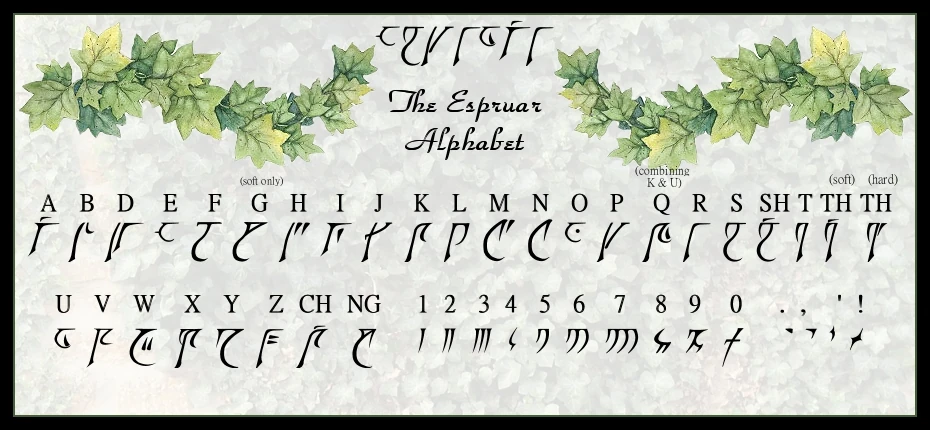
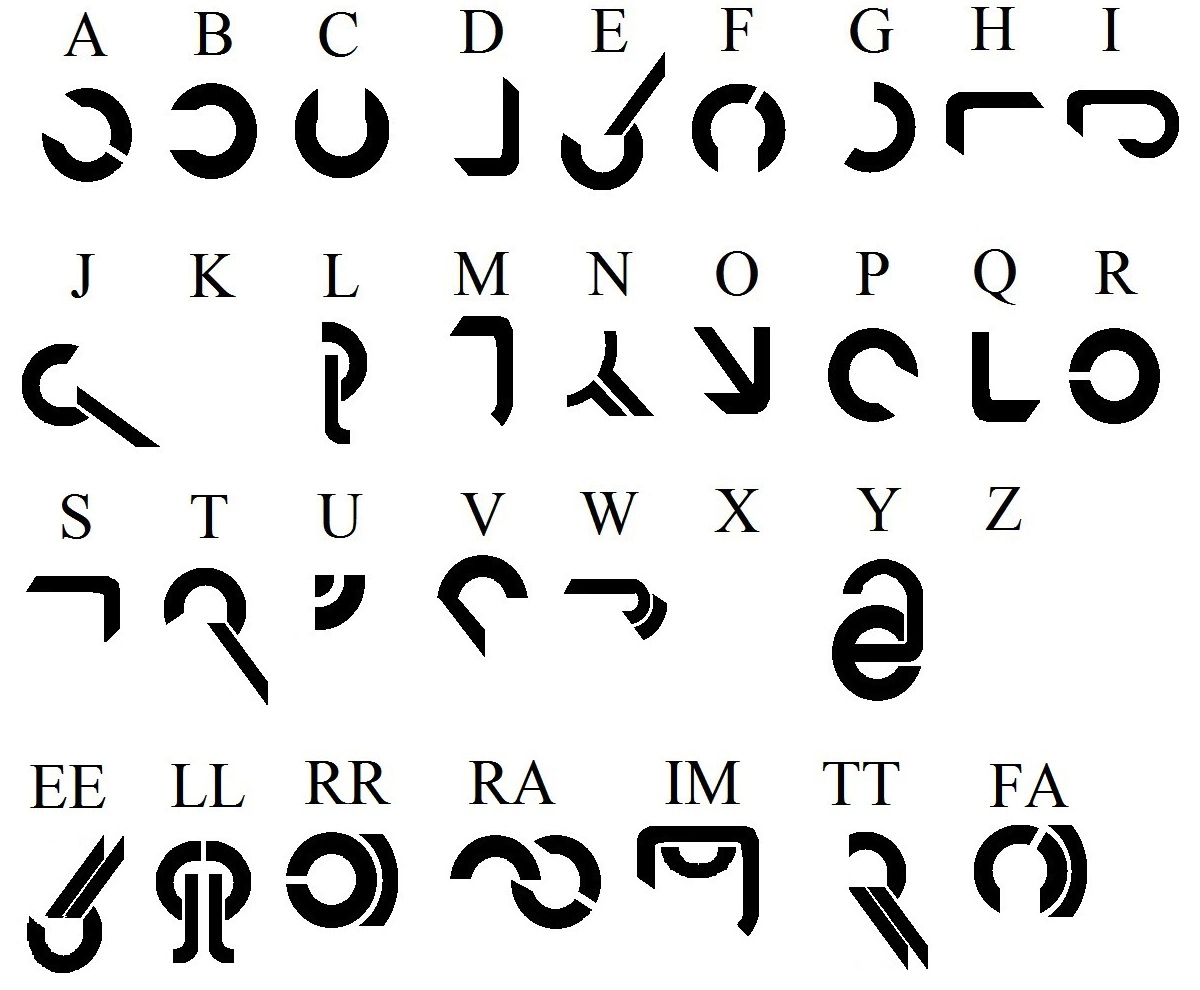
- Man it's hard to come up with a Dwarven script that looks as good as my Elven script (if I say so myself). Took me forever to figure out what shape I wanted it to be based on (I use a "theme" shape in most of my nonhuman scripts). Was thinking triangles, maybe use some element from the Covenant alphabet from Halo. My Elven draws inspiration from the 3e rework of Espruar and the Eliksni script from Destiny.
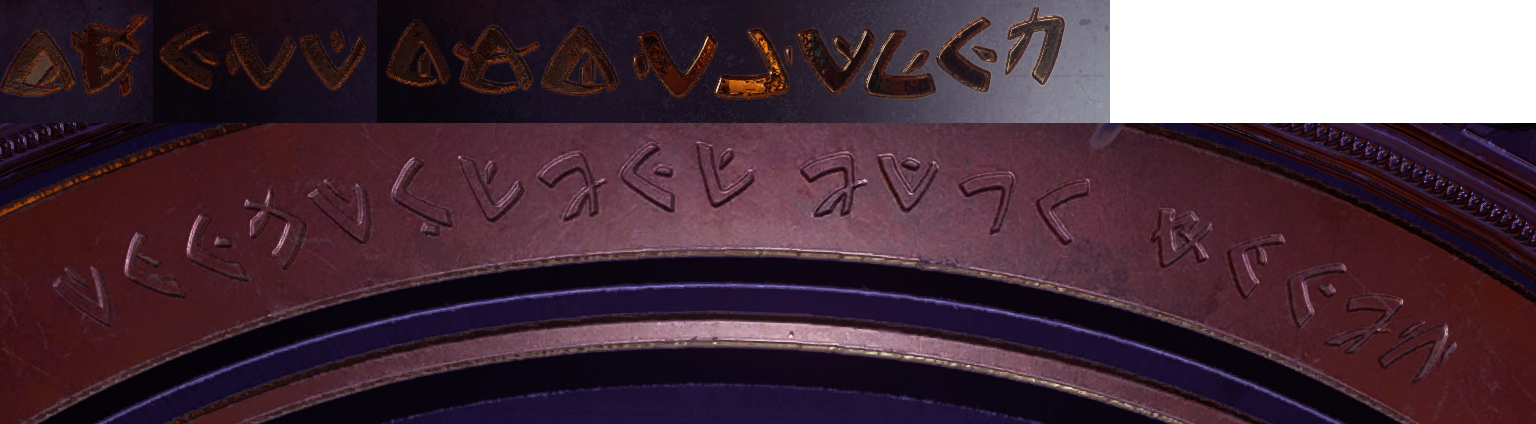
Eventually decided, my Dwarven combines the Covenant script with the "cat-pupil shape" that Rellanic, the 4–5e Elven, uses. See, I realized, dwarves aren't carving their script into rock with a chisel or wood with a knife. They're engraving it in metal with a burin (which burin is a single one of their mushrooms, metallized and with a sharpened tip). And you can get insanely florid with a burin engraving, so I actually have complete freedom in letter forms! - My Ogrish (based on Dwarven) retains more elements of the original, Covenant-like triangle script, but is more of a cursive form of it, like the version that you can find in signs and stuff on Sanghelios, in Halo 5.
- Decided that the best way to do my games at the actual table was to get a cheap (something like $250) flatscreen, hook a laptop to it, and then use a map program like Megasploot's Dungeondraft to make a dungeon map, to scale. You put a cover (we got a special one eventually but the first time we just used carefully arranged overhead-projector transparency films), and just move your miniatures, pawns, etc., around on it. Given the prices of poster printing, it pays for itself by like the sixth map you use it for.
Of course this would all be somewhat moot (I keep having players have to telecommute, and have someone on my end point their camera at the map and stuff) if virtual tabletop programs like Foundry were easier to use (also apparently there are issues with how you host it?), and if Roll20 was not a terrible, terrible company, from being shockingly petty to critics of their business practices to obnoxious Corporate Woke™ grandstanding on Twitter and elsewhere. - I would say my view of Dungeons & Dragons: Honor Among Thieves does not even approach cautious optimism, but I am willing to be impressed. Kinda wish they would actually play things straight for ten seconds, though. Not every movie has to be the thing those "Marvel fans when The Batman doesn't…" memes were talking about. (Also I loathe, abominate, and revile the "fast-talking bard" archetype that shallow 5e fans seem enamored of.)
- It occurs to me that making my dwarves actually be gnomes, and therefore have roughly the same build as half-elves, will make the dwarf/gnome-based ogres and orcs be much more similar to goblins. Then again I suppose my elves and gnome/dwarves are big and little "fairies", so it kinda makes sense that the monster versions are similar to each other.
The culture is still very different, with goblins having strong personal loyalties and an obsession with fear and stealth, and ogres being very nearly a war of all against all, with a penchant for frontal attacks (which in no way means they won't stab each other in the back, though). Among other things, goblins get a Dexterity bonus, while ogres get a Strength bonus. - Very hard to figure out what to do with my Draconic, since too cuneiform-like will be too much like Dovahzul. Kinda wanna examine the Banished alphabet from Halo Infinite (which is in many ways the worst Halo, not least because the Banished suck as villains—Cortana would have been much better, but 343 has an amazing ability to utterly squander villains, see also the Ur-Didact and Jul 'Mdama). There's also Iokharic from D&D, which as I may have mentioned at some point shares letter-shapes with 3e Espruar.
Thinking I'll do something like the Naboo futhork from the Star Wars prequels, probably combined with vertically skinny letter-shapes reminiscent of Nüshu, an odd women-only script from part of China. Though with the letters grouped closer together (and words grouped into trios, in formal writing, like the tetrads in Classical Chinese).
Also reworked my "Sylvan", which in my setting has become the language of the araneas, formians, and thriae—bug people—that serve the law-spider outsiders. The previous script looked much too much like "Daedric" (really Dunmeris, with the other name being just what it was called in the Daggerfall game files). Went with, in contravention of my usual practice, a featural alphabet, since they're the minions of law-spirits; it wound up looking vaguely reminiscent of "Daedric" anyway. - Apparently Spelljammer in 5e, rather than bothering with ship's ratings (a table based on the level of a spellcaster sitting in the helm that would determine how fast the ship could move), has the thing go 10 miles per hour per level of the highest unspent spell-slot the spellcaster has. I take a couple issues with this (miles per hour do not tell you tactical speed intuitively—10 mph is a "normal move" of about 45 feet, or a "full-round move" of 90 feet—and I liked the major-minor helm distinction, though I suppose the latter does also affect the largest ship you can move via the helm in question), but it does streamline things. Might use it for my airships, or some of them, since I think Wizards has the basic Spelljammer rules (such as how helms work) as OGL.
- A search of le blogue suggests I have not mentioned the problems with Stranger Things? Probably the more fundamental but also the simpler is that it allowed the shills at Hasbro to market the game by the most shallow methods imaginable, flooding us with bandwagon-jumping bounders with no respect for the hobby (that invasion really took off with Critical Role but Stranger Things began it).
More complex, probably less important but more emotionally visceral, is how they have warped a generation's understanding of the names they have the characters drop. Demogorgon has two baboon heads and tentacles for arms (also that thing is a damned gug). A mind flayer…you know what a mind flayer is, and you probably know the thing in Stranger Things is nothing like one. And Vecna is an archlich.
Of course, D&D itself visited upon us the ludicrous idea that Vecna could lay siege to Sigil. Right, because She Who Flays, who can impose terms on entire pantheons, would need adventurers' help against an attack by one lich-god.
Showing posts with label movies. Show all posts
Showing posts with label movies. Show all posts
2022/07/31
Playing with Fantasy XXXV
More icosahedral fantasy thoughts.

2021/11/29
Mélange VIII
Random thoughts, only 5/8ths about icosahedral amusements. None of them reference Dune because I hate Dune (much like the Warhammer 40,000 setting it heavily influenced, it's better as a source of memes than actually engaged with seriously).
- Realized probably the simplest way to turn kytons into goblin ancestor-gods, which I'm calling "barghests", is to swap out a few powers here and there (because they're pure fear, not torture) and then apply, basically, the lycanthrope template, but with my version of worgs as the "base animal". I actually have to swap a lot fewer things than one would think, because kytons run almost as much on fear as on pain, and many of their mutilation-y things will still fly given how much influence from Predator my goblins have.
- Arcane is good. Really, really good. My brother has the bizarre idea that Silco having a cause, the independence of Zaun, makes him better than the other gang leaders of the Lanes, who operate purely from self-interest. But the other gang-leaders didn't spread Shimmer around or come very close to a losing war with Piltover largely out of nationalistic pride.
In the immortal words of Daeran Arendae, violence in a good cause is indeed different: it's much more bloody, and is done with pinkies out.
If I had another complaint, it would be that "Get Jinxed" plays at one point (albeit diagetically, when Jinx is listening to the radio while working—"you're listening to your own image song? don't be that guy"), but "Here Comes Vi" never does. Shameful, shameful oversight. Admittedly she isn't a Piltover enforcer yet, maybe that's it? - Golly bob howdy but Pathfinder is weirdly light on items for storing and preserving food, and cooking it. I mean you can use a cauldron of brewing in camp as well as in the alchemy lab, but other than that? I don't think there are any magical storehouses or anything.
I also think there need to be more low-level magical traps, let your rogues earn their keep earlier on. I mean, since a summon monster VI trap is CR 7, isn't a summon monster I trap CR 2? And maybe summon minor monster as CR 1? 1d3 fiendish-template animals sounds like a CR 1 hazard to me. - Ghostbusters Afterlife is a fitting conclusion to the franchise. The two main kids are extremely believable as Egon's grandchildren (the girl especially is adorable—not just her looks and mannerisms but how her shirt is often buttoned wrong), and everything else is good to excellent. (It does have the weakness of being much more interesting before the big ghost stuff starts happening, but that was also true of the original.)
Critics have mostly panned it in the stupidest manner imaginable, seemingly to punish it for being what the fans wanted, because the critics wanted the 2016 one to be well-received. Which was never going to happen; you can't try to reboot one of the tightest-written movies ever made as a piece of crappy improv, no matter what 1986 Fundamentalist "everything in pop culture is satanic" moral payload you attach to try to shame people into liking it.
Sorry but the 2016 one was fourth-rate improv consisting very largely of fart jokes, extended painfully-stupid dancing sequences, and a running gag where the protagonist is obnoxious to a Chinese-takeout delivery guy. Can't imagine why people didn't like it. - The seven deadly sins are drastically overdone, in fiction. Decided instead that my setting's blasphemous warlockery will run off the Four Sins Crying to Heaven for Vengeance: perversion (the sin of Sodom), betrayal (denial of wages to workers), oppression (of widows and orphans), and murder. Of course, a game-setting is more PG-13, so the main form perversion takes (aside from the decadent witch culture having some sibling marriages) is cannibalism—sexual appetites aren't the only ones that can be perverted. Helps the royal caste of the modern thalassocratic Valyrians are dhampirs.
Also decided that the non-fiend evil gods basically want to use the witch-power of the fiends against fiends, like using the One Ring against Sauron, or using Stasis against the Darkness (huh funny how one of those examples understands what a bad idea it is, Eris). They mostly take the form of murder (i.e. human[oid] sacrifice), although the ogres and orcs are tyrants and cannibals and the dark elves and dwarves are tyrants. (Both go in for a certain amount of backstabbing but you can't encourage that and still maintain a society, any more than you can permit most versions of perversion.) - Decided that the elves' panthers age relative to lions as elves age relative to humans: maturity 2/3 later (elves in my setting are adults at 25 to humans' 15), then age 12 times slower. Which means that, as lions are adults at 3 years, the panthers are at 5; lions get to be middle-aged at 8, so the panthers reach it at 96.
From there though we apply the game-rule aging system where "venerable" is twice middle age (70 for humans, who hit it at 35), so 192 for the panthers. Then "old" is halfway between the two, 144 for the panthers. Lions only live about 19 years in the wild, which makes the panthers' maximum lifespan 228 years. - Thinking I'll redo my Draconic alphabet, since the old one was pretty much just Persian cuneiform upside-down and with the phonological values assigned at random. Thinking I'll take some cues from the Covenant alphabet, but with the strokes inside the triangles rather than as the triangle. But also from how Ugaritic is actually a cuneiform version of Phoenician (e.g. all the signs that incorporate an O shape, the ones that in Greek or Latin are O, Θ, or Q, replace the O shape with a <-type thing).
Specifically how I think I'll have it work (I need to figure out all the nitty-gritty still) is take letters like something in a standard alphabet, convert them to cuneiform-esque shapes, and then convert those cuneiform-esque shapes to triangles. Specifically upward-pointing ones: Draconic is written bottom to top, by a dragon perched above whatever hard surface they're scratching letters into (hence the cuneiform, they're claw marks). - HBO Max has a bunch of DC stuff, and while the fourth season of Young Justice is even more painfully terrible than the third, at least there's a bunch of movies. I particularly like Superman/Batman: Apocalypse and Superman Unbound—I really like Supergirl when she's not being desecrated by the CW (and by current DC writers, of course). Also the fight in Apocalypse with Wonder Woman and Barda against the Female Furies, is one of the best fights in all of animation.
There's also The Batman, in many ways the most underrated DC show (and it's pretty highly regarded, just not highly-regarded enough given it's close to as good as Batman the Animated Series). I wonder why Krypton isn't on there, though, unless it's a licensing issue with Syfy or Universal—tell me the thing with Sig-El's grandfather's Fortress of Solitude, and the camera pulls out to show the El crest, and the Superman theme plays, doesn't stir you deep inside.
2020/02/07
De romanicorum theoriarum XVI
Speculative fiction thoughts, fewer of them about Pathfinder.
- The reason marine mammals have flat tails and swim up-and-down rather than side-to-side like fish, is that mammals evolved a different gait—a dolphin or whale is essentially doing with its torso what the torso of a dog or rabbit does when they run. That's why ichthyosaurs (whose taxonomic relations are far from clear) had fish-like rather than dolphin-like tails: reptiles still use the ancestral, fish-like side-to-side motion, when they run. (Dinosaurs didn't, but in between they evolved bipedalism—the ancestor of all dinosaurs was a biped, with some lineages later dropping back to all fours. You can see it in how different the forefeet are from hindfeet, obviously in hadrosaurs but even in ceratopsians, sauropods, and thyreophorans—they're all modified hands.)
Bipedal dinosaurs did not modify the orientation of their forelimbs from those of the ancestral reptiles, although they did move them to face in front of their bodies. Like a lizard, the palms of a bipedal dinosaur like a dromaeosaur face out when the arms are spread, and each other when the hands are put toward each other: because palms that face each other are better for grabbing. The default position of a dinosaur's hands, when it has hands, is not with the thumbs toward each other and the palms toward the ground, like yours are (relax and let your hands fall, and you'll see this). It's with the palms toward each other and the thumbs pointing up, because a bipedal dinosaur is not a modified quadruped like you are—a quadrupedal dinosaur is a modified biped. - Searching the blog claims I haven't mentioned it here, even though I could swear I did, but the smart birds, all of which are psittacopasserines (the songbird-and-parrot superorder), took a different route to intelligence from primates. We got smart and then learned to talk, but they learned to talk and then got smart. What I mean is, the reason corvid and parrot brains got so advanced, is the need for processing power for ever more complex song. They then became able to handle other kinds of cognitive task. Whereas we got smart for those cognitive tasks, and then developed language.
But it occurred to me, maybe a further justification of zled intelligence despite their being more powerful than humans, aside from their world being as scary as the Mesozoic, is that they had a sort of evolutionary feedback loop like birds did, for boosting their intelligence. Maybe they descend from something like a predatory howler-monkey, but with a far more complex repertoire of calls, like a songbird or parrot (and, y' know, roaring rather than hooting, birdsong, or mimicry), and the processing led to their ancestors increasing in intelligence before tool-use was a factor.
The main interspecies reason their ancestors would've roared would be to warn potential predators that gangs of arboreal jackal-baboons are around and would take a dim view of preying on their young, while the intraspecies reason would be the same as the one for wolves howling and lions roaring, announcing to conspecifics "if you can hear this, you're in our territory". (The complex calls would, of course, be mainly for the latter purpose.) - Realized the best choice for making the elemental outsider-race in my setting would be to repurpose divs, as "neutral, chaotic neutral, or lawful neutral" outsiders. Only with mephits, with the "young" template to turn them tiny and knock a point off their CR, instead of doru divs. Of course I gave the divs a variable elemental affinity/immunity, rather than fire, and change their cultures to be more like normal genies (Pathfinder divs are corrupted genies—though their ultimate origin is the daevas of Zoroastrianism). Also gave them, as I said, pterosaur wings. Which they can use as legs, giving them the Bull Rush resistance of something like a centaur. (The reason pterosaurs, even giant azhdarchids, could take off in a leap, despite being bigger than any bird let alone any bat that ever was, is their wings were still forelegs, and the massive muscles for flapping them were also available for pushing off with.)
I had said that all nonevil humans become agathions, in my setting, and elves become azatas. I think I also mentioned dwarves become inevitables (but with no axiomites to command them)? Well I decided nonevil gnomes become kami, and nonevil giants become asuras (but not evil). I went down the list of outsiders that constitute races, planeborne as we knew them in my day—aeon, agathion, angel, archon, asura, azata, daemon, demodand, demon, devil, div, elemental, inevitable, kami, kyton, oni, protean, psychopomp, qlippoth, rakshasa, titan—and figured out which ones were the best fit to be the "petitioners" of my humanoid races. I also still have elementals, they're just the div-types' spirits channeled into elemental matter temporarily; the rest of them just aren't there, any more than the fey are. I think my setting's dragons will just reincarnate? - I've said that skeptics often seem to be magicians and special-effects people, i.e. professional fakers—their skepticism turns out to be merely projection. So I'm not exactly surprised that James Randi's "challenge" was rigged, requiring a far higher standard than science normally does, and potentially requiring far more resources to produce the tests than the prize-money could cover—and isn't really epistemically or scientifically valid anyway. Conmen always assume everyone else is dishonest.
- They're putting the X-Men in the MCU—starting with the New Mutants, because we totally care about them. Also the movie about them seems to be a horror movie? Maybe it's just one of those cases where the advertisers criminally misrepresent the work in question, like how they always make kids' movies look gratingly obnoxious. Anyway, though, if Marvel could try to put its craniorectal inversion into remission for a moment, they have a chance to do something cool, and introduce diversity in a justifiable way that doesn't utterly gut characterization, but actually updates it in a meaningful way.
Namely, Magneto would be around 90 this year, if he was in his early teens (the age mutant powers usually manifest, and the age he's depicted as having been) in 1944. So instead, have him be Rwandan. Change his name to Érique and find a Tutsi surname that sounds like "magnet". Then have his flashback be to turning Hutu machetes into curlicues. (They can also make Xavier be black, too—played by Lance Reddick or someone—since Cameroon, Cape Verde, and Brazil are all more likely to have "Xavier" as a surname than anywhere in Europe.)
Yes that complicates Wanda and Pietro, two clearly not-Lance-Reddick's-children people, but it's not like Marvel doesn't have a peckish Anti-Monitor worth of plotholes at the best of times. - Henceforth Star Trek: Picard shall be known as The Normandylorian, and the bioroid girl, Dahj, shall be known as Baby Data.

- Occurs to me I can just have the aquatic eldritch abominations of my setting be "sea snake" nagas. Also thought I'd make them the main one of the subterranean world. This reduces me to two, nagas and araneas. Which is a Jim Stafford song. 'Course, there are three kinds of evil naga (dark, deep, and spirit)—I'm pointedly ignoring slime nagas—and only one kind of aranea.
Maybe repurpose proteans and qlippoths into, respectively, nagas and araneas? The former are various kinds of snake; the latter often have more than a few spider aspects. I never actually called them "araneas" or "nagas" in my setting—they're "silk lords" and "serpent lords". I don't think I need too much stat-shifting, though I'll probably have to use some other CR 20 outsider's special attack in place of the iathavos qlippoth's abyssal transformation power—since spiders by definition do not swallow their prey.
Still going to have the serpentfolk ("snake people") and ettercaps, though I gave the latter back their hands (don't know why Pathfinder changed them to having sickle-hands; they're not mantises, they're spiders. Of course, a mantis actually still has a tarsus on the end of its arm; the claw is actually the preceding joint, the tibia. A mantis's claws are really on its frontmost heels. - Ooh, actually I like that; if the snake-spirit creatures have all the scaly servants—serpentfolk, lizardfolk, sahuagin—maybe the spider ones should have the chitinous ones, like formians and thriae. Maybe some treaty keeps them from also creating crab or lobster servants and encroaching on the snakes' aquatic territory? Yeah, sea for snakes, surface for spiders, and underground for whichever can get it, works. Ooh, instead of ettercaps, still have araneas, but as the equivalent not of the nagas but of the serpentfolk.
- Actually watched The Witcher. It's…not shit gravy. I like how subtly Slavic everything is; not only the curious cheerful pessimism, but also, I've got a nagging suspicion about half the seemingly fantastical wordplay is actually just ordinary Polish figures of speech. You get the feeling that you're reading subtitles and the dialogue is really in Polish, even though it isn't. I also like how most of the cast of both sexes are actually attractive, particularly after the homely-as-a-mud-fence, seemingly-selected-for-dumpiness cast of The Mandalorian (though Henry Cavill is a bit too much of a pretty-boy for Geralt, who's supposed to be a lot more grizzled). And it gets bonus points for much better armor design than Game of Thrones, though. Finally, I was pleasantly surprised that Nilfgaard actually seems to be more the Soviets than the Northern "Crusade" (which was never preached as such by any competent ecclesiastic authority). Even if Nilfgaard had been the Romantic Nationalist version of the Teutonic Knights, at least Sapkowski isn't Czech, so we're spared the fantasy version of the Romantic Nationalist (read "laughable unhistoric self-serving propaganda") conception of the Hussites.
Still, though, really not much more than my initial assessment of "Warhammer Fantasy Roleplay with the VIN numbers melted off"—albeit executed pretty well. It's got far too much subscription-TV T&A and gore, and is just generally a little too sordid to take seriously even as dark fantasy. It's not quite unwatchably grimdark, unlike Game of Thrones. It also made me realize: fantasy worlds should be places where most "superstitions" are as accurate as the average person's understanding of science, in our world. There'd be common misconceptions, but the basic rules should actually be known. Because this is information you can actually go out and find for yourself, in these worlds. I deduct significant points for the "demihumans"-as-oppressed-minority thing, also seen in Dragon Age (I also deduct them for snooty bigoted elves, so we're clear): Find. Another. Angle. The half-elves being deformed is somewhat interesting, but it would be more interesting if the deformities were modeled on real-world interspecies hybrids, rather than just having random normal-human deformities (I'm not only saying that because their idea is similar to mine; mine is cooler).

2020/01/21
De romanicorum theoriarum XV
Speculative fiction thoughts, a lot of 'em about Pathfinder.
- Not only are Mandalorians paper tigers, only alive because the Jedi are too nice to annihilate them, but they're also belligerent nomads who historically made most of their living stealing and slaving, and yet they inexplicably get treated as some kind of noble warrior. They're space Kurds.
Or space Spartans (except nomadic), who only had a c. 48.5% win-rate, almost exactly 50% win-or-draw, no better than any other Greek city-state, despite their absolutely nightmarish child-soldier childrearing, and had a population something like 80% slaves. (For comparison, Rome was c. 30–40% slave.) Okay that might be slightly unfair to the Mandalorians; you can be adopted into them, you couldn't even rejoin the Spartan citizen class if you, or an ancestor, were ever rejected from it.
And "this is the Way" is the most irritating meme since "winter is coming". It's a bit less grating in the show proper, though. (But it's too bad The Witcher is now outperforming The Mandalorian. I guess "same premise but with T&A" wins every time. Or that putting something on Disney+ hurts its ratings. Both?) - Aside from how Arataka Reigen is proof that a rogue can absolutely be lawful good, we know his specific rogue archetype—clearly he calls his sneak attack "self-defense rush". He's probably in my top five favorite characters in all of fiction.
- It occurs to me that the elves, dwarves, and gnomes of my setting have yet another advantage over humans: their mounts all have darkvision. You can't use cavalry at night, horses being as diurnal as we are (the tapeta lucida notwithstanding)—and a lot more likely to die if they trip on something in the dark. People who ride magic animals that have the same night-vision as elves and dwarves have no such limitation. The riders of such creatures can also sleep in the saddle much more safely, and the mounts can stand watch and rest at the same time—I crunched it, if they have the same senses as the mundane animals they're based on, their Perception score while asleep is the same as an average, NPC-class human's is, wide awake.
Somewhat relatedly, rather than breed special chargers from Equus ferus, the rural-settled culture of my humans will, instead, have domesticated Equus giganteus. Seem like a logistical problem, since chargers can't survive on grazing and have to be fed in stalls? (Presumably charger-sized mustangs would starve.) Nope. In an ice age, plains are dominated by C3 grasses like wheat, rice, and rye, rather than C4 grasses like corn, millet, and sorghum. They have much higher protein content—the shift from C3 grasses to C4 ones, when the glaciers melted, is thought to have been a factor in E. giganteus going extinct (though humans probably played a role too). The other human cultures, and people who aren't super-heavy cavalry in that culture, ride regular old Equus ferus, though.
(And no, it's not weird to domesticate more than one species of horse; the Tibetan wild ass is semi-domesticated, along with the fully domesticated African one, i.e. the donkey.) - Speaking of logistics, I mentioned my dwarves doing their farming with piped-in lighting—they also might use something like a Dawnflower's light, obviously minus the Sarenrae branding. But the "high" elves also pose some issues, since they live above the treeline (except where their sacred tree is concerned, because the World Tree doesn't care about elevation), meaning most plants won't grow in their cities. They also have a sharp limit on their arable land, living at mountaintops.
They're also (the dwarves are too, but their space isn't as constrained since they have whole caverns to raise herds in) mostly carnivorous, though they only raise small things like poultry and squirrels domestically. I think a lot of it can be done with Dawnflower's light hydroponics and druidic magic (e.g. plant growth) increasing agricultural yields, to grow more fodder for the domestic animals that are the main thing they eat. Like the dwarves, their farms are underground. - Epithet Erased is freaking amazing, though I do admittedly weight "heroine cuteness" excessively. There isn't a single character in it that I don't like or that the writers mistreat to no purpose, two rarities in animated works. About the worst I can say about it is that while the swearing scene in like the third episode is funny, it does prevent it being recommendable to parents, who are hard-up for things that will entertain their children and aren't terrible. Anyway, the first season's over now and they need you to go subscribe to VRV or donate to the Patreon.
- As I think I mentioned before, I watched Chivalry of a Failed Knight on Youtube, because I didn't want to spring for Hulu. Well, I got Hulu for Christmas, and was all set to rewatch it on the up-and-up. But then I discover that some slavering beast, forgotten of God and man, wholly foreign to all decent people and right reason, had decided that that series should only stream dubbed. "Well, you can finally get this wine that wasn't sold in your country, but the only supplier pees in every bottle."
Oh well. It's still got Weakest Undefeated Bahamut—subbed not dubbed—which, while fundamentally just a standard magic-school harem series, is extremely solid in terms of setting and characters. And pacing—nary an episode happens where you don't think "oh wow the end credits should be by any time now"…and then the eyecatch comes, because that was just the midpoint. Besides, standard magic-school harems are a breath of the sea air off the Grey Havens compared to isekai. - Turns out it's actually really simple for my nonhuman races to use their talking critters as mounts or companions. For ordinary purposes, of course, they just ride them; the talking critters don't usually fight beside them, but, for instance, watch the humans' horses while the humanoids are all down in a dungeon. But for purposes of class features like paladin or cavalier mounts or ranger or druid companions, they have to wait a bit and spend a feat to get Monstrous Mount. Since none of the mounts are quite as OP as griffons, they don't have that kind of prerequisite; the ones that paladins ride may have an unusual alignment relative to the rest of their races, of course, but there isn't an alignment requirement for the rider like on a worg.
Of course in practice this might mean nonhumans are likely to choose the other option that doesn't involve a mount or companion—the other version of paladin's divine bond or ranger's hunter's bond (honestly does anyone actually still take paladin mount in Pathfinder, now they have the other option?). I also think druids will still much more likely take actual animals as their animal companions—elf and gnome druids are also more likely to take plant or fungus companions anyway (and either might just take a domain, instead). For cavaliers, I think the nonhumans are more likely in the first place to take archetypes that replace the mount class feature with something else, like green knight, esquire, or musketeer. "Animal trainer" is kinda humans' "hat", after all.
Still gotta work out what the prerequisites for having these guys as mounts are, and what Monstrous Mount Mastery lets you do with them. But it speaks to the elegance of Pathfinder that there was already a rule in place for what I wanted to do. - Decided that I'm not going to use the aboleths as the illithid stand-in of my setting; that's the role they play in Golarion, after all. Instead, thought I'd just have the kraken do it. It makes perfect sense for evil quasi-squid to be the origin of a bunch of fish-races like skum and sahuagin, after all, and be the things the gillmen ("gill people"—"gill man" being, by the way, what The Creature from the Black Lagoon is known as, to the cognoscenti). Might restat them as aberrations (just involves shifting around some hit-dice, saves, and so forth).
Perhaps relatedly, since my outsiders and aberrations are ultimately the same thing, thought I'd have my elemental spirits—I might have to retool some things from core Pathfinder to get enough of them—also follow the "winged humanoid" theme the celestials and fiends do. Only, bird and bat wings are already taken. So how about pterosaur wings? Works well with a sort of more "primal" theme elementals generally have (presumably the fiends have bat wings because mammals' attempt at flight is an abrogation of the natural order that succeeds only through sheer perversity).
It's odd that there isn't really a hierarchy of elementals like there are for fiends, celestials, proteans, inevitables, and aeons. (Which I'll insist on calling "planeborne", berk.) - I know I've mentioned that the "can't stop the signal" tagline for Serenity is dumb. As I said at the time, actually you can stop signals, it's called jamming, and since they released that "signal" while a space battle was happening overhead, it would very likely have been choked off from the get-go. (You mainly use jamming in space battles because missiles are the chief weapon.)
But the stupidity of this is perhaps illustrated by something else. Now, we all expect something like Halo to know you'd jam enemy communications as a prelude to attack. That's Halo, like the definition of military science fiction. But do you know who else know that comm-jamming is inextricable from an attack, in technological war? The Star Wars prequel trilogy, that's who. In both Phantom Menace and Attack of the Clones, people—the Naboo in the first one, the Separatists in the second—know they're about to be attacked because someone is jamming them. When Star Wars—all of whose militaries would be deeply outclassed by a few lances of Grunts with no Elite leadership above Minor (since Grunts, unlike clones, battle-droids, or stormtroopers, are acquainted with grenades)—understands science fictional warfare better than you, it's flat-out shameful.
Everything wrong with the Star Wars sequels, incidentally (at least that isn't Rian "Taken King" Johnson's detribution), is partly Joss Whedon's fault. Aside from how he helped make the MCU's early installments successful, helping Disney to Take Star Wars, the deeply unfitting snark that disfigures dialogue in The Force Awakens really became a thing in pop culture because of his influence.
2019/12/18
Mélange VI
Random thoughts.
- Watching And You Thought There Is Never a Girl Online? reminded me of real MMOs with a marriage mechanic (e.g.). Seems super awkward. Maybe it's just because I play Destiny with my sister, but unless you're playing with your actual girl-/boyfriend (in which case you can go to hell), it seems like it would either be very uncomfortable, or just too much of a metagame thing, doing it just for the mechanical bonus.
Seems like it might be better to have the spouse as a person-shaped "non-combat pet"; presumably works best in games like ESO where you can acquire real-estate, since having your spouse follow you around adventuring would be very odd. (Huh, is ESO a community-property setting, concerning homes and other assets owned by one half of a Ritual of Mara pairing?) Maybe if you sleep at home you get a bonus for the next few hours or character levels, like the "Lover's Comfort" rest bonus in Skyrim? (Or an aisai bentô item you can use later, like Skyrim's "Homecooked Meal".)
Actually an option to sleep with your character's spouse in the euphemistic as well as literal sense (no need to actually be graphic about it, of course) could allow the creation of other "non-combat pet" NPCs: namely children. Rather than being like Skyrim where practically every single child except Jarl Balgruuf's kids and Hadvar's cousin Dorthe is adopted (I guess making Redguard children for the Redguard couples was too hard). That could be a kinda cool mechanic, and would make the world feel a lot realer (if done right, a big "if" in game-design). - Thinking of how the Clone Wars were just to keep the Jedi from seeing Order 66 coming, made me realize that Lucas is actually really good at plot, and theme. Now I wonder if Yoda actually meant his warning to Luke in The Empire Strikes Back, that going to save his friends at Bespin would really undo his training and doom them all. Now it seems like that was actually a test, to see whether Luke would fall into the same errors the Jedi Order of old had, of forsaking attachment—the whole point of the fall of the Jedi Order was that the Jedi had forgotten that one attachment, to other sentient beings, was the whole reason their order existed in the first place.
Basically you can view Star Wars, before it was Taken by Disney, as being the Mahayana Buddhist version of Narnia. The old Jedi Order can be compared to Theravada Buddhism, pursuing the path of the arhat, concerned only with releasing oneself but not others from the Cycle of Rebirth. What Luke does, first at Bespin and then with Vader, is the bodhisattva path: of replacing the final desire to be extinguished, desire for Nirvana, with the desire to bring others to Nirvana, and vowing not to enter Nirvana till others do. While attachment to others cannot come at the expense of other goods—that was the path to Anakin's downfall—it's that same attachment to others that can result in their salvation. Including Anakin's.
Indeed it was the whole attempt to do away with attachment that led to Anakin's excessive attachment, and his pathological fear. The thought you try to put away from yourself becomes the thought that you cannot put away. - Got the Pathfinder Monster Codex, and decided my campaign will have boggards, though not called that since that's actually a synonym for bugbear. While their constant cannibalism is indeed how many frogs behave, that's because most frogs are stupid creatures that jump on and devour anything that moves, not something intrinsic to their nature if they were intelligent enough to talk. After all, boggards are not described as being exceedingly likely to engage in necrophilia, but the same stupidity that makes frogs eat each other, also totally routinely makes them try to mate with dead frogs.
Personally, since my setting takes place during an Ice Age, I think it'd make more sense to have them behave like the viviparous toad, Nimaphrynoides occidentalis, since live birth means you aren't dependent on the availability of standing water to reproduce. Oddly parental care in frogs seems to be more typically the male rather than the female, with the tree-frogs that exhibit care by both parents having evolved it as modified male care. (I assume the relative infrequency of cannibalism in toads is just that most toads are toothless.) Intelligent frogs can still regard you as food without this "constantly eating each other" nonsense.
(Unlike in core Pathfinder none of my races eat their own, and far fewer—only ogres/orcs, hyena people, lizard people, frog people, and maybe some cat people—eat other intelligent beings. Goblins hunt other humanoids for Predator-style trophies, but taboo eating intelligent beings.) - All the idiots saying "if Baby Yoda is 50, then 900-year-old Yoda is in his mid-30s": first off, they never said Baby Yoda was specifically two. Second off, he's about a foot and a half tall, being as long as Mando's forearm. Yoda is 2.2 feet tall, according to the official sources. 1.5 divided by 2.2, times the average height of an adult male human, yields 3 feet 11 inches—the average height for a six-and-a-half-year-old, according to the CDC. Which is still quite a young little child, and probably easy to mistake for a toddler (he's not really a baby) if you're not familiar with the relative sizes involved. And if he's six and a half, Yoda's 900 becomes 117. (Yes the child has that hover-stroller thing, but we put children who can walk in those all the time, because their legs are short and they get tired, not some age cutoff. Yoda is shorter as an adult than the 3rd pecentile of American two-year-olds.)
- Redoing some things about my setting's scripts. Decided the giants will be the ones who have the "increasingly complex zigzags" numerical notation, since it makes sense with their octal numbers, which can use the zigzag's corner as a representation of the space between fingers; think the main human script will use the Hebrew or Greek type of numerals, since they have 27 letters. Then they just repurposed the first nine as digits, and maybe use a space for zero, like Chinese rod-numerals did?
Also thinking I'll actually have the Thalassocratic Valyrians' script be the one that gets the Etro script treatment, something like cuneiform since they have more than a little influence from Mesopotamia; the other human scripts will be uncial, blackletter, and runic versions of theirs. And then the Tainish Egyptians on the other side of the world will have something similar to the symbols on the Lantern of Osiris in the current "season" of Destiny 2, which also appear on the thing Osiris used in the first expansion to navigate the Infinite Forest. (Is that Vex writing? I think it's Vex writing.)
I realized my Dwarven had words that end on vowels (which was going to cause trouble for their script), a -ka suffix that marked nouns as feminine (like the -t suffix in most Afro-Asiatic languages), but I changed it to an -ok suffix. Also the pronouns—the only non-triliteral words in the entire language—had ended in vowels, and their roots still do in every case except the unmarked nominative; in the nominative, though, they switch vowel and consonant, so the word doesn't end on a vowel. - Can we talk for a minute about how Frozen and Frozen II are unworthy to scrub the toilets of Tangled and Rapunzel's Tangled Adventure? Tangled had very probably the best Disney princess since Aurora, and the best Disney prince period. Mother Gothel is one of the best villains in all media—someone pointed out, watch how she uses touch, and its withdrawal, to manipulate Rapunzel. And Rapunzel's Tangled Adventure is the best fantasy outside a video game in the English language. It's a better expansion on the original than the Aladdin animated series, high praise indeed, although unfortunately I can't give you a link to the best example without spoiling an incredible twist that you need to see.
Frozen, meanwhile, is a Frankenstein's monster sewn together out of the corpses of more drafts than the David Lynch Dune, any one of which would've been a better movie. Its villain, who has absolutely no reason to exist and is not necessary for the plot, is not only the only person in a position of power who actually lifts a finger to help the people of their kingdom, he also makes his own plan more difficult (let that guy shoot Elsa and he just has to worry about finding and wooing Anna, which'll be easier she's grieving), just to fake out an audience he isn't supposed to know he has. It's also based on a story from the 1840s where a girl saves a boy, helped almost entirely by female characters, but sure Disney, keep pretending you improved on the source material.
Frozen II is a sequel that nobody over the age of ten actually wanted, and its theme is hilarious hypocrisy considering Disney's concurrent pusillanimity RE: Hong Kong and the live-action Mulan (also Xinjiang but the Mulan star hasn't actually endorsed the Konzentrationslageraufseher there, like she did the HKPF's "fraternal assistance"). (One also wonders how it's received in, oh, say, Turkey, pretending for a moment that most Turks understand how that movie's theme could be relevant to them.) - Incidentally, Rapunzel's Tangled Adventure has characters who quite neatly slot into Pathfinder classes. Eugene's a rogue, of course, as are most of his social circle, but Lance is a bard (see the third season); Cass is a cavalier, Varian is an alchemist (duh), Adira is probably a cavalier too, Lord Demanitus was a wizard or possibly a summoner, and of course Mother Gothel is a witch. Rapunzel is a cleric, with the power of her hair being her channel energy ability; the Moonstone Opal is an artifact that switches her channel ability from positive to negative energy whether she wants it to or not. (I judge the quality of a fantasy show partly by whether it makes me want to play a tabletop game.)
- Watching Bokutachi wa Benkyô ga Dekinai (whose title means "We Can't Study" not "We Never Learn"), specifically the episode where Ururaka and Kirisu-sensei have that conversation in the locker-room about how Ururaka shouldn't worry about feeling nervous in her swim-meets, because she always will (Kirisu speaking from experience, having been a figure-skater), revealed something. Namely, though the Bechdel test is absolutely worthless for most purposes, it's actually a very valuable tool in evaluating, of all things, harem series. If a harem series doesn't pass the Bechdel test, it's probably too purely wish-fulfillment to be worth the time.
The "test's" relevance to other genres is more variable, because the female characters may have other reasons for never having conversations about something else—if, for example, the major female characters know each other because their boyfriends/husbands are friends, they're not all that likely to talk about anything else. E.g. Kaya and Miho in Bakuman happen to have been school-friends before they got married, but if they weren't they would only know each other through their husbands; even as it is most of their conversations afterwards probably involve the topic of their husbands in heavy rotation, since almost every major event in both their lives has been related to those two and their manga careers. But in a harem series, where it's a given that the girls are there for the harem, if they can't have any other conversation then there probably isn't enough work put in.
Also…does anyone apply a reverse Bechdel test to works for a female audience? (If you don't think it's an issue—that and a female version of everything feminists complain about in supposedly male-centered media—go read some shojo manga. Or josei. And then we can remind you of the only-qualified value of the test, because something like Dolls by Naked Ape passes the reverse-Bechdel with flying colors…because it's deliberate slash-ship bait. Just like how every yuri manga, for an audience so pathetic their masculinity is threatened by having a fictional dude be the POV-character who gets their wish-fulfillment harem, passes the original version.) - I decided that the modern human witch-nation in my setting, as opposed to Evil Atlantis/Thalassocratic Valyrians, are actual witches (as in as a character-class), but the dark elves aren't; they're just scary druid-archetypes. Their goddess is not a fiend and doesn't deal with fiends, any more than the goblin or ogre gods do, she just has utilitarian evils and blood-sacrifice of speaking beings, but not deliberate taboo-breaking. (There isn't much to pick between Rome and Carthage in practice, even if the Romans don't pretend their infanticide is holy.)
I think the modern witch-nation will still have clerics but they use the same mechanic as the witches, which mechanic I haven't entirely worked out; I think the clerics use a deliberately twisted version of their god's iconography, and specifically pervert their dearest taboos (infanticide for the guardian-mother goddess, necromancy for the death god, etc.)—and all really draw power from the ape-goddess. The very word for "ape" in many Indo-European languages has an implication of undesirable mimicry, e.g. simia and "similar" have the same first two syllables for a reason, and the verb "to ape" means what it does for the same reason.
2019/12/03
Sierra and Two Foxtrots VI
SF and fantasy thoughts. None tabletop RPG-related!
- Mandalorians are severely oversold. In Karen Traviss's works, of course, but even outside them. In reality, the idea these guys were a credible threat to the Jedi is ludicrous. Even without using the Force to enhance his perceptions, a human Jedi can focus on up to eight objects (all humans can). Humans can also continue to perceive objects up to 17,500 meters per second, 0.5% the speed of light (though not necessarily to actually notice, or otherwise begin to focus on, an object moving anywhere near that fast; you're quite likely to never see a bullet in flight, for instance, which is why Jedi use precognition to block shots with their lightsabers).
Since "size matters not", neither does inertia, so a Jedi can move something—say, a Mandalorian's helmet—at any speed they can still perceive, i.e. up to 0.5% the speed of light. Anything that impacts anything else at that speed does so with the force of a quarter its weight in TNT. If a Mandalorian helmet weighs the same as a modern riot helmet, a quarter its weight is about 12 ounces of dynamite. And even at a minuscule fraction of that theoretical maximum, their heads can still be made to impact the ground so hard their heads and helmets crush like overripe grapes wrapped in foil. One unarmed Jedi can kill eight Mandalorians in less than a second.
That fact is why Palpatine went to all the trouble of starting a war and playing half the galaxy against the other half, to put enough death and malice into the Force that Order 66 would get lost in the shuffle and the Jedi wouldn't see it coming. - Which is of course not to say that The Mandalorian is not the best thing Disney has done with Star Wars since getting their grubby paws on it, because it is (well, second-best); it's just important to remember that Mandalorians are something of a paper tiger. (At the very least they should've had—in Clone Wars or Rebels, say—a Sith do the helmet-smash thing, and then inform them that the only reason they were ever able to fight the Jedi is the Jedi were going easy on them.)
- Dragon Prince is mostly pretty good, except that you would never let a deaf lady be a soldier (maybe a behind-the-lines officer). Even if she weren't ambush bait and incapable of doing guard-duty, and she is, enemies with spyglasses would be able to see her signing.
But there is one huge flaw in the worldbuilding: how is it only now, and only Callum, that figured out how to do magic as a human? And how is Esran's ability to talk to animals not magic? Humans were so desperate to get magic that they decided to call out to the Deep and live as death and devastation. Nobody tried Callum's method before? Or noticed people who can talk to animals? Bullshit.
I do also deduct a significant number of points automatically for there being no major male elf protagonist. (Seriously, someone needs to tell people who produce fantasy, particularly fantasy art, that the elf species has a male half.) - Come to think of it, the existence of male elves is something that Warhammer Fantasy did actually grasp (but guess what the playable elf in Vermintide isn't). Pity they tore the setting apart in the stupidest way possible and then sewed the pieces of its corpse together into "Age of Sigmar". (The dumbest of the decisions in question being Malekith being the true Phoenix King all along.)
Usually when someone guts an IP and hangs themselves with its entrails, it's ideologically motivated—Disney Star Wars, Star Trek Discovery, Marvel Comics. But in the case of Warhammer Endtimes, it was simple greed: Fantasy Battle wasn't selling as well as 40K, so they decided to destroy it and make something more like 40K. Apparently the fact they could retool their generic fantasy races into things that could be copyrighted was a big part of the decision. Unfortunately it seems people are still buying the minis and playing the game, but the funny thing is you can basically never find any actual fans defending it as anything but a pis aller.
Another shameless cash-grab own-goal by Games Workshop would be Warhammer Adventures, which are middle-grade novels set in the 40K and Age of Sigmar universes. At the point where I run out of fingers counting the reasons that each child in the 40K branch of the series would be executed by their own government, it is officially not a kid-appropriate setting. - So the real theme of Elder Scrolls Online is probably "Beauty of Dawn"—which is basically a sampler of references to Elder Scrolls lore. "Days and nights of venom and blood" is a quote from Brief History of the Empire, describing the post-Reman dynasty anarchy of the Second Era. The Serpent is of course one of the signs of the Tamrielic zodiac. "Beauty of dawn" is what "Tamriel" means in Ayleidoon. And, of course, there's a reference to the White-Gold Tower.
- Between Granblue Fantasy and Cerberus, for some inexplicable reason anime based on phone games are actually often really good. Chain Chronicle: The Light of Haecceitas might be too, if it didn't start in the middle and thus make it very hard to give a damn about anything that happens; I give it bonus points for including the Scholastic term for "individual identity" (literally "thisness").
If you also consider stuff like Sengoku Basara (except for End of Judgment, which was absolutely phoned in), Tales of Zestiria, and of course Ace Attorney, it's clear anime can just in general buck the curse that plagues adaptations of video games. Probably because the people making the adaptations actually give a shit about the games and their stories. - Related to that issue with Chain Chronicle, the anime of To the Abandoned Sacred Beasts is an absolute train-wreck, and a monkey could see why. They front-load the backstory, rather than us only finding out about it when Nancy does like in the manga. It'd be like if Trigun (which really needs to get the Fullmetal Alchemist: Brotherhood treatment) had had its first episode be Vash and Knives on the ship.
Just in general, if your anime is about a drifter with a dark past and some ordinary person cast into contact with them, you have to keep the past "dark" in the other sense or you'll strangle all narrative tension. First give us a chance to see how the character is perceived; then make us suspect that there's more to them than meets the eye; and only then show us the backstory. You can't do it out of order. - It occurs to me, the mechanic of the Altars of Sorrow, in Shadowkeep, where killing Hive enemies adds time back to your clock, is not just a game mechanic. It's actually a direct aspect of the story and setting. It's the Sword Logic. The Hive give you additional opportunities to thwart their dealings with the Darkness, when they die—because the Sword Logic says that they deserve to be thwarted if they die instead of killing. (Of course the Darkness says that those who cannot claim and hold existence might as well never have existed…while talking to someone who was returned to existence by the Traveler.)
2019/10/22
Rannm Thawts Twel
Random thoughts. Turns out "twel", along with "twal", is the actual Scots form of "twelve".
- I once said that androids de-frag, and that they dream about the memories while processing them. But then I discover that solid-state storage doesn't defrag; it's fast enough for fragmentation not to be much of an issue, and defragging is extra write-rewrite cycles, which is just extra wear on the device. So now I just vaguely describe it as "memory optimization".
Incidentally their processing uses quantum computing, but their storage is some kind of ("classical") 3D storage, though I don't think it's exactly optical storage (if it is, it's a super easily-rewritten one). Not just in the AIs (though those are the highest-end ones), but also in things like phones. The no-cloning theorem makes quantum ROM probably a physical impossibility. - I love how the same people who deny that the forced labor by Irish POWs from Cromwell's wars was slavery (it may not have been as bad as black slavery but it sure as hell wasn't not slavery), will turn around and claim that serfdom was pretty much equivalent to slavery. Never mind serfs had exactly every right of freemen except traveling without permission and owning purely military weapons (they could carry their tools for self-defense)—far more rights than indentured servants, which all non-black unfree labor in the New World is, a priori, declared to have been, without checking the particular rights of a particular population of unfree non-black labor. This is, of course, a classic argument known to the Schoolmen as si est caput, vinco; si est navia, amittis.
- The only issue I have with the Joker movie, is that it isn't one. The Joker doesn't have a tragic backstory; he's basically just the platonic form of an asshole. He does monstrously evil things because he finds them amusing, period, the end—a troll on a borderline genocidal scale. That was also something Nolan got wrong: the Joker does not have a message to teach, he's an absolute nihilist.
It's interesting that the "basically pure evil" Joker is opposed by a subtle, borderline antiheroic hero like Batman—whereas the platonic form of a do-gooder, Superman, is opposed by the subtle, borderline antivillainous Lex Luthor. I don't know if anyone at DC meant that to happen, or maybe the writers just noticed things were kinda pointing that way on their own and ran with it, but it's still cool. - Am I the only one a bit disappointed that Destiny 2: Shadowkeep doesn't involve any ill effects from Eris picking up the piece of Oryx's soul that was left inside his sword? Like…Eris, that's exactly what you're not supposed to do. I mean maybe it doesn't count as replacing him and allowing him to be immortal, since Toland the Shithead refers to you as "squanderer" when he meets you in the Dreaming City, but still: don't touch shards of dead demon lords. That's like…Fantasy-Universe Survival 101, Eris.
Still, pretty cool, especially since the Nightmares were only the beginning, and then the Vex invasion starts. And you get to go back to the Black Garden. I especially like how basically everything on the Moon except Sorrow's Harbor is just the places you went on the Moon in the first Destiny—but with scarlet spiky walls here and there (which, e.g., allow extra cover in the part of the World's Grave where you fight Omnigul's Nightmare, which lemme tell ya, is a huge improvement over the original version).
Also, real Legend of Zelda vibe. I mean, the main bad guys are "Nightmares" à la Link's Awakening; the particular form taken by the Darkness in the final cutscene of the main questline is à la Ocarina of Time; and a huge portion of it is asset-reuse, à la Majora's Mask (not a complaint, just an observation). - Will say, though, that the book of Vex-related lore (basically a neo-Grimoire) that you find, Aspect, is infuriating to me, and probably nobody else. Namely, its chapters are named things like "Mirative", "Irrealis", or "Jussive". Those are moods. Aspects are related to tenses, and express things like the completion ("inchoative", "progressive") or repetition ("frequentative", "iterative") of the verb's action. Moods express the verb's relation to reality or the knowledge or attitude of someone (the speaker, the subject, sometimes the interlocutor)—that the action of the verb is doubtful, surprising, desired, or normative on someone or something.
- Hmm. Is An X of Y and Z (A Song of Ice and Fire, et al.; A Court of Thrones and Roses) worse than long-winded nonsense like High School Prodigies Have It Easy Even In Another World! or Do You Love Your Mom When Her Normal Attack Is Two Attacks at Full Power? I mean just in terms of titles. (Though "is edgelord dark-fantasy bullshit, whether neckbeard or YA, as bad as isekai?" is also a valid question. Though most isekai is also dark-fantasy bullshit, for similar demographics.)
Also annoying, though not to the same degree, is the [Character Name] and the X, often specifically [Character Name] and the X of Y, e.g. most of the Harry Potter books. (Now I want to see if I can get a paper about "periphrastic genitive constructions in fantasy-novel titles" past peer-review. Actually you could probably seriously look into what, exactly, makes fantasy series have titles in those two formats; there's actually been research into why light novels have the kind of titles they do, after all.) - Turns out I was worrying over nothing, years ago, when I said it's anachronistic to have leaf-spring suspension carriages in a medieval-based setting. I mean it still is, but instead, they had a chain-based suspension, called a "rocking carriage" (char branlant)—back to at least the 1300s and quite likely Roman times. Unfortunately period-accurate wagons would, in a visual medium, strike most of the audience as anachronistic…because they were covered wagons visually indistinguishable from the ones we know from the Oregon Trail (though actually the medieval wagon probably had a more advanced suspension…since it had one).
- I wonder, when they translate Lord of the Rings into non-European languages, how much of the setting do they translate? E.g. I would not be surprised if Frodo's pseudonym, recommended by Gandalf, were "Okanoshita" or "Okashita", in Japanese, but the thing is, "Frodo" is just as much a translation; his name is actually "Maura" (and his surname "Labingi" and his house "Laban-neg"). To do justice to the translation convention that's a part of Tolkien's world, all the Common Tongue names would have to be rendered by Japanese equivalents, since they were converted from Westron to English.
And then, of course, you'd have to convert the names of the Dwarves from Old Norse (representing Dale-tongue) to something like Okinawan, and then the Rohirrim to maybe, say, Old Japanese. Or maybe Dale to Old Japanese and the Rohirrim to Middle Japanese. That of course deletes the link between Thorin and Company and the Dvergatál. No idea what the Meriadoc/Kalimac names, representing a whole different language-group from Westron, would be—maybe Ainu? Actually yeah that'd work perfectly. There's presumably some Ainu word that sounds like the native Japanese for "cheerful" (tanoshi).
Upon looking, sadly, I discover that the Japanese form of Frodo's house's name is simply "Baggu-Endo". I mean I'm not really surprised, but come on. - A search of Le Blogue suggests I haven't mentioned it, and it bears repeating even if I had, but the pilot episode of Star Wars:
ResistyResistance features both pirates and monkeys.
2019/07/22
De romanicorum theoriarum XIV
SF and fantasy thoughts. Many concerning my own writing and DMing.
- No sooner did I say monks are useless than I decide to make their style-feats and vows the basis of naming for my Tainish-Egyptian culture. Why not Egypt with warrior monks? They totally had some Taoist-like elements in their culture…and liked to shave their heads. Now they also worship a dozen heroes who sacrificed themselves to form a sort of spirit-barrier and allow their people to use clerical magic (albeit with only four domains each instead of the five of full deities); decided they're a married couple for each of the six "mythic paths" from Mythic Adventures (which I'm otherwise not really using).
Based their clan-names, though, on the types of basic familiar listed in the Core Rulebook and Advanced Player's Guide, plus the abilities that familiars acquire—the familiars in question being those available to the adepts that were the main priests of human society without clericalism. Even on the first continent I decided there weren't even oracular or druidic priests, just adepts—until one of the human nations became witches and started subjugating the others, who eventually covenanted with gods and became able to wield clerical magic, which gives energy-channeling. - Decided the Hyksos/Sea Peoples language that's based on Le Guin's Old Speech will just work like Chinese, grammatically. (Maybe Old Chinese, which had a few affixes, like a fricative suffix indicating a participle, and a nasal or fricative prefix that de-transitivizes verbs—basically shifting between the two senses of the English word "smell".) Also gave their culture names based on two groups of mesmerist class-abilities (from Occult Adventures), to reflect their having once been enslaved by the snake people (whose magic is all psychic, remember). Anyway while I was researching it, I noticed people are dummies—though it's probably selection bias, since we are talking about people who are big enough fans of Le Guin to care to catalogue her languages (zing!).
See, a bunch of them said that one of the languages descended from Old Speech (Hardic) having "hundreds" of runes must mean it's logographic. But no, if it's hundreds rather than (tens of) thousands, you're probably talking syllabary. A syllabary for Mandarin Chinese would be 300-something characters, something between 1000 and 2000 if each tone of each syllable is a different character (compared to the circa-50,000 logograms there are in Chinese, the 20,000 you'll see listed in a typical dictionary, or the 3000 to 8000 a literate Chinese person usually knows). A syllabary for Cantonese would be two to four times as big as Mandarin's, since it has a bit more than twice as many possible syllables—mainly ending words on more consonants—and has more tones. (I would just mark a syllable's tone with a diacritic, because I'm not a masochist. Though some people count a letter with a diacritic as a separate grapheme.) - Here's how Hollywood could save two franchises it's utterly wrecked, at a blow.
You start with a large person chasing a young man, who hits it with something, scraping some skin off the face to reveal the iconic "hyperalloy" skeleton. Barely fazed, the Terminator corners the young man—who is identified, either by its words or by the display through its eyes, as John Connor. Suddenly, though, a pair of jagged metal claws punch through the Terminator's torso from behind, instantly rendering it inert. A seven-foot figure, with a mane of dreadlocks and a glowing-eyed mask, flickers into visibility behind the now-dead cyborg, and a raspy voice, not unlike a parrot's, says "Come…with me…if you want…to live."
That one's free, Hollywood, you can have that one. - Recently decided that my SF setting's Japan, Taiwan, and Korea all learn Australian English, where nowadays they learn American. See, a major part of my future history is a decline in America's global influence, and also an end to various regional hegemonic ambitions. Without the economic or military need to cozy up to a superpower, East Asian countries often learn the language of a regional neighbor, instead. (They also learn Chinese at least as often as English, since they're both UN official languages that also make economic sense.) Mainland China, of course (including Hong Kong) still learns British, as do Thailand, Singapore, Indonesia, and Malaysia, and most points west of those like India. Think Vietnam might go either way, the way Thailand does now.
- Disney's laughable bungling of Star Wars is, indeed, as many have said, because they're American liberals. But not because of anything directly ideological; just because their party-loyalty as Democrats has them want to make it so that, when people think of huge Kennedy-Johnson blunders, the Vietnam War is not the first example that comes to their minds.
Actually I kid. In reality, Rian Johnson the Taken King, father of Master Codebreaker the Eater of Hope and the sisters Rose Tiko the Unraveler and Amilyn Holdo the Weaver, Deathsingers, has done all this to chase the idea of heroism, which he calls the Lying God, down galactic arms in a howling pack of moons. Hence why he corrupted the wielder of the Light, Jake Skywalker, once the hero Luke, whose new name means "The Eternal Abyss" in languages forgotten but not dead—using Rey the Nobody, formerly Rey the Secret-Parented.
But I kid again. Or rather I exaggerate very slightly for comedic effect. Nevertheless, was I the only one amused by how Disney-Marvel Avengers: Endgame has Thanos say "As long as there are those who remember what was, there will always be those who cannot accept what can be"? Oh, you mean like Star Wars fans? Irony is ever the weapon of Nemesis. - Speaking of franchises they killed, entirely unnecessarily, I know that I've said I think Jurassic World should've been a hard reboot, not a soft one. But here's an example of what I mean by that: suppose you have the scene in the kitchen, only instead of the
raptorsDeinonychus making that weird chainsaw noise, they make no noise—the kids just turn around, and one is just there, having approached entirely soundlessly. See, we think, based on their eye anatomy, that many if not most dromaeosaurs were nocturnal. They also had feathers. So you could be talking about something like this:
A barn owl the size of a large jaguar. Owl skulls don't have the facial disks (which are basically ears); I think they're cartilage, and that means dinosaurs could've had 'em too, if they lived anything like owls. If you're going to make dinosaurs out to be monsters (rather than, what they are, just dangerous animals—really Jurassic Park is the same basic movie as The Ghost and the Darkness), why not go with the most monstrous of extant dinosaurs as your model?
And if you wanted to make them super-intelligent—which, so far as we can determine, they weren't—why not some corvid DNA splicing? Maybe to make them more tractable, since corvids are indeed trainable—in the same sense that cats are. Similarly you could get your pack-hunting dinos (we have no evidence actual dinosaurs did that), by the simple expedient of giving them Harris hawk DNA. Those are popular for falconry because they hunt in packs (!) and therefore are much easier to train.
- I love being right, especially because the poor bastard didn't deserve what happened to him. Kinda seems like Mara is doing something stupid, like she believes she has to go and side with the Darkness (the ones who did all this to the Awoken) because the Traveler's getting too strong.
- Crunched some numbers for my Pathfinder setting's population. Decided that there's one 20th-level human of each PC class, two 19th level, four 18th-level, and so on; the NPC classes in the NPC Codex only go up to 10th, so I only gave them that progression. But once I have all that, I then make there be 19 times the total number of PC-class members (because they're only 5% the population), and the remainder is 1st-level commoners.
Things are more complex with civilized nonhumans. Elves, dwarves, and gnomes have no commoners; instead, the 95% are all 1st-level members of the PC classes. This gives them a somewhat smaller but much more powerful (like, CR 1/2 vs. CR 1/3) population. I did the same for bugbears and hobgoblins, except in fewer classes, and bugbears start out at 3rd level (1st- and 2nd-level bugbears stat as hobgoblins), then gave goblins a setup similar to humans except instead of commoners, the 95% are all the NPC classes they belong to (hobgoblins and bugbears don't have NPC-class members, in my setting). Ogres and orcs both work like goblins, but with a somewhat different class makeup.
Still have to work up my beast-people and reptilian humanoid numbers, and gotta figure out if my giants should have markedly lower ones than the other humanoids (ogres are not giants in my setting, but slot into the subtype formerly known as orc). But I think I'm looking at a total population on par with some point in the 19th or early 20th century, but distributed very differently. Supportable with late-medieval tech? Maybe not, but late-medieval tech and magic? Now I think we're talking. - Borrowed Detroit: Become Human from my sister's friend, and…wow. What a pretentious cliché-storm, huh? They should've called this thing "Detrite: Become Humdrum". Or even "Lifetime: Television for Women presents Blade Runner Meets AI: Artificial Intelligence"; that would've been more honest, anyway. Like, that lady (Amanda) that you meet, the first time you have to get rebooted as
R. Daneel OlivawConnor? That is a woman who plays chess with J. F. Sebastian and is going to get murdered by Roy Batty sticking his thumbs in her eyes; nothing you say can convince me otherwise.
Every single depiction is tired and shopworn, without a single original concept or story-beat in the entire thing. From the alcoholic cop to the out-of-work abusive dad to the "ride in the back of the bus" nonsense to the ridiculous idea that defunct androids would not be stripped for their incredibly advanced and almost certainly both expensive and proprietary components. Nothing in thisseries of cutscenes separated by clunky quicktime eventsgame happens for any other reason than because it's a cliche of the robot genre, whether it makes any sense at all in this setting or not.
I don't even know if I'm going to finish it, but I'm super glad I'm only borrowing it.


2019/02/28
Mélange IV
Random thoughts. Mostly about Pathfinder, still, but I also talk about video games and movies, a bit.
- I'm not using them in my game, but if I did, I think the "elven" weapons in Pathfinder would basically be various sizes of shashka—the thorn blade and leaf blade are both dual-typed, piercing and slashing (I would actually extend this out to the curve blade, too). The shashka has a less pronounced curve than a typical scimitar, saber, or szabla, which presumably makes it easier to stab with.
I'd personally further modify that list of weapons by making the "Aldori dueling sword" an "elven" weapon, and making the curve blade not only piercing as well as slashing but making it eligible for "Slashing Grace" (which currently only applies to light one-handed weapons, whips, and the dueling sword…I think maybe also scimitars, or would that render "Dervish Dance" redundant?). - Decided to do "weapon familiarity" for human ethnicities, too. The urban intrigue-y duel-happy society are always proficient with rapier and jutte and treat estoc as martial; the rural one, with politics centered on a heavy-cavalry elite but not exactly in the manner of European chivalry, are proficient with lance and heavy pick and treat whips as martial weapons. The land-nomads (whose main dismounted weapon is morningstar or greatclub—I follow Kingmaker in making the greatclub simple, because it always should have been) are proficient with bow and hooked lance and treat lassos as martial, while the sea-nomads are proficient with trident and treat harpoon and net as martial weapons. Halflings, who are small humans, in my setting, are proficient with atlatls (which don't have a plural in Classical Nahuatl, being inanimate) and treat bolas and boomerangs as martial weapons.
- In my campaign, elves are proficient with longswords and bows, and treat bastard swords and fighting fans as martial weapons. Dark elves, on the other hand, are proficient with light and heavy flails and treat spiked chains and scorpion whips as martial. Dwarves are proficient with warhammer and earthbreaker and treat pistols and muskets as martial; "dark" dwarves are proficient with heavy pick and mattock, and treat net and bola as martial weapons—their gear is made of the silk and chitin of giant spiders, acquired by trading with the aranea. Gnomes are proficient with battleaxe and treat heavy and light repeating crossbows and "dwarven" waraxes as martial weapons. (This gives them a one-handed weapon that does 1d8 damage despite being Small.)
Goblins are proficient with bows, falchions, and butterfly swords—butterfly swords are just small falchions, and perfect for dual-wielding, since my male hobgoblins are mostly rangers—and treat mancatcher as martial, because they get all their agricultural labor from non-goblin slaves. Ogres (including orcs) are proficient with battleaxe, throwing axe, and greataxe, and treat the orc double axe (the only "racial" exotic I keep with its original owner if I have it at all) as martial. Of course, ogres/orcs in my setting make most of their weapons from stone, so the typical "orc double axe" is two knapped-flint blades lashed to one axe-haft. (Incidentally, has anyone noticed that the so-called "war clubs" used by Plains cultures, would more accurately be called "stone warhammers"?) - Anthem really, really is just Destiny in powered armor. I mean, Legion of Dawn? Yeah I liked them better when they were called Iron Lords. The Scars are just time-locked Vex pretending to be Fallen (they even look like Spider's guys from the Tangled Shore). The Fall of Freemark is just the Six Fronts but they lose (it helps to be immortal, who knew).
The thing that starts the game off, with the Heart of Rage, was kinda like the Great Disaster, except the people in the Last City weren't dumb enough to turn on the Guardians over the defeat at the hands of Crota, since they knew they really needed these son-bitches to survive. (And Crota was an actively hostile demon god, not just an unusually virulent natural disaster, so picking a fight with him was a much worse decision.) Maybe it's like the fall of the Iron Lords, actually?
Shall we discuss the whole part in the middle of the main campaign where the protagonist makes a bargain with a piratical type with pretensions to royalty? I was half expectingQueen MaraPrincess Zhim to make her entrance after the Freelancer is startled by seeing Scars with blue markings instead of orange, acting as guards. - I totally accept the BioWare devs' assertion that they started on these ideas before Destiny even came out; basically everyone was bruiting these ideas for MMO shooters at the time. Here's the thing, though: they didn't think, in all the time between the first E3 trailer and release, to maybe tweak anything in the final product so it's less reminiscent of Destiny?
They were already trying to carve out a niche in the same "market space" as Destiny; they really should've put in some effort to set themselves apart. (And not go the "well, Destiny doesn't look like a PS2 game, so we're unique in that regard" route, the one taken by Warframe.) I don't know how you would do that, but they needed to. They're doing so badly in sales because most of the people who might want what Anthem gives them, are already getting it from Destiny.
However, I don't care how bad of decisions EA has made with this game, no way no how should it be reviewing worse than Mass Effect Andromeda. This is me defending a BioWare game, that should tell you how unfair that is. Yes Anthem is nothing to write home about, but Andromeda is something to scrawl on the walls of a padded cell about! - Aquaman absolutely got robbed at the Oscars—not even getting a production-design or visual effects nomination? Really? That movie was the first truly DC Comics movie that doesn't even have the trifling issues Justice League did. It did what DC does best: "here's most of a century of continuity in one plot, but you're not going to feel overwhelmed by it in the slightest".
Personally I would say it's even a Best Picture candidate, but the Academy doesn't nominate comic book movies for that unless there was an "Oscars so white" hashtag the year before a comic book movie with a mostly-black cast came out. (I'm not saying Black Panther didn't deserve the nomination: I'm saying deserving it, isn't why it got nominated.) - I know I said Cyberpunk 2077 was dumb, given how cyberpunk has been played out for about a quarter-century, but apparently it's based on a tabletop game. It's still dumb, though, because that game is, as far as I can tell, the one that introduced the CyberneticsEatYourSoul trope. And they eat it less if you implant it into your brain than getting it for your limbs, because that's totally logical. Cyberpunk, capital-C or otherwise, is dumb-dumb-dumb. It is, like all the *punk subgenres it spawned, long on aesthetic and criminally short on make-a-lick-of-sense.
- So it occurred to me that even though I don't have azatas, agathions, or archons in my setting, I can use the cleric subdomains that derive from them, for the nonhuman races' gods—like how the 3e Forgotten Realms books had "Elf" and "Dwarf" and "Drow" domains. You could use the Azata subdomain as one for the elven gods, for example, and in my setting, anyway, Archon for dwarves and Agathion for either humans or gnomes.
Could also give Demon to the dark gnomes (not sure if they have any divine casters at all, let alone any who have domain access) or maybe witch-humans' inquisitors, Devil to the goblins' inquisitors, and Daemon to either dark-elf or witch-human inquisitors. Most of my evil societies have witches for their priesthoods, not clerics, but most of them do have inquisitors. - Relatedly I think azatas are what elves become when they die. Mortals in my setting are worshiped when they die, and the celestials are explicitly the same kind of being as deities. It would be weird if every dead mortal became something stronger than all but the greatest celestials, so the "average" mortal doesn't really become a deity; they just become a sort of deified form of their mortal self. It gets harder with the other races, though, which don't resemble any celestial type as much as elves resemble azatas. I think I might have to have dwarves become inevitables, gnomes become aeons, and humans become agathions. This would necessarily entail changing their alignment to "any non-evil", of course, and changing a whole bunch of the fluff. Of course, what evil dead mortals become, is something else: undead.
2018/07/31
Sierra Foxtrot 12
Post #600, SF thoughts.
- I know I've mentioned (what is incontrovertible) that Rey is easily as much a Mary Sue as Korra (or, before you embarrass yourself, as Ender Wiggin, Harry Potter, Kirigaya Kazuto, or Alucard). And that The Last Jedi was mean-spirited in its treatment of Luke—and Snoke. But I haven't mentioned how it makes the previous eight movies completely incoherent.
If Force-ghost Yoda can lightning Luke's shrine, why couldn't Force-ghost Qui-Gon lightning Palpatine? If you can use hyperdrives to kamikaze capital ships, why does anyone ever do anything else? This is a setting where droids are cheap, plentiful, and generally considered less-than-persons; every battle would just come down to who mobilizes their droid Tokubetsu Kôgekitai first.
Also seriously those bombers at the beginning: where are your Y-wings and B-wings? TheRebelsPirate MonkeysResisty already have bombers that aren't sitting ducks while they attack. - Absolutely the champ of this anime season is Cells at Work, which has no business being as educational and entertaining as it is. About the only way it could be better is if viruses looked like Angels from Evangelion, and then vaccines were giant robots for fighting them, made from the same material. (I don't know if moe anthropomorphisms of cellular biology count as SF, and I don't care, either; I just needed to mention how great Cells at Work is.)
- I was thinking that maybe the widespread gun-control in (the human parts of) my SF setting might not be possible with things like 3D printing of weapons, although doing that in such a way that the weapons are worth a damn is likely to remain relatively expensive. The "Liberator" (which can't actually beat metal detectors) has been compared to "holding a centerfire cartridge with a pair of vice grip pliers and hitting the firing pin with a leather punch".
But then I realized that, given their firearms use caseless ammunition, and non-caseless isn't much good against their armor, they can enforce gun control by requiring a taggant in all caseless propellants, as we now require it in plastic explosives. It's likely to be very hard to make your own denatured octanitrocubane, after all. Presumably the high-end black-market gunrunners make their own taggant-free propellant, as do assassins.
Of course, just because all the firearm propellant involves taggants doesn't mean they'd be stupid enough to stop using metal detectors. My future UN is an oppressive regime, not a straw dystopia. - Zledo don't have any gun-control; it's technically legal for their civilians to own artillery, up to things designed for taking out fortresses. It's never an issue, though, because they aren't allowed to store the ammunition in residential areas. (All their arms manufacturing takes place outside population centers, to reduce collateral damage in wartime—their Weaponeer Sodality all live outside of "city limits".) Even if they own isolated land where they can stockpile ammunition for their legally-owned artillery, the costs are still prohibitive. Aside from how artillery shells ain't cheap (one standard round for the M109 howitzer costs about $650), the liability and other forms of insurance would quickly outstrip any private budget.
Technically speaking, the Second Amendment in our constitution applies to artillery; privately-owned cannon were once commonplace. About the only weapon it doesn't actually apply to are WMDs, because those can be used to overthrow a constitutional order, including the one the 2A is a part of, whereas the Confederacy wasn't even able to use artillery to quit this constitutional order. (And nowadays, just like zledo, it would largely be moot if we did legalize it, because of the insurance and liability costs involved—like, tens of thousands of dollars in premiums per month, if fire-codes actually allowed you to have it in a residential area at all.) - My NotUsingTheZWord approach to SF writing—where I say "volumetric display" instead of "hologram" and "fighter with prosthetic enhancement" rather than "cyborg"—might have some research to back it up. Apparently, interpreting that study with the appropriate sodium intake, reading words that indicate something is science fiction causes readers to read less carefully.
That other study mentioned in that article, claiming lit-fic made its readers more empathetic, is utter nonsense, of course. People who read lit-fic can't even get inside the heads of the inhabitants of "flyover country"; SF readers can get inside the heads of Kzinti. Did the study get a false positive because lit-fic involves so much more silent-film pantomimic emoting? - I was unsure how to have Zbin-Ãld express the concept "for themselves" or "their own", since my other reflexive involved putting both the ergative and absolutive particles on the same word (yes they mark the absolutive—Indo-European originally marked all of its cases, too, and so does Japanese when it's bothering to mark them at all). "For themselves" is benefactive (not a marked case in Zbin-Ãld, it's the oblique case and "for") and "their own" is genitive (that one is its own case).
Then it occurred to me I can make a word for "self" from the word assigned to "nature" (as in "natural world") by the word-list generator I used, since zledo have no concept of "nature" in that sense as a distinct thing—where you say "naturally" they say "expectably". Basically the construction in "for themselves" is something like "for their same self", and then "their own" is the genitive of "same self". I don't think "self" inflects for its referent's number, though, unlike in English. - Decided to give Zbin-Ãld gendered pronouns for all three persons. Or rather to inflect all their pronouns for noun-class/paradigm: although male names are in one paradigm and female in the other, they're not exactly "masculine" or "feminine" grammatical gender (their names are respectively "blue paradigm" and "red paradigm", among zledo, after the moons and the two colors their markings come in). In the singular, when referring to specific people, you use the one that goes with their name, so it matches their "gender" in that sense, but when speaking of a common noun ("a child", "the noble") or in the plural ("zledo") you use the one for the word that goes with whatever noun you're referring to.
Thus if you say "people" (or "mortal men"), sõ'ã, which is in the same paradigm as masculine names, you use the "masculine" pronouns, but if you say "zledo", which is in the paradigm for feminine names, you use the "feminine" pronouns. It gets counterintuitive for Indo-European speakers when they leave the referent implicit and use one or the other paradigm seemingly at random, based on what particular word they were thinking of people as. I was thinking I might get some rhetorical effect out of it—like when you count humans with the marker for "small animal" in Japanese, to add oomph to concepts like "just one man"—but with only two paradigms, roughly evenly distributed, you can't really do that. - Between Life having "thinking muscle" and Annihilation having a telepathic, reality-warping fungus, can we just make a rule that you're not allowed to have the damned Gravemind in your SF movie? I mean come on people. Come up with something else. At least rip off a different video game (although even video games—*cough*—rip off the Gravemind). You haven't tried zooplankton that learned to fly by Social Darwinist witchcraft as your totally-science-fiction-and-not-fantasy antagonist or plot-mover, yet. Or a space pirate who was born a bug-lizard and became an immortal dragon.
2018/06/13
Rannm Thawts Ten
Random thoughts.
- People keep citing Clarke's Third Law (the "sufficiently advanced technology" one) as if it's a real scientific principle. It's not. It's Clarke demonstrating that island savages are prone to Cargo Cultism, no matter what island they live on. Because magic doesn't have to take thermodynamics into account; technology does. Go look up how hard it is just to make things float, via technology; now consider how easy it generally is for wizards (moving objects up to 5 pounds is a zeroth-level spell, in D&D).
This is not only why hover-tanks and "nanomachines are magic" plots are stupid, it's also why shows like Gate: Thus the JSDF Fought There are stupid. A wizard who can make portals isn't going to be impressed by physics, except in the sense that you're impressed by things some disabled people can do; they can already do things our physics says are probably impossible and almost certainly practically impossible even if they can technically happen.
And a "great red dragon" in a blatantly D&D-based setting isn't going to be impressed by your tank shells, son; it's wholly immune to the half that's fire damage and little if any of the half that's just regular damage is going to get through its damage reduction. Those five or so HP of damage you might do are going to piss it off, though—it'll probably take about six seconds to land, dig open the hatch, and turn the crew (and upholstery) into a fine coating of white ash inside the tank. Maybe you don't know how many attacks a dragon gets in a full-attack action? - The reason critics praise "subversion," even when it's manifestly moronic, and will defend even mean-spirited, incoherent dreck like Star Wars: The Last One Anybody Will See in Theaters, has little to do with politics or being adherents of post-structuralist or postmodern ideologies, and much to do with the fact critics are unhappy people, basically damned while still alive. You see, to be a critic is to do something that real humans do for fun, as your job.
Film critics, for example, go to see every movie, whether they want to or not. They see far more movies than anyone else. Hence why they habitually mistake all tropes for clichés (the fact they don't know tropes from clichés is why assertions that they're some kind of ideologues are doubtful: they would need real educations for that). Hence also why they will snap up anything novel, no matter how mean-spirited or half-assed. They're dead inside, and novelty is the only thing that makes them feel anything. - It is 100% fair to call Thundercats Roar badly-drawn crap. Ditto Steven Universe, though its bad art is the least of that show's problems. But it is not fair to call that art-style "CalArts"; that term, as a form of abuse, was actually coined by John Kricfalusi, the talentless psychopath behind Ren and Stimpy. And he actually applied it to the usual form of Disney animation. Which he presumably didn't like because, unlike his art, it doesn't look like an unsolicited dick pic. (I'm not really picking that analogy at random.) Also the hacks behind Steven Universe went to the School of Visual Arts in New York.
The art-style of Steven Universe and Thundercats Roar, aside from being much closer to Kricfalusi's art style than to the one the mongrel was attacking, really ought to be called "Tumblr Arts", because that's the place you'll see it most. Remember that "let people enjoy things" comic that's the only defense that people with no taste can make of the trash they're into? That art style. Now, admittedly, good shows have been made in a similar style—Gravity Falls and Star vs. the Forces of Evil, for instance. But those shows are made by people who know what they're doing, unlike Steven Universe or Thundercats Roar. - My Common Tongue has an agreement system somewhat similar to Uto-Aztecan or Bantu. Because they're prefixes rather than unbound morphemes, it's kinda hard to use possessives predicatively ("this dog is mine" vs. "this is my dog") in Uto-Aztecan languages, and predicative possessives are important in a particular type of phrasing that I like. Tribute must be paid to the greatest fantasy currently being done in English, as once 'twas paid unto Tolkien and Howard and Vance. But there is an equivalent, in Nahuatl: you basically say "O [...] that I have" rather than "O [...] mine".
The power of undeath behind the nightshades, by the bye, talks in trochaic heptameter. I'm not sure how that actually works in the Common Tongue; I also haven't really worked out how the beast-totem chants being in trochaic tetrameter ("Kalevala meter") works. I should probably give their poetry more kennings and parallelisms, which A, work largely independent of language (one of the reasons the Bible is such a great work of literature is its parallelisms usually translate well—in which you may certainly see the hand of God if you choose), and B, are the two features that define Nahuatl poetry. - It occurs to me, that theme I like about how individualism and collectivism are both really bad for civilization, and are fundamentally errors with regard to the Problem of Universals, is also kinda similar to the existentialist concept of "bad faith". Except that existentialism mainly starts from the ethics end and I start at the epistemology/metaphysics end. Existentialist epistemology is generally pretty vague, if not actually incoherent; it thus tends to be too easily corrupted into Postmodernism and Social Constructionism, where all truth is reduced to power-relationships—or as those schools' most consistent adherents know the concept, the Sword Logic.
- I don't understand people's inability to be pleased. There are mongrels claiming that the writers of Halo 5 didn't know who the game is about (you're actually fighting logic if you just deny that it's the best game in the series except ODST and maybe Reach). I admit I automatically award significant bonus-points just for not involving the Flood, who as I've said turn a top-notch shooter into third-rate survival horror, and for having been actually playtested (not like that's the only reason Halo 3 is better than Halo 2, but it's a big one...though admittedly Halo 3 does have the level "Cortana").
Others of these beasts of the field will claim that Destiny 2 is worse than the first one in every way, which is actually the opposite of true. The second has a better inventory system, a better interface, better loot, and public events are much easier to participate in. Yes, Warmind was kinda lackluster, and while Curse of Osiris isn't terrible it could've stood to be longer and go more places (there was apparently some funny business with the experience calculation, which is an issue of the game as a product but not of the game as a "text").
However, it's not like The Dark Below was particularly brilliant, and I personally don't give a damn about Rise of Iron beyond its resolution of the Fallen plotline making Destiny 2 make sense. Hell The Taken King is near-universally regarded as the best expansion of the first game (I don't know how so many people can misspell "House of Wolves" like that), and that was when your character became a mime, for no apparent reason. Also the Taken show up in various areas before your character has actually encountered them in the game's story (which you'll note they don't, in the second game). - Reading a lot of tie-in novels lately; there's a summer-reading thing at my local library. I find I like tie-in fantasy more because I don't have to sit while Sandon Branderson or somebody lucubrates on forty-three different kinds of metamorphic rock and how each affects the color of your astral cord when you mix your astral-projection potion in a mortar made of it.
One thing I noticed is that not only are the Warhammer Fantasy novels less pointlessly grimdark than ASoIaF (despite being the people who literally invented it), they're actually less pointlessly grimdark than the Pathfinder ones. Ain't even passing references to people being raped by ogres (or "greenskins"), in Warhammer. It's basically impossible for Pathfinder to mention ogres without that coming up.
I'm really looking forward to Kingmaker, but I can't escape the worry that I'm going to be subjected to something out of a tenth-grade creative-writing club-member's attempt to be edgy. - Noticed something watching E3: people are actually praising "gritty" environments. Um...what? Every game has "gritty" environments, and basically has ever since the hardware was up to displaying that many objects on-screen. Actually what they should be praising is the few games where everything isn't bombed-out hovels plagued by nuclear mutants. At least Destiny is the ruins of a bunch of space-colonies, but would it seriously kill you people to have a video game where people don't all have gravel-pits in the middle of the living room?
Sure, the occasional bombed-out building makes sense, in a shooter or war-game, even an RPG or open-world. Every building being a bombed-out shell? No. Halo 5, especially in the Sanghelios levels, hit a nice balance between clean modern buildings, ancient ruins, and bombed wreckage, and when the Guardian started breaking things in Sunaion it actually meant something. I suppose this is just a broader thing about how post-apocalyptic settings are fundamentally lazy; even in Destiny the "wreckage of
the Golden Age" thing is the weakest part of the setting. - Tangentially related to the tie-ins thing, it is utterly inexplicable to me that 40K is more popular than Fantasy Battle. The black-and-gray morality of WHFB was Flanderized into evil-vs.-evil; the Empire that could maintain cordial relations with elves and dwarfs became genocidal totalitarians. The one time science fiction (in the very broad sense of "set in space in the future") does better than (traditional) fantasy, and it's the markedly inferior product!
Subscribe to:
Posts (Atom)