- Had been thinking the morlock/gollum people needed to have stone blades attached to cords woven from their own hair, since there's nothing to make weapon hafts out of down there. But then it occurred to me they can use the long limb-bones of their own and other humanoid dead. Still giving them slings made of woven hair though.
Thinking mine will be blind, like grimlocks in D&D, but I think I'll just give them blindsight within the standard hearing distances. Or even just treat them as sighted except colors and other visual stimuli, and visual illusions, mean nothing to them, and they always fail purely visual Perception checks.
Thought the whole race would stat as grimlocks from 3.5, with the little ones trading +4 Strength and +2 Dexterity for +2 Strength and +4 Dexterity. But that's kinda OP relative to goblins or ogres, so I might give them a whole different set of ability adjustments—maybe bonuses to Dexterity and Constitution and penalties to Wisdom? - I also figured out what the gollums should be: derros. At least in name. But the priests of the other ones, and they just somehow get stunted to halfling size. And give them the spellcasting of alchemists, since goblin priests are inquisitors.
- I was going to have the orc priests be bards. Then I thought of having them be kami mediums, explicitly made divine casters (with verbal and somatic components instead of emotion and thought) the way onmyoji spiritualists are. But thinking about "make them an only four spell-levels class" made me realize I was overthinking.
So, their priests are antipaladins now. My orcs and ogres now have troll regeneration, so they don't need healers nearly as much. And their chiefs are barbarians. Hit dice-wise, an orc barbarian is to an antipaladin as a hobgoblin ranger is to an inquisitor. (Also the orc priests' trump, smite good, is worthless against goblin raids.) - If your setting needs slang terms (not to say "racial slurs") for elves and goblins, "hob" and "puck" both serve well enough ("hob" is part of hobgoblin because they were traditionally more benevolent than other goblins, and were thus known as "elf-goblins"). I think "puck" is sometimes used that way in at least the English version of the Witcher games. Honestly "troll" and "dwarf" should be viewed as less than complimentary, but I can only get away with that because mine are also ogres and gnomes, respectively—otherwise what would they even be called?
- Turns out, at some point late in 1e, Pathfinder repurposed the aeons as the lawful neutral planeborne (as they were known in my day), I think with psychopomps taking over as the main true-neutral one. Which clinches which one the law-spiders will be. The fact aeons often have multiple limbs doesn't hurt. Thinking I'll call them "norns", since that means "weaver" and…they're spiders.
Also decided, though, that I would have an ethically-neutral race of Outer People, to go with good celestials, evil fiends, morally neutral elementals (stats of divs with some different immunities and minus the specifically evil parts), chaotic nagas (=proteans), and lawful norns (=aeons).
Not sure what to base them on—psychopomps, oni, rakshasas, and asuras all have a case. Or kami, now that nonevil gnomes are dwarves and become inevitables (but "any nonevil") when they die. Also what do they look like? All my others have a look: snakes, spiders, bird wings, bat wings, pterosaur wings. Maybe something with fish? Maybe I make them birds but give them the stats of couatls, which are also treated as an family of creatures in Pathfinder. I had wanted something to base thunderbirds and firebirds on (there are also snowbirds in I think Algonquian mythology). - Decided my setting doesn't have the threefold dragon-wyvern-drake division, it just has wyverns that stat as drakes but with venom instead of speed surge. And still have the heads of Bungartius and tiny, Carnotaurus-like forearms that they normally tuck under their feathers.
- It occurs to me that, given proteans are immune to acid and aeons to cold, and hellfire plus divine smiting-lightning, I might make fiends immune to fire, celestials to electricity, nagas to acid, and norns to cold, and then they all have a second immunity based on the other part of their alignment—evil nagas immune to fire and acid, lawful celestials immune to lightning and cold, etc.
Of course this screws things up for the elementals, the absurdity of "fire elemental who's immune to cold because he's lawful"; thinking instead they just go with "immune own element, resistant to the two adjacent ones" (not sure about vulnerability to the opposite?). And whatever I decide the ethically neutral guys seem like they should only have the one that goes with their moral alignment (and the true neutral ones be SOL).
Yeah probably gonna just leave the elemental immunities as they are. - Giving real thought to replacing "Inner People" and "Outer People" in my setting with "mortals" and "immortals". "Immortal", countable noun, having a long history in this game and all. Of course, then that makes me wonder if the gods should be called "powers" instead? But I lean to not. Unless maybe the humans call them "gods" and the elves, dwarves, etc., who are their descendants rather than their adopted children, call them "powers".
Showing posts with label production design/props. Show all posts
Showing posts with label production design/props. Show all posts
2022/11/28
Playing with Fantasy XXXVIII

2022/10/26
Playing with Fantasy XXXVII
Icosahedral RPG thoughts.
- Decided to change how my humanoids scale to each other. Now elves are twice the height of dwarf-gnomes and humans are twice the height of halflings—I made human males 6 feet and females 5 feet 6 inches, which is likely how we'd be if we had 0th-level purify food and drink in the hands of everyone's village priest and nobody who grew up in the Depression dragging down the averages. Then the elf males are 6 feet 6 inches and the females 6 feet 3 inches. So we have halflings at 3 feet and 2 feet 9 inches, and dwarves at 3 feet 3 inches and 3 feet 1 inch.
Also decided to make hobgoblin males the same size as elf males, and goblin ones half that height (so, same height as dwarf-gnomes, but skinnier). But then I increased the height difference between their sexes: female hobgoblins are only as tall as human females, and female goblins as halfling females. Then I decided to make bugbears half again the height of hobgoblins, which had the interesting effect of making almost all of them, including most of the females, Large. (Thinking if random generation makes a female bugbear Medium, you reroll her as a hobgoblin female, including rerolling her height.)
For orcs and ogres I decided to make the females the height of female dwarf-gnomes, and the males twice their height, or the same height as female elves. Then I made the ogres half again the height of the orcs, like bugbears and hobgoblins—this had the interesting effect of not only making male ogers shorter than bugbear males, but also of making female ogres Medium, in fact notably shorter than male orcs, which I think they stat as. - Also decided that the evil human state that makes half-elves, half-orcs, and half-ogres, through magical hybridization, doesn't make female half-ogres. And it only keeps around male ones that are Large, to be super-heavy infantry, and female half-orcs that are Small, to use as sappers. Presumably they can give them alchemical treatments to encourage or discourage growth, and only cull the ones that are complete failures for their engineered purpose despite the alchemical assistance. But also, it's an evil regime, treating slave-soldiers as disposable before they ever see battle is on-brand.
- Decided how I'm going to have something in my campaign take inspiration from Shadow House: doppelgangers. Each doppelganger is raised as an aristocrat with a stable of humanoids, like the Shadows' "living dolls", that they learn to take the shape of. Maybe the weakest, poorest, or otherwise lowest-status dopplers only have one humanoid to model themselves after, and the higher their status the more humanoid models they get and the faster their shapeshifting abilities improve.
Thinking humanoids who have some inkling that doppelgangers do this, sometimes rumor the stable of humanoids to be a harem, but (unlike what's described in the Pathfinder Bestiary), I think my doppelgangers are essentially sexless, occasionally taking each other as consorts to bear heirs (mutually, since mine are hermaphroditic) on a purely pragmatic basis. (It is the absolute nadir of worldbuilding for beings that didn't evolve with anything like your mating system to have anything like your sexuality.) - Thinking my setting's humans will also have a race that are to them as orcs are to dwarf-gnomes and goblins are to elves: morlocks. And then there be a Gollum-y halfling version. Of course the human equivalent of dark elves and dark dwarves is the evil Atlantean/thalassocratic Valyrian state—and its dark-folk, gillman, and tiefling-dhampir-"genasi" offspring. Not sure if the morlock/gollum guys will be yet further degenerated members of those evil races, or maybe offshoots of the protagonist culture, driven underground and utterly debased—the ancestors of ogres and goblins were dwarves and elves (respectively) who lost a bunch of conflicts to the dark elves and dwarves, and turned to dark gods, outcast members of their respective pantheons, for help. Is there a dark human deity that the morlock/gollums had recourse to? Wouldn't you like to know.
Don't think I'll actually use the stats of morlocks as presented in the Pathfinder rules; also there is no particular stat-base for a gollum (though you can just apply the "young creature" template to morlocks to get a small one, I suppose). Might look for the common element of goblins and ogres and then do those things to humans to produce the stat-base for the degenerate subterranean version. Also occurs to me that the "ancestor-touched morlock" template makes a good basis for ogres who do not have the penalty to Charisma; that or I might just have ogres and orcs only take a penalty to two of their intellectual ability scores and let them have bard priests (I prefer not giving my "savage humanoid" races full caster priests). - However, this still leaves me wondering what the Samuel Langhorn Hell trolls are. Maybe they're the same thing as ogres/orcs, since dwarves are also gnomes? Maybe call the orc-sized ones "drow" (or "trow"?) and the ogre-sized "trolls", since those are the same word?
But then what to do about the regeneration? Maybe have them have some kind of template that just gets troll rend and regeneration but take away the fire and acid resistance they share with dwarves/gnomes? Or maybe they all lose that resistance, maybe as a result of their god's alienation from the Earth and Fire gods, but in exchange they get the regeneration, and acid and fire defeat it because of the gods.
Hmm. Does that mean I should give half-orcs half the regen of their ancestors? That could work. Or maybe they don't get the regen but instead have the fire and acid resistance of their dwarf-gnome ancestors. Nah. Let 'em burn. - Decided the other continent's main civilization, the hydrocratic Púkel-men, uses druidism as their main priesthood—and also their main source of names. With all the domains and subdomains druids are capable of having (including archetypes), that gives a fair number of first elements; the second element is the things other than domains (companion, familiar, herbalism, etc.) that a druid can use with nature bond.
- Kinda going back and forth on maybe giving my elves and dwarves light sensitivity, since they have 120-foot darkvision and, I decided, also low-light vision. On the one hand, svirfneblin don't have it, and they're treated as an ordinary PC race in Pathfinder, no level adjustments (though not PFS legal). On the other hand I do think it would make the most sense.
Hey, dazzled is only a -1 penalty to attacks and visual Perception. I considered maybe having them use eye-veils or tinted lenses or kohl, but what I can find of statting those has worse effects than dazzled does. (I also considered football player-style eyeblack, which from what I can tell would remove the attack-roll penalty but not the Perception one.) - Still working on my Draconic. Definitely going to try to get some inspiration from the Banished alphabet (which is probably just Brute, as the "Covenant" alphabet is just Elite). Thinking I'll do like Tolkien's Sarati script and have the vowels be small marks to the right or left, on one side if they're before the consonant and on the other side after.
2022/07/31
Playing with Fantasy XXXV
More icosahedral fantasy thoughts.
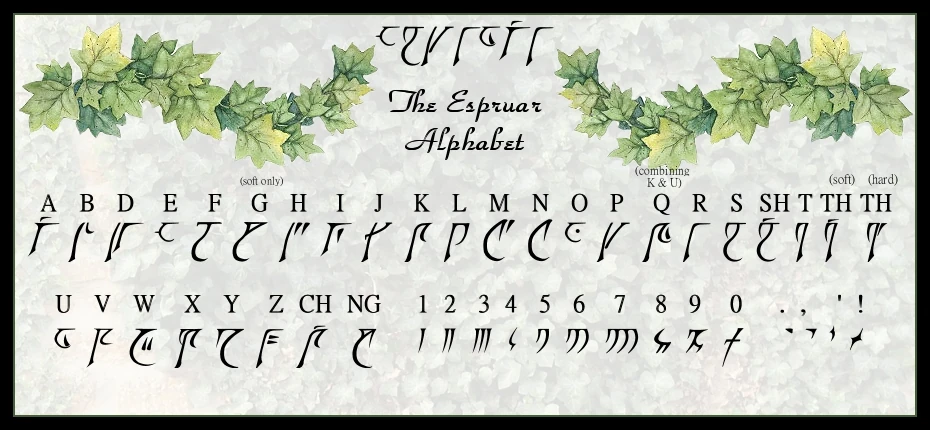
- Man it's hard to come up with a Dwarven script that looks as good as my Elven script (if I say so myself). Took me forever to figure out what shape I wanted it to be based on (I use a "theme" shape in most of my nonhuman scripts). Was thinking triangles, maybe use some element from the Covenant alphabet from Halo. My Elven draws inspiration from the 3e rework of Espruar and the Eliksni script from Destiny.
Eventually decided, my Dwarven combines the Covenant script with the "cat-pupil shape" that Rellanic, the 4–5e Elven, uses. See, I realized, dwarves aren't carving their script into rock with a chisel or wood with a knife. They're engraving it in metal with a burin (which burin is a single one of their mushrooms, metallized and with a sharpened tip). And you can get insanely florid with a burin engraving, so I actually have complete freedom in letter forms! - My Ogrish (based on Dwarven) retains more elements of the original, Covenant-like triangle script, but is more of a cursive form of it, like the version that you can find in signs and stuff on Sanghelios, in Halo 5.
- Decided that the best way to do my games at the actual table was to get a cheap (something like $250) flatscreen, hook a laptop to it, and then use a map program like Megasploot's Dungeondraft to make a dungeon map, to scale. You put a cover (we got a special one eventually but the first time we just used carefully arranged overhead-projector transparency films), and just move your miniatures, pawns, etc., around on it. Given the prices of poster printing, it pays for itself by like the sixth map you use it for.
Of course this would all be somewhat moot (I keep having players have to telecommute, and have someone on my end point their camera at the map and stuff) if virtual tabletop programs like Foundry were easier to use (also apparently there are issues with how you host it?), and if Roll20 was not a terrible, terrible company, from being shockingly petty to critics of their business practices to obnoxious Corporate Woke™ grandstanding on Twitter and elsewhere. - I would say my view of Dungeons & Dragons: Honor Among Thieves does not even approach cautious optimism, but I am willing to be impressed. Kinda wish they would actually play things straight for ten seconds, though. Not every movie has to be the thing those "Marvel fans when The Batman doesn't…" memes were talking about. (Also I loathe, abominate, and revile the "fast-talking bard" archetype that shallow 5e fans seem enamored of.)
- It occurs to me that making my dwarves actually be gnomes, and therefore have roughly the same build as half-elves, will make the dwarf/gnome-based ogres and orcs be much more similar to goblins. Then again I suppose my elves and gnome/dwarves are big and little "fairies", so it kinda makes sense that the monster versions are similar to each other.
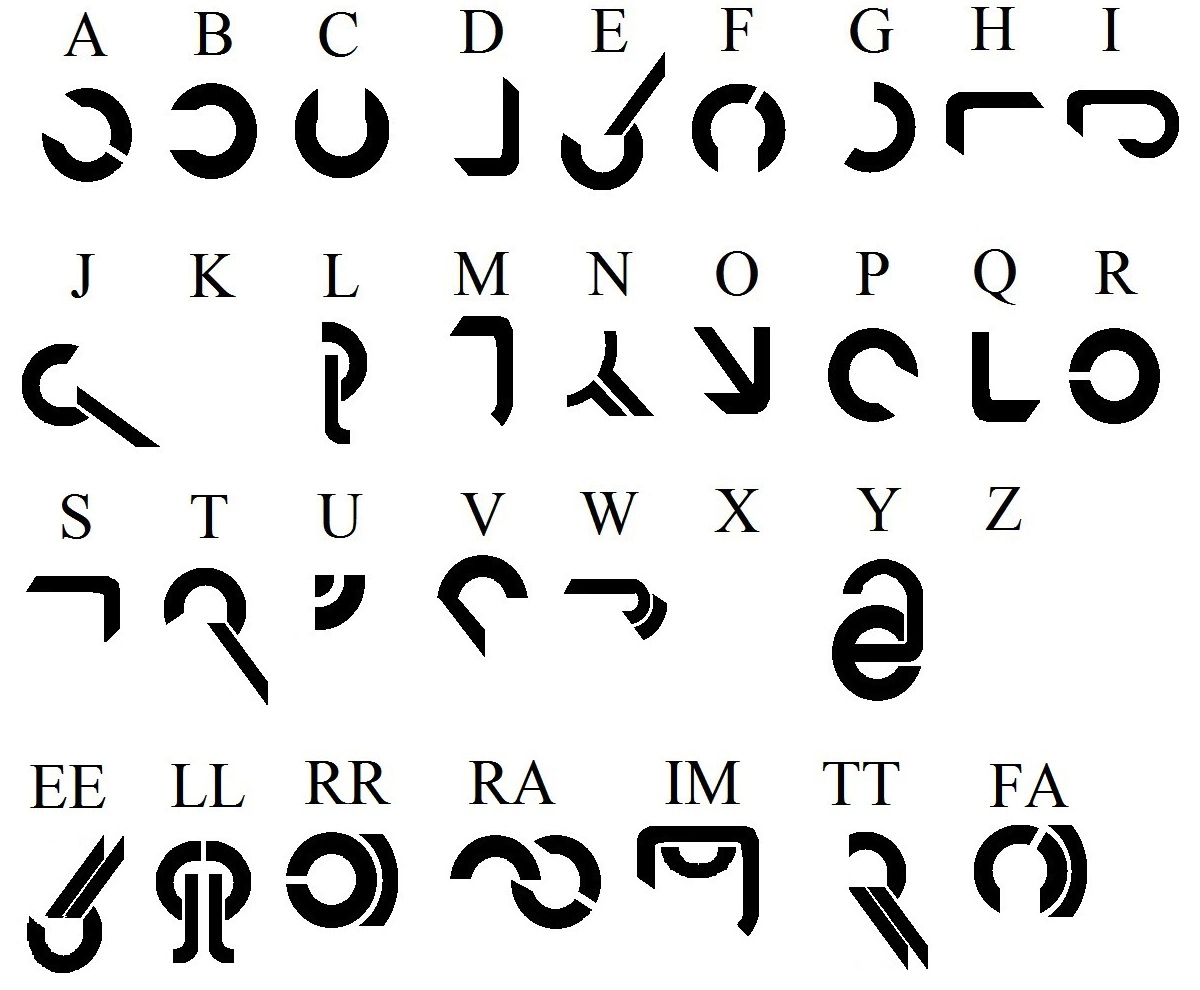
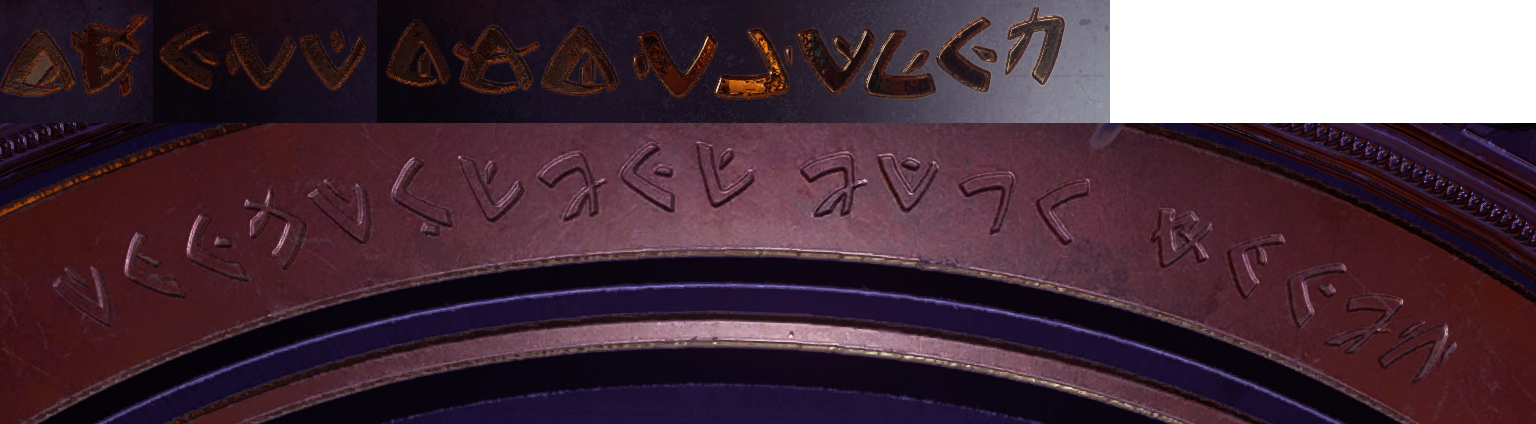
The culture is still very different, with goblins having strong personal loyalties and an obsession with fear and stealth, and ogres being very nearly a war of all against all, with a penchant for frontal attacks (which in no way means they won't stab each other in the back, though). Among other things, goblins get a Dexterity bonus, while ogres get a Strength bonus. - Very hard to figure out what to do with my Draconic, since too cuneiform-like will be too much like Dovahzul. Kinda wanna examine the Banished alphabet from Halo Infinite (which is in many ways the worst Halo, not least because the Banished suck as villains—Cortana would have been much better, but 343 has an amazing ability to utterly squander villains, see also the Ur-Didact and Jul 'Mdama). There's also Iokharic from D&D, which as I may have mentioned at some point shares letter-shapes with 3e Espruar.
Thinking I'll do something like the Naboo futhork from the Star Wars prequels, probably combined with vertically skinny letter-shapes reminiscent of Nüshu, an odd women-only script from part of China. Though with the letters grouped closer together (and words grouped into trios, in formal writing, like the tetrads in Classical Chinese).
Also reworked my "Sylvan", which in my setting has become the language of the araneas, formians, and thriae—bug people—that serve the law-spider outsiders. The previous script looked much too much like "Daedric" (really Dunmeris, with the other name being just what it was called in the Daggerfall game files). Went with, in contravention of my usual practice, a featural alphabet, since they're the minions of law-spirits; it wound up looking vaguely reminiscent of "Daedric" anyway. - Apparently Spelljammer in 5e, rather than bothering with ship's ratings (a table based on the level of a spellcaster sitting in the helm that would determine how fast the ship could move), has the thing go 10 miles per hour per level of the highest unspent spell-slot the spellcaster has. I take a couple issues with this (miles per hour do not tell you tactical speed intuitively—10 mph is a "normal move" of about 45 feet, or a "full-round move" of 90 feet—and I liked the major-minor helm distinction, though I suppose the latter does also affect the largest ship you can move via the helm in question), but it does streamline things. Might use it for my airships, or some of them, since I think Wizards has the basic Spelljammer rules (such as how helms work) as OGL.
- A search of le blogue suggests I have not mentioned the problems with Stranger Things? Probably the more fundamental but also the simpler is that it allowed the shills at Hasbro to market the game by the most shallow methods imaginable, flooding us with bandwagon-jumping bounders with no respect for the hobby (that invasion really took off with Critical Role but Stranger Things began it).
More complex, probably less important but more emotionally visceral, is how they have warped a generation's understanding of the names they have the characters drop. Demogorgon has two baboon heads and tentacles for arms (also that thing is a damned gug). A mind flayer…you know what a mind flayer is, and you probably know the thing in Stranger Things is nothing like one. And Vecna is an archlich.
Of course, D&D itself visited upon us the ludicrous idea that Vecna could lay siege to Sigil. Right, because She Who Flays, who can impose terms on entire pantheons, would need adventurers' help against an attack by one lich-god.
2022/04/27
Playing with Fantasy XXXIII
Icosahedral fantastication thoughts.
- Thinking I'll give dwarves back the Hardy racial trait, since several feat lines require it.
- I had lost vowel-length in Dwarven, owing to the desire to keep it orthographically simple, which is why I did away with plural forms, but I can actually use acute accents. See, I had had my old one, with long vowels, mark them with circumflexes, but now, with umlauts added, I can't do that—umlauts don't combine elegantly with circumflexes. (And Ŷ is weirdsville, even if I weren't exclusively using Y for consonants, and good luck putting a circumflex on Ø.) But I can do Ű and Ő, because they exist in Hungarian (and are frankly the most elegant method of writing those two sounds as long).
Currently /y/ and /ø/, written ü and ö respectively, represent the common gender, of my Dwarven, because they're at the point of articulation of masculine /i/ and /e/ (written i and e, respectively) but are rounded like feminine /o/ and /u/ (written o and u). (The close vowels are animate, while the close-mid ones are personal.) Then I have neuter be with /a/, written a. I figure lengthening those will do just fine for plural (before I'd had long vowels in verb stems represent imperfect/frequentative and short represent perfect/momentaneous, but I decided not to bother with aspect in Dwarven).
Also decided to go with not really either of my dwarven or gnomish script, but rework to make a new script. Still mostly hexagon based. - Apparently in Tagalog, at least, there is a distinction between the indirect and oblique cases (whoever named them should be slapped), with the indirect being the ergative in patient-focus verbs and the accusative in agent-focus ones, and the oblique being the dative and locative. In some other languages, though, the indirect and oblique are one case and the direct is another (I think they usually have genitives, too). Which is how my Dwarven does it. (I also call my voices active, middle, and passive, when really they should be agent-focus, intransitive, and patient-focus.)
- I think, using a version of arcanist casting, you can have prepared casters prep a spell for each spell-per-day slot, but then have flexibility about how many of each they use (i.e. they prep one spell for each slot, but can spend any of their slots to cast any of the spells they've prepared, like super versatile spontaneous casters). Arcanists proper can only prepare as many spells in a day as sorcerers of their level would know, which among other things means they only get spells when their character level is twice the spell's level, as opposed to prepared casters' twice the level minus one. You can still have prepared casters do clerics' or druids' spontaneous casting, by the expedient of not having to prep cure wounds or summon nature's ally spells beforehand.
Similarly specialist wizards have to use two of their flexible slots to cast spells from their opposition school, and spells can be prepped as being a slot higher, or metamagic can be applied on the fly as a full-round action like for sorcerers. Hmm, maybe let sorcerers apply metamagic on the fly by burning higher-level slots? That might be a bit broken though.
I do kinda feel like just giving spontaneous casters the undercasting of psychic magic (which is also not used by PCs in my setting, just like hybrid classes) is probably not enough to make up the difference, but then again, wizards don't get special powers at 3rd, 9th, 15th, and 20th level, they only get them at 1st and 8th; clerics don't get nearly as many benefits from their domains as oracles get from their mysteries (and even their curses). Plus sorcerers get extra class skills and, while they get one fewer bonus feat than wizards, they get a lot more leeway in what it is, assuming they pick their bloodline appropriately. Oracles are honestly probably OP as it is but maybe give sorcerers the bloodline mutations at the appropriate level without their having to give up powers and bonus feats? - Decided to change my dwarf/gnome ethnicities so the ones that live underground have lavender or pink hair, and the ones on the surface have violet or crimson hair, and both have violet or crimson eyes. Then I think the subterranean ones will have yellow skin, and the surface ones orange, from carotenoid pigments in place of melanin (subterranean dwarves need it less).
My orcs and ogres, meanwhile, are green, due to having a blue pigment along with a yellow one (several blue pigments are used in UV-blocking by some fungi and red algae, though in the latter they more commonly appear purple). They have bright red hair and eyes, which presumably comes from betalain (the pigment that gives the red coloring to beets and fly agaric). - Also changing my giants so the ones based on elves and humans are Huge, and the ones based on dwarf-gnomes are Large, thus making each two size-categories larger than its base race. The frost and wood giants based on elves can use some stats from taiga and maybe jungle giants, while the hill giants and cyclopes based on humans will use taiga giants and great cyclopes (but with the mental and magical characteristics of the smaller giants).
- The gillmen and dark folk now have native-outsider ruling classes, like the other surviving thalassocratic Valyrians with their tieflings and elementals (and dhampirs, but that's not outsiders). Gillmen have (primarily evil) tritons, who in my setting are a mingling of mortal essence with that of aquatic fiends; and dark folk have fetchlings.
Also the gillmen and tritons have 40 mm eyeballs, like a harbor seal (minus the blubber, a harbor seal is about the same size as a human). But where (I decided) elves have wider faces, to accommodate having bigger eyeballs (which makes them look younger, long skulls being a gerontomorphy), the aquatic mutant humans just have bulging eyes. - My dwarves will actually use both hammers and axes; I think I'll have it so they're proficient with battleaxes and warhammers, treat dwarven waraxes and sphinx hammers as martial weapons, and also live in a society with the "commonplace guns" level of availability. (Maybe they'll also be proficient in pistols, even if their class doesn't have martial proficiency?)
- Maybe have halflings get a +2 to Wisdom, not Charisma? Or actually stat them as Small humans, with +2 Dex, -2 Str, and then +2 to any one ability score. Yeah that could work—you could waste your variable score on giving yourself no Strength penalty, for example.
That's roughly what the Small version of a tiefling is, after all—just the size adjustments added onto the normal tiefling (if your tiefling subcategory includes a Dex bonus or a Str bonus, a Small version might be more than a little OP, frankly, since you're either as strong as a human at Small size or else you get +4 Dex).
2022/03/23
Come On, Shorty
Decided to consolidate dwarves and gnomes into one race, in my setting. They're redundant with each other; Paracelsus, who came up with gnomes as his earth "elementals", also called them pygmaeus—what that means to a Swiss German is left as an exercise for the student. Also as is pointed out in the TV Tropes article OurGnomesAreWeirder, the gnome in D&D is the dwarf from European folklore, the dwarf is the dwarf from Tolkien (usually via Warhammer, I would add). This also gives me a roughly human-sized "fairy" humanoid and a small one, like humans and halflings, without trying to wedge in the "human sized but weirdly proportioned" fifth wheel.
Decided to give them dwarf magic resistance (6 + HD), energy resistance 5 to both fire and acid, 120 ft. darkvision, and stonecunning, and the spell-like abilities I'd previously given dwarves, but also gnomes' ability score adjustments, obsessive trait, and keen senses. They have dwarves' weapon familiarity (hammers not axes, handguns, firearms are martial weapons), but use both the gnomes' mushrooms (particularly for armor) and the dwarves volcanic-pool algae (particularly for weapons). The rationale of that is that, while elves' gods are both the one tree, the dwarves' gods are fire and earth, two things that are more separate. Also dwarves make more stuff (although I guess this kinda makes the dwarves a lichen, a super rare rhodophyte-basidiomycete one). Maybe the dwarves can also make their algae weapons into the copper that harms neutral-aligned outsiders.
Decided they use largely dwarven language, which has the interesting effect of making all four of my protagonist cultures (elves, dwarves, inland Númenor, hydrocratic Púkel-men), except for halflings (who are an offshoot of the thalassocratic Valyrians), use a language inspired by Tolkien. I decided to take out plural forms and aspect distinctions in the verbal stems that both nouns and inflected verbs derive from, and just have three main verb paradigms: active/agent focus, passive/patient focus, middle/intransitive (in Austronesian alignment the important question is which noun that relates to the verb is in the direct case and which in the oblique one, and intransitive verbs only have a direct-case noun). Still haven't figured out which of their alphabets they'll use, Dwarven or Gnomish.
The gnomes were from the planet, but the dwarves that I consolidated gnomes into (and vice-versa) still come from one of the moons, which means I might have humanity have just grown up naturally, on the planet, unobserved by the more advanced lunar races because you can't see cavemen from orbit.
Not sure what to do about their coloration. Probably yellow structural coloring, in their skin, with phycoerythrin turning them various shades of orange, red, or pink. I thought I might have to give up on white dwarves and purple-haired gnomes but there are rhodophyte algae in basically every shade of red and magenta, up to dark lavender-violet with no red at all.
I struggled with what to do with orcs and ogres, if they should all be much bigger than their dwarf ancestors, but I hit on this: female orcs are gnome-sized (male and female gnomes are the same size), then male orcs are as much bigger than them as male mandrills are compared to females. Then female ogres are the same size as male orcs, and male ogres are mandrill male-to-female larger than them. This gives me Small orc females (whose stats become +2 to Strength and Dexterity and -2 to all mental stats), Medium male orcs and female ogres (which latter have the stats of orcs), and Large male ogres.
Decided to give them dwarf magic resistance (6 + HD), energy resistance 5 to both fire and acid, 120 ft. darkvision, and stonecunning, and the spell-like abilities I'd previously given dwarves, but also gnomes' ability score adjustments, obsessive trait, and keen senses. They have dwarves' weapon familiarity (hammers not axes, handguns, firearms are martial weapons), but use both the gnomes' mushrooms (particularly for armor) and the dwarves volcanic-pool algae (particularly for weapons). The rationale of that is that, while elves' gods are both the one tree, the dwarves' gods are fire and earth, two things that are more separate. Also dwarves make more stuff (although I guess this kinda makes the dwarves a lichen, a super rare rhodophyte-basidiomycete one). Maybe the dwarves can also make their algae weapons into the copper that harms neutral-aligned outsiders.
Decided they use largely dwarven language, which has the interesting effect of making all four of my protagonist cultures (elves, dwarves, inland Númenor, hydrocratic Púkel-men), except for halflings (who are an offshoot of the thalassocratic Valyrians), use a language inspired by Tolkien. I decided to take out plural forms and aspect distinctions in the verbal stems that both nouns and inflected verbs derive from, and just have three main verb paradigms: active/agent focus, passive/patient focus, middle/intransitive (in Austronesian alignment the important question is which noun that relates to the verb is in the direct case and which in the oblique one, and intransitive verbs only have a direct-case noun). Still haven't figured out which of their alphabets they'll use, Dwarven or Gnomish.
The gnomes were from the planet, but the dwarves that I consolidated gnomes into (and vice-versa) still come from one of the moons, which means I might have humanity have just grown up naturally, on the planet, unobserved by the more advanced lunar races because you can't see cavemen from orbit.
Not sure what to do about their coloration. Probably yellow structural coloring, in their skin, with phycoerythrin turning them various shades of orange, red, or pink. I thought I might have to give up on white dwarves and purple-haired gnomes but there are rhodophyte algae in basically every shade of red and magenta, up to dark lavender-violet with no red at all.
I struggled with what to do with orcs and ogres, if they should all be much bigger than their dwarf ancestors, but I hit on this: female orcs are gnome-sized (male and female gnomes are the same size), then male orcs are as much bigger than them as male mandrills are compared to females. Then female ogres are the same size as male orcs, and male ogres are mandrill male-to-female larger than them. This gives me Small orc females (whose stats become +2 to Strength and Dexterity and -2 to all mental stats), Medium male orcs and female ogres (which latter have the stats of orcs), and Large male ogres.
2022/02/25
Playing with Fantasy XXXII
Thoughts concerning icosahedral amusements.
- I realized how to represent the effect of wearing a helmet, thanks to the Hard-Headed feat line. Namely, if you don't wear one, you (Hard-Headed) have a -2 to saves against being staggered or stunned, and (Dented Helm and Cloven Helm) have a -2 to your AC against critical hit confirmation rolls. Now, I think, you can still keep those feats around—having them means you just get a bonus over and above just having a helmet.
- One theory about the question mark is that it's originally a cursive (lowercase) Q over an O, from quaestio (question). I don't know how sound that theory is in the real world (the Wikipedia article on "question mark" doesn't mention it), but I decided that my main human script's question mark, exclamation mark, and period would derive from the first and last letters of the words for "question", "exclamation", and "statement" (more or less).
Decided the other human language that uses a form of the same script does something similar but with just the first letter, with like a dot over and above it, or a line through it, or something. And then the last human script, on the other continent, uses a trio of dots pointing up, for questions, and one pointing down for statements (it doesn't have an exclamation mark, because most scripts don't—maybe they eventually borrow one from the other scripts, the way Arabic and the East Asian scripts borrowed the question and exclamation marks from Roman).
Not sure what to do with Elven, Dwarven, or Gnomish. Elven and Gnomish usually use verb-infixes to mark interrogatives, but there are also pitch questions—like how in Japanese you normally have the -ka ending on an interrogative-mood verb, but you can also just say "[Word]?" Considering having my Elven derive its question mark from the infix (or rather, two question marks from its two infixes, one used for polar questions and the other for nonpolar). - Was thinking my Dwarven might have articles, and definiteness obligatorily marked on all common nouns—maybe the definite divided into proximal and distal demonstratives. I considered it so there could be something (definiteness) that verbal adjectives could agree with their "head" on in the unmarked nominative, but it also let me give Dwarven a feature of Chukchi, namely inflecting proper nouns differently from common ones. Which is a trait I had been meaning to use in a conlang.
However instead I decided to bite the bullet and have my Dwarven use Austronesian alignment, and thus I now use the old accusative for the direct case and the old dative for the indirect (the genitives, volitional and nonvolitional, remain the same). So now there's case agreement on the "nominative", because the direct case is marked. Thinking only the oblique case will mark on proper nouns, though, which still lets me inflect them differently (and you mark adjectives for them with the direct suffix).
I also decided to give my Dwarven seven genders: masculine, feminine, common, neuter, and then divide each of the ones other than neuter into animate and personal. Unfortunately I can't think of a way to name the genders "Doc, Sleepy, Happy, Grumpy, Dopey, Bashful, Sneezy", but that would of course be the ideal if you had seven genders in Dwarven. - Crunched the numbers: if elves have eyeballs the same size as humans (they probably have bigger ones), 24 millimeters in diameter, they have a surface area of 1839.84 square millimeters. Taking just the outer half of that, you get 919.92 square millimeters. Now, rod cells can pack at densities up to 150,000 per square millimeter, which means the front half of the eye can fit 137,988,000 of them. Rod cells are also 100 microns long.
So if an elf has the entire outer surface of their eyeball (or a nictitating membrane that closes over the eye) covered in special rod-cells, that form a fractal antenna for passive radar, they effectively have a length of 13.8 kilometers. Which, given an "electrically small" antenna is the wavelength over 2π, means they can receive wavelengths up to 86.708 kilometers. That's low in the VLF radio band, 3457.5 Hz, which is used in geoscience and so could form the basis of passive-radar darkvision.
Hmm. If we gave elves eyes only slightly larger, say 35 millimeters like a tiger's, 35 millimeters in diameter, you get a surface area of 3848.45 square millimeters, half of which is 1924.225, and thus can pack 288,633,750 of them onto the surface, for an effective length of the fractal antenna of 28.9 kilometers, and a possible wavelength as high as 181.6 kilometers, a frequency of 1650.8 Hz—pretty much dead-center of the ultra low frequency band. - Bows, I decided, should not be divided into "long" or "short", nor "composite" and "non-composite", but into "hunting" (stats of regular shortbow) and "war" (stats of composite longbow, including the minimum strength requirement). Because warbows had draw weights upwards of 100 pounds; 200 pounds was not unknown, and some required assistance to string them. In terms of how it's used, though not how it's made and stored, an English longbow has much more in common with a Mongol bow than either does with pretty much any hunting bow (and you honestly can't pick between a well-made example of either type for power).
And then we could give specifically composite versions of bows the "horse bow" advantage, when being used mounted. Namely, no attack penalty when used on a mount making a double-move, only -4 when mount runs, rather than -4 and -8; the Mounted Archery feat would then reduce the penalty from a running mount even further, to -2, which is normally the benefit of Improved Mounted Archery, which feat would presumably remove the penalty entirely. (You think, of course, of mounted archery as a military technique, but lots of animals are best hunted while mounted, too—buffalo, for example.) Maybe have composite versions cost 50% more.
No idea what the hell I'll have elves' "Wabenaki" double bows do. Maybe just make them regular bows but made of two leaves ("elven twoleaf bow"?) and therefore collapsible by folding the leaves together, allowing it to count as "easily concealed" for purposes of Sleight of Hand? Maybe with a dagger's +2 bonus for the shortbow/hunting version? Yeah I think I'll go with that. They're already basically made of darkwood, so they weigh half as much and count as masterwork. - Yeah I'm just gonna have special-material stuff that equates to mithral, add to the price of weapons the way darkwood does, masterwork plus an amount per-pound. Given mithral has 50% higher hardness than steel, the metallic version will come to masterwork +15 gp per pound. Maybe, since my mithral-equivalent is also applicable to things that could be made of darkleaf cloth, which is twice as good as wood, masterwork +20 gp per pound? (Darkleaf cloth is mostly used to substitute for armor materials, and my armors cost, instead, what mithral does, because it gives all of mithral's benefits even to nonmetallic armor.)
- Discovered a very weird fish, the bichir (the ch is like sh), from Africa, that has lungs and can live on land for extended periods of time. Sound normal? It's not a lungfish. It's not even a lobe-finned fish. It's an extremely basal ray-finned fish, and may be the closest fish still extant to the common ancestor of all bony fish. It has really weird, simple lungs, and a unique method for filling them with air (along with "buccal pumping" i.e. gulping with the mouth), namely it exhales by pulling the scales on its chest inward to exhale, and creating negative pressure when that's released, pulling in more air. They're the only vertebrate with lungs but no trachea.
Anyway I think I'll base my sahuagin on them, which is cooler because ray-finned fish are more "normal fish", and also makes sense with the association with nagas since one group of bichirs are called "snakefish", guess why. The only question is whether to have them have serpentine lower torsos, like Warcraft nagas, since bichirs generally only have particularly developed pectoral fins. (I'm inclining to no, though.) I briefly considered maybe having them also be the serpentfolk, but I'm leaning toward no, since my nagas (which are actually proteans, stat-wise) are snake-y almost by definition. Maybe they also appear as eels, morays (which aren't really eels), caecilians, and other serpentine critters. - Semi-relatedly I think my gillmen will breathe through their ears, underwater, since the gill arches became part of the ears (among other things) in tetrapods, and the ear also connects to the respiratory system by the Eustachian tube. Of course they also have increased sensitivity to vibrations when underwater, to make up for the fact their ears are doing something else.
2022/02/10
Measure, and Number, and Weight II
So I think zled units will be generic terms, instead of untranslated words. (If that bothers you, go look up what "meter" means.) Since they're based on multiples of 12 and various powers of 10 of the Planck units, they can be divided into halves, thirds, quarters, fifths, sixths, eighths, tenths, and twelfths and still be even numbers of the base units.
For length, thought I'd just call the 6.350 centimeter, 1.2 billion Bohr-radius unit a "stretch" (and volume just be "cubic stretches"). Their mass unit, 120 million Planck masses or 2.6117 kilos, will just be a "ladings". And their time unit, unlike the others not based on a natural unit, will be…hmm. "Periods" seems most obvious for the hour-analogue, actually the equivalent instead of a Chinese double-hour because it's 1/12th of a Lhãsai day. Then "subperiods" for 1/120th of that, and "subsubperiod" for 1/120th of that, 1/14,400th of the period, and 1/172,800th of the day. Which makes it roughly half a second, ignoring the difference in length between Lhãsai's day and Earth's.
Let's see, then. What if we express speeds in, instead of meters per second, stretches per subsubperiod? Which comes to about 1/8th of a meter per second. Which in turn comes to about a quarter of a meter per second per second, because you apply the difference of time units squared. And imparting such an acceleration to a weight of one lading results in a "force" of 0.618863217 newtons. Then if we move that force over one stretch we get an "energy" of about 0.0393 joules (or about 245,277,675.123 GeV, i.e. 245.278 PeV, or about a quarter of a EeV—there are some surprisingly small units out there in science-land). And then that is equivalent to a "power" of 0.0759131869 watts, sustained for one subsubperiod.
Hmm. Maybe just call them "units (length, volume, mass, time, acceleration, force, energy, power)"? Or, given how Zbin-Ãld works, "long unit" and "heavy unit", and then "period, subperiod, subsubperiod"? Yeah I like that. Then the derived units, though, are "units of (acceleration, force, energy, power)"? Area and volume of course being "square/cubed long units", of course.
For length, thought I'd just call the 6.350 centimeter, 1.2 billion Bohr-radius unit a "stretch" (and volume just be "cubic stretches"). Their mass unit, 120 million Planck masses or 2.6117 kilos, will just be a "ladings". And their time unit, unlike the others not based on a natural unit, will be…hmm. "Periods" seems most obvious for the hour-analogue, actually the equivalent instead of a Chinese double-hour because it's 1/12th of a Lhãsai day. Then "subperiods" for 1/120th of that, and "subsubperiod" for 1/120th of that, 1/14,400th of the period, and 1/172,800th of the day. Which makes it roughly half a second, ignoring the difference in length between Lhãsai's day and Earth's.
Let's see, then. What if we express speeds in, instead of meters per second, stretches per subsubperiod? Which comes to about 1/8th of a meter per second. Which in turn comes to about a quarter of a meter per second per second, because you apply the difference of time units squared. And imparting such an acceleration to a weight of one lading results in a "force" of 0.618863217 newtons. Then if we move that force over one stretch we get an "energy" of about 0.0393 joules (or about 245,277,675.123 GeV, i.e. 245.278 PeV, or about a quarter of a EeV—there are some surprisingly small units out there in science-land). And then that is equivalent to a "power" of 0.0759131869 watts, sustained for one subsubperiod.
Hmm. Maybe just call them "units (length, volume, mass, time, acceleration, force, energy, power)"? Or, given how Zbin-Ãld works, "long unit" and "heavy unit", and then "period, subperiod, subsubperiod"? Yeah I like that. Then the derived units, though, are "units of (acceleration, force, energy, power)"? Area and volume of course being "square/cubed long units", of course.
2022/01/25
Playing with Fantasy XXXI
Back on my fantasy RPG bullshit.
- Decided that the underwater city of the thalassocratic Valyrians, who became gillmen, will also have a race of native outsiders, namely tritons but not good (they have aquatic-fiend patrons); the underground one, whose normal inhabitants are dark folk, have a fetchling ruling class. Though instead of owbs they have shadow demons as their main outsider patrons.
- My fiends usually wrap their wings around themselves like clothes, one bat wing as a skirt and the other as a shirt (maybe the males wear both as a skirt), even though they're only anatomically correct if they want to be (or maybe they flash you when they fly, or materialize clothes over the relevant body-parts before spreading their wings). Also think the aforementioned aquatic fiends have a patagium (flying/gliding membrane) attached to their tails, like fish-eating bats, though they use it for swimming instead of catching fish.
Think on the other hand my celestials (bird wings) and elementals (pterosaur wings) will wear apron-like shirts, like the ones used as women's undershirts in China and Vietnam. I don't think my proteans/nagas have wings, but they might grow gliding membranes like flying snakes or fins like flying fish (they also made the sahuagin, after all, and have eel traits too). Dunno what to do with the spidery law-outsiders; maybe ballooning like money spiders. Those two kinds of outsider are not particularly humanlike. - Not sure what to call the law-spiders. I incline to ōgumo, i.e. "great spiders", another name of the tsuchigumo. There's actually a shocking dearth of spiders in mythology, as a class—there's a bunch of specific spider gods, like Anansi and his equivalents in Africa, Iktomi in Siouan cultures, and too many Spider Grandmothers to count in other Native American cultures, and individual semi-mortals like Arachne, but races of spider creatures are actually bizarrely rare.
In-setting the proteans/naga are called neither, but just "snake gods", with the serpentfolk as "snake people" and nagaji as "snake children", or maybe "serpentborn" to signify their partially human ancestry. (They're hybrids of snake people with humans, accomplished by the same alchemical genetic engineering as makes the half-elves and half-orcs of my setting.) I can't find a base for a hybrid aranea, here the law-spider counterparts of serpentfolk, so I guess they never made one. - My setting's cairn wights are basically human inugami. An inugami is a yōkai created as an artificial guardian deity by burying a dog up to the neck and letting it starve within view of its food bowl; they guard their master's property loyally but bear dangerous resentments (can't imagine why) and their protection can easily become a curse. My cairn wights are made from soldiers buried to the neck within view of an eating area and allowed to starve while watching others eat.
- I really hate the "elves as dying race with low fertility" thing. My elves have a two-thirds longer reproductive cycle than humans—menarche at about 21 with good nutrition instead of 12½, ovulating an average of every 48 days instead of 29, average gestation of 467 days instead of 280—but their reproductive lifespan is twelve times as long. If they ever have to outbreed you, they can.
Same goes for dwarves, who have the same reproductive cycle as humans but six times the reproductive lifespan, and gnomes, whose cycle is one-third longer—menarche at 17, ovulating every 39 days, gestation of 373 days—but have nine times the reproductive lifespan. They just mostly live in conditions where extra children are not an advantage, which always reduces birthrates even without modern contraception. - Realized I should revise my height-weight tables. Turns out the government standard that pretends the same BMI range is healthy for both men and women (granting BMI itself is all that useful), is hokum; the real ranges are 20.7–26.4 for males and 19.1–25.8 for females (females have more fat and less muscle, meaning they're less dense). So now my humans average 5 foot 9 inches and 160 pounds for males and 5 foot 4 inches and 130 pounds for females (yeah I'm rounding a little).
For the nonhumans I based the relative weights on canids, with humans as golden jackals, dwarves as Borophagus, and elves as corsac foxes. (I tried humans as coyotes and elves as red foxes or black-backed jackals, but the differences weren't big enough.) Based on how much all three would weigh at 80 centimeters long (not counting tail), and then applying those mass ratios to a 5 foot 9 person, then giving the same BMI to a person of the average height of elves and dwarves (6 feet and 5 feet, both sexes, respectively), I get elves who weigh 120 pounds and dwarves who weigh 270. Then I took the common canid ratio of females 85 percent as heavy as males, and got female elves who weight 100 pounds and female dwarves who weigh 230. Gnomes are halfway between human and elf builds, which results in a gnome male of 3 feet 8 inches weighing 55 pounds, and a female the same height weighing 45.
One interesting side effect of this is most dwarves cannot even lift each other, let alone carry each other, and dwarves probably don't roll around much in their sleep. Certainly married ones probably learn not to, fairly early on in the marriage. (Elves weigh so much less than humans of their height because they have much more fast-twitch muscle than slow-twitch, and also have smaller guts, being generalist hypercarnivores like wolves.) - My dwarves' special material, I realized, makes more sense if it's just seaweed grown in volcanic pools, instead of coralline algae. You take the leaves and shape them into plates, much like elven armor, but the seaweed can make bigger plates so dwarves wear plate armor instead of lamellar. I also think their hammers will be made of a bunch of the leaves curled up and pressed together.
It also occurred to me that, since I don't have demons, daemons, or devils, but just fiends, who vary with regard to law and chaos, that I should just have cold iron be what hurts chaotic ones, alchemical silver be what hurts lawful ones, and "mountain copper" (orichalcum) be what hurts neutral ones. - Thinking I'll just have the dwarf stuff be like mithral, the way the elf and gnome stuff is—certainly that would make it more valuable as a trade commodity than stuff that makes your weapons and armor heavier for very little tactical advantage (sure dwarves don't slow down when carrying heavy loads, but no potential customers get the slow and steady trait).
Weapons made from the elves' leaves have the special quality of wyroot, and armor from gnomes' mushrooms have the special quality of singing steel. Armor made from the dwarves' seaweed will just have the special quality of spiresteel. And weapons made from the humans' far rarer stuff, made from the bones of things like hydras, have the special quality of cryptstone.
2021/10/28
Playing with Fantasy Λʹ
Thoughts, back on my constantly-RPG bullshit again. This is numbered with the Greek numeral for 30 so as to avoid "XXX".
- Decided to break down divine casters this way: clerics still come from dwarves, but now so do druids; oracles come from gnomes; witches come from elves. Humans still acquired all three late, having only had ancestor-worship adepts for most of their history. Decided the prevalence of witches among the black-magic empire (so I don't have to rewrite as many things) was because they were more influenced by elves than by dwarves or gnomes, magic-wise. Think I might have witches count as divine casters in terms of stuff like scrolls, but not for armor purposes.
- Decided that my Elven, which used to mark nouns and pronouns for ergative, oblique (in practice often genitive), and reflexive cases, will instead use two different pronoun stems for absolutive (formerly unmarked) and ergative, combine the two for reflexive, and do the oblique by just putting prepositions on the pronoun (like "of" for the genitive). Nouns are marked for case just by position, agent before patient before verb (same as Tibetan and Basque).
I was going to use the absolutive, since I was thinking of it as an "object" case, including "of a preposition", but apparently it's actually usually the ergative that's used as the prepositional case if a language doesn't have a separate one (helps to think of the ergative as being "by [noun]", and then every other preposition just replaces the "by"). You do not want different prepositions to take different cases; I have trauma flashbacks to high-school German just thinking about it. - Giving my elves and dwarves 120-foot darkvision and spell-like abilities, like drow and duergar; the dwarves get the derro spell-like abilities (ghost sound, daze, darkness, but once a day each, and not sound burst) instead of the duergar ones (enlarge person and invisibility, once a day each). I'm also giving elves 11 + character level spell resistance and dwarves 6 + level, along with letting them have the Healthy trait that replaces the Hardy trait (there's an option in the core rules for dwarves to replace Hardy with 5 + level SR).
They also get resistance 5 to cold (elves) or fire (dwarves), which is only worth 1 point in the Race Builder, but in the rules for elves it replaces Elven Immunities, which is worth 2, so I give elves the 11 + level SR which costs 1 point more than 6 + level. 11 + level isn't that OP; a caster 1 level higher than you, or 1 level lower with Spell Penetration, can overcome your SR by just rolling a 10. And I took away all the elves' and gnomes' racial bonuses to saves against stuff like enchantments and illusions—plus SR doesn't work on most witch hexes unless it specifies they're spell-like abilities.
Gnomes are less nocturnal, and so have only 60-foot darkvision (plus electricity resist 5, the standard gnome spell-like abilities, and 11 + level spell resistance, same as svirfneblin). The elves and dwarves are from the moons, where the nights are 15 days long, and on the far side you can never get "moonlight" from the planet overhead being in daylight (but since the day is also 15 days long, no light sensitivity). Gnomes are from the planet. I basically restrict low-light vision (which elves and gnomes have in the core rules) to real animals and things based on them, like catfolk and gnolls. - Thinking I might call witches, in the "dark magic" sense rather than the "quasi-divine primary-caster class" (because now witches in that sense can be any divine casters, while witches in the class sense are elven priests), "warlocks". Firstly because it literally means "oathbreaker", and second because the warlock class, introduced in
Let's Send 75% of Our Playerbase to Pathfinder or 1e4e, is the most hateful thing in 5e to people of decent good sense.
Warlock is a douchebag-bait class (though Critical Role makes all of 5e straight-up catnip to that demographic no matter what class they wind up playing), balanced by people who went to the Riot Games school of design, that absolutely runs off the "15-minute adventuring day". Alternatively I might call the bad ones "defilers", which does of course raise the question of whether the good ones are "preservers". - My hunt for a dwarven hammer comparable to the waraxe (which is a gnome weapon in my setting) and bastard sword, leads me to use the sphinx hammer, I think used by the Egyptian dwarves of Osirion, on Golarion, but with the "one-handed with Exotic Weapon Proficiency, two-handed martial" thing instead of being able to throw it. Still not sure what to call it—leaning toward "battlehammer". "Hammer of arms" seems to sometimes be used for a particularly large warhammer, also—think I've seen it used as a translation (possibly by machine?) of the Warhammer Titan's name, in Attack on Titan.
My dark dwarves, on the other hand—distinguishable from the others only in their weapon familiarities, stat-wise—use (light and heavy) picks instead of hammers. Where the other dwarves make weapons from a coralline algae, the dark dwarves make them from the chitin of giant spiders. Thinking they'll also make crossbows from chitin, instead of firearms like other dwarves use—though come to think of it you could probably make a decent-ish barrel from the leg exoskeleton of a giant arthropod, given how strengthened it would have to be at that size. - Decided that my elves' hunting god, who is the poisonous resin that protects the World Tree, will get Calistria's stuff, in elven contexts—his sacred animal is a toxic moth with venomous caterpillars, and those are easy to swap in for wasps. He'll also get most of Desna's butterfly-themed stuff. (Look, I'm a Spelljammer player, elves and Lepidoptera go together.)
I had had the elves make textiles from fibers of their sacred trees, and I think they still make some, but a lot of their stuff, now, is going to be made from silk collected from the abandoned cocoons of his sacred moths. There are actually three different other kinds of silk, from three other moths.
Haven't figured out what gods of my setting will get most of the other stuff from Golarion (as far as I know, if it's on the Archives of Nethys it's OGL, once you change the names; they're on the PFSRD site under the disguised names), though of course each pantheon's war god gets most of the Gorum stuff. - Minagho in Wrath of the Righteous made me realize the obvious path to doing multiple levels of "seducer fiend" (succubi and incubi, minus the pretense those are two different things). Namely, succubi as "common" ones and lilitu as "greater" ones. Decided to make cambions into the basis for a "lesser" one, too.
Think, though, that I'll replace the lilitu's husk stuff with the deimavigga/apostate devil's evangelization, indomitable oration, and ohrwurm powers. Think I'll also replace the cambion's sinfrenzy with the raktavarna rakshasa's "master's eyes" ability, minus the part about being a familiar.
2021/08/27
Playing with Fantasy XXIX
FRPG thoughts.
- Realized I can actually give my talking-beast accent thing to the cat-, hyena-, and yak-people that the thalassocratic Valyrians made, rather than having them speak (and be named in) Giantish. Which works out better because now I have five languages derived from that one, four languages in the other (landlubber Númenorean) group, for a total of nine languages native to the continent. (Really I should work out multiple dialects of the four landlubber-Númenorean languages, too, though.)
- Thinking the hydrocratic Drúedain will have daughter-languages that change the quality of consonants based on vowel-length of the root, resulting in short vowels in all words (like it might change voiced to unvoiced or stops to fricatives, I dunno). Or I might have it change long vowels to something tonal—Spanish changed the Latin long vowel into stress, after all.
Also should probably come up with different dialects for the Dothraki-type people. Maybe have initial biliterals change to a single consonant with a different vowel quality (long, maybe, or palatalized?). And, either in a different dialect or concurrent with that (maybe both, for three different languages) reduce the final-consonant inventory and have the other ones change to tones. - Decided that "hide" armor actually means "boiled leather version of half-plate", and "leather" armor means "something like buckskins or a buff coat, made of rawhide" (hey it's only one point better than padded). (And there is no studded leather—or maybe they use something like some Pacific Northwest cultures, where they reinforce buckskin/rawhide with little medallions?)
Boiled leather is not like a lot of people think of it being: it has roughly the consistency of, like, a Rubbermaid trash can. There actually isn't a reason fantasy characters can't have the "motorcycle leathers" armor that sticklers complain about, but it did in fact not historically exist till far later.
If you don't like the look of boiled-leather plate armor for a druid character, and I kinda don't either, there's always horn lamellar. The actual best-attested horn armors I can find are either scale or a Filipino thing that uses brass mail to connect plates of buffalo horn, similar to Japanese "tatami" armor. There's also wooden lamellar that you'd probably stat the same as the horn stuff, very thematically fitting for druid-types. - I'm kinda an idiot sometimes. I had had my Elven be number invariable except on pronouns. Just recently, though, I realized I can just stick an -i on the end of noun-stems. I think it'll stay where it is when the case-suffixes are added, which basically makes the case-suffix preceded by a Y sound. (I think plural -i plus a case-suffix starting in -i will yield a long I, though, instead of a -yi-.
This might complicate things for the talking cats they ride, of course, who replace dental and alveolar sounds with palatalized labial and velar ones due to the shape of their tongues. I suppose I can just transcribe it as -Cyi, or -Cyí in the case of the aforementioned case-suffix staring in I. (Given Elven writes palatals with i, yi and yí would be written ii and ií, in their script.)
I'd had a similar problem with the hyenas my gnomes ride, since Gnomish already has palatalized consonants; I made it so the combination of two palatals results in CryV. Of course, one of the palatals is ry, and they could already geminate r—so yes, rrry is entirely possible. Who doesn't like trigeminate consonants? - Hmm. Actually what if, instead of -i, the Elven plural is an echo-vowel of the noun-stem? Noun-stems' final vowels (which derive from verb inflections) are already repeated in the inflectional suffix, but currently it's always short. What if I had that suffix's echo-vowel be long in the plural? Of course the absolutive (my Elven is ergative) has no suffix, but what if it has a long vowel, not followed by a consonant suffix, in the plural? That'll work. Maybe you can put an "open" echo-vowel after the singular, too, to emphasize there only being one of something?
Briefly worried that this would mean I'd have to change all my elven surnames to have long final vowels, because surnames in many languages imply a plural ("the descendants of so-and-so", for example) but the elven ones are "of X grove". Groves might be groups of trees, but they're singular groups. I was worried this would mean I had to change something about my Goblin language, a form of Elven, but then I remembered it lost vowel-length, and uses reduplicated determiners derived from pronouns, to mark its plurals. - If I had to find one flaw in the Pathfinder rules, it's that there is no rule support for being able to dive in the way of an attack that's going to hit someone else, unless you burn two feats to get Bodyguard and In Harm's Way (and Bodyguard has Combat Reflexes as a prereq, so you're actually burning three). Personally I would house-rule it that you can't do it as an attack of opportunity, but have to waste a standard action, like you do to aid another if you don't have Bodyguard. But that's a house rule; the default ruleset contains no such provision.
- There isn't a Charisma witch-archetype in Pathfinder proper other than the seducer from Legacy of the First World, but that's more than a little awkward for mixed company—particularly the seducer's kiss and garden of delights abilities—and better suited for an NPC. (It's one thing if the antagonist always has their significant other charging into battle for them, quite another if one of the PCs does.)
Wrath of the Righteous comes to the rescue here, with the stigmatized witch archetype, which casts from Charisma, and loses its patron, but acquires an oracle's curse. (I don't know if it has an oracle's mystery, too, to make up for the lack of patron spells?) No word on if they're spontaneous or prepared casters (most Charisma casters are spontaneous, of course). - Very irksome that there are the aforementioned Charisma witches, Charisma druids, Intelligence and Wisdom sorcerers, Charisma maguses, Wisdom and Intelligence bards, and Intelligence inquisitors, but no Intelligence clerics, druids, or oracles.
I mean I guess it just means elven priests are in the same predicament as dwarven wizards, and better off than dwarven oracles or sorcerers (other than the aforementioned empyreal sorcerers), but it's still irksome that there's a druid offshoot that specially advantages gnomes but not elves.
I guess it makes sense for gnomes to be a little more magical than elves, since gnomes are at a significant disadvantage in a physical fight (sure, there's a Constitution advantage, but that doesn't help much when you can be physically picked up and moved, due to the CMB and CMD penalties). - Decided that my setting's vampires die like vetalas, mostly because turning into a flock of bats (like a moroi), a cloud of fog (like a nosferatu), or a pile of dust (like a jiang-shi), or having to possess an object while it recovers (like a psychic vampire) is dumb and annoying to work with. Gotta figure out which other abilities they have, though—obviously the vetala's possession abilities aren't ideal (even with the revised possession rules from Occult Adventures). Maybe the children of the night ability of a moroi and the spider climb ability of a nosferatu? Yeah I like that. They also still get a nosferatu's swarm shape, they just don't turn into a swarm when brought down to 0 hit points.
2021/07/14
Playing with Fantasy XXVII
Fantasy game thoughts. Try to get two this month so I average out to one a month.
- Think I'll just have my dark elves ride the same cats as the other elves, instead of Simbakubwa-based crocottae. And I think I'll go back to goblins riding a Carnivoran, too, instead of hyaenodonts, but instead of the amphicyonids they were riding before, I think they'll ride percrocutids, like Dinocrocuta (or rather like Percrocuta, but then also scaled up so hobgoblins and bugbears can ride them). Might give the voice-mimicry ability of crocottae to the things the goblins ride, since wargs ("worgs") are described as mimicking voices, in several D&D/Pathfinder sources. (Presumably the crocotta of legend, based on the striped hyena, was said to mimic voice because of the laughing.)
Not sure I'll keep the orcs riding pigs (or entelodonts or mesonychids). I do like the idea, because Twilight Princess, but riding an artiodactyl when everyone else rides carnivorans makes them the odd one out. Maybe I'll have the orcs ride hemicyonid bears, since the dwarves ride giant wolverines and they're both caniforms. The dark dwarves (which are not duergar) do not ride the wolverines; they ride giant spiders. Elves' cats are chaotic neutral and thus more likely to just go with whatever, while dwarves' wolverines are lawful neutral, i.e. sticklers. Maybe just have the ogres walk everywhere, with their dwarf endurance? Yeah that could work.
Not sure what my evil gnomes ride. Maybe edgelord versions of the other gnomes' hyenas? They're true neutral, so they could go along with their two-legged friends just like the panthers. - If we base the beastie the goblins ride on Percrocuta—5 feet long, 3 feet at the shoulder, 205 pounds—and use the height ratios of the three goblin races (rounding up or down as needed), we get a hobgoblin mount that's 8 feet long, 5 feet at the shoulder, and (taking the cube of the dimensional difference) weighs 900 pounds. But applying the bugbear one gives us a mount that's only 11 feet 6 inches long, 7 feet at the shoulder, and weighs 2,555 pounds—which is only a Large creature. However, because it's freaking enormous, you could apply the Advanced template, like you do to make a warhorse out of a regular horse. (This means bugbears, themselves Large, have to burn a feat to get Undersized Mount, but it's worth it.)
- My dark elves no longer practice blood-sacrifice of speaking creatures ("human sacrifice" with a slightly broader target category). Decided it was a bit too witchy; in the real world there are plenty of human-sacrificing cultures that do not go all the way into witchery (the Nahuatl city-states that semi-forced Cortes into conflict with Tenochtitlan practiced human sacrifice too, just on a much smaller scale and without cannibalism), but in fantasy it's better to keep the themes distinct.
Basically the dark elves now keep to the level of evil found in ancient civilizations like Rome and Sparta, with pragmatic murders like eugenic infanticide and constant honor-killing, but with a taboo on human sacrifice. Of course, part of their pragmatic murder is massacring communities that manage to fight back against their slave-raids, to cow others; they also perform experiments on intelligent beings. (Other than goblins or other elves, whom they always kill rather than capturing.) - A recent Wizards of the Coast customer survey had, to ensure that they actually surveyed customers (imagine preferring that!), a very basic rules question ("What is advantage?"). And a bunch of Twitterati went ballistic at the "gatekeeping", because even knowing the basic rules is an imposition, I guess. Remember, this is after they simplified the d20 rules because Mike Mearls thinks women are stupid, but apparently DnD now attracts people, gender unspecified, who are actually even stupider than Mearls assumed, and think that that's a problem for everyone else.
- Holy mackerel but the cavalier Order of the Blossom is OP. You get a sneak attack while being a heavily armored cavalier with a martial class attack bonus, which not only means your sneak attack is more likely to hit, but also that your sneak attack can be stacked with Vital Strike at 6th level—you don't have to wait till an odd level because cavaliers get a bonus feat at 6th.
And then, because that wasn't horrifying enough, you also get a bonus to Bluff checks equal to half your cavalier level. You use Bluff (which is modified by Charisma, which many cavalier abilities run off of) to feint. Which denies enemies their Dex bonus against you till your next action. "Enemy denied Dex bonus" is all that is required to sneak attack.
Rogues can often sneak attack every round or every other round, but they generally need an ally to be helping them flank, and are a "glass cannon" if they get into an even fight. Order of the Blossom members can likely sneak attack every other round solo, and have d10 hit dice and heavy armor. - So I decided that my elves' inquisitors are mostly living grimoire archetype from Horror Adventures, mostly because Int instead of Wis is an advantage for them.
But that archetype uses a holy text. I had originally conceived my religions as not having those much—they're not as common in real-world religions as a Protestant culture would understandably assume, let alone as important—and they'd have to be somewhat different for a people whose gods are their actual still-living ancestors. But living grimoires beat people with steel bibles, like Alice in Shadow Hearts. So.
I eventually decided that, rather than a revelation like Judeo-Christian scripture or a combination mystical vision and philosophical tract, like Buddhist and Gnostic scripture, it'll be in the format of memoir (equivalent of a real-world mythology, but the mythic creature is right there reminiscing about stuff), and one of those books of advice, like the Handbook that Dhuoda of Septimania wrote for her son William (equivalent of the moral precepts a real-world holy book would set forth). - Decided the hydrocratic Púkel-men, who looked like Australian Aborigines with brown hair and eyes and medium-brown skin, will instead have blond hair and green eyes, because brown eyes and hair is basically actual Aborigines. Also the Dothraki-esque speaker barbarians from that same continent, I decided, are Dravidian-looking but with red hair and blue eyes.
- Kinda cheesed Kingmaker makes you pretty much have to be lawful good, if you're not going to lose Kesten or Jhod during the Season of Bloom. The reason being that I really want to be a blight druid, and get to use the bleed power of the Death domain (not normally available to non-evil clerics or inquisitors).
I really hope they make that a viable choice in Wrath of the Righteous. That and the elf-witch better be romanceable, and to dudes. There was no romanceable full elf last time, and it was a travesty. (It's also a travesty that there was no romanceable halfling or gnome—the big people were still romanceable for halfling or gnome PCs.)
2021/05/23
Playing with Fantasy XXVI
Icosahedral FRPG thoughts.
- It turns out it's not too far-fetched for my darkvision to be passive radar, because echidnas have electrolocation in air, though we're not sure how sensitive it is. It's at least a fig-leaf to hide passive radar using background radio-noise, with cells in the surface of eyeballs as antennas and a detection range of only 60 to 120 feet.
- My setting calls its artificial hybrids, which includes the half-elves and half-orcs and also the nagaji, catfolk, and gnolls, "flaskborn". I also decided that the first batch (the animal hybrids) were made by a witch who bestowed them on her country's government during a big civil war. Which civil war she may or may not have had a hand in starting.
Of course, eventually, after her animal-hybrid troops won the war, she used her influence, and the government's trust in her, as an opening to assassinate their ruler and seize power for herself. She was the founder of the thalassocratic Valyrians being a witch-empire (before that they were just a typical ancient empire, so still pretty evil).
Her apprentice eventually assassinated her and seized power for himself. Occupational hazard of being a witch-lord, just ask Darth Plagueis (and his apprentice…Sidious). - Wyverns having pangolin tail scales but modified to deliver venom is actually unnecessarily bizarre, given that there is such a thing as a lionfish. They have venomous spines, containing multiple grooves and venom-producing tissues. Wyverns can just have tails tipped with those, but modified scales (like those on a horntoad but arranged like on a lionfish), not fin-rays.
- Decided that rather than dominate person, vampires in my setting have the abilities of siren songs: captivate, fascinate, obsession, and slumber. Since this is a bit weaker than dominate person, it becomes a gaze attack that affects anyone within a 30-foot cone in front of the vampire’s facing.
Think it lasts as long as dominate person does, namely one day per level but with an extra saving throw each day that the caster doesn't spend at least one round concentrating to maintain the effect. The subject also gets another save if someone casts protection from evil (all vampires being evil, and all). - There are no rules for how often vampires have to feed, in Pathfinder. Decided that in my setting, they have to feed as often as living people have to eat.
But instead of taking nonlethal damage directly, when they don't feed, they take that damage to their maximum hit points (with hit points above that level becoming, effectively, temporary hit points with an unspecified time limit), reducing for example how much they can be healed by negative energy.
They have to feed to remove the cap—think feeding still gives them temporary hit points, but also raises the cap by the same amount, until it equals their real maximum hit points. - Watching—then reading—Shadow House, one of about fifteen worth-a-second-look anime this season (usually there are like two) makes me think I should maybe bring fey back into my Pathfinder setting. Maybe as something like emotional/psychic effluvia produced by the elves, dwarves, and gnomes.
But then I recall that for most purposes, my elves fill the slot of big fey (fae), and my gnomes the slot of small ones. They're not exactly as bad as some of the fey in a standard setting, like mites or boogiemen, but they definitely fill the "may not really give a shit what happens to other beings" thing, at least when young and irresponsible (they consider "lead travelers to get lost in the woods" to be their equivalent of "killed someone in a duel over winks at a barmaid" that human young people get up to).
Might have some particular fey creatures that aren't redundant with elves and gnomes, though—possibly including mites or boogiemen. (Redcaps, though, are the gnome version of dark elves—makes more sense to use them than spriggans, whose gigantifying is a headache.) - I actually have a perfectly sound reason for my elves and dwarves to have darkvision and cold or fire resistance. They're from the moons. Meaning their environment spends half of every month in darkness, and has permanently frozen poles and baking tropics. See, moons have no seasons. Their climates are extreme in a way that people from a planet can't imagine; only the fact that most moons are vacuum makes this non-obvious—Titan has barely any seasons, beyond slightly clearer skies around the equinoxes and hydrocarbon rain in the northern hemisphere winter. Though I don't know how much warmer it is at its equator than at its poles. That could just be Saturn's location, though.
I have no idea how I justify gnomes having darkvision, or really, electricity resistance (other than that they're fungus-themed and fungi really like electricity). But then, dwarves are subterranean, so their fire resistance and darkvision might actually have more to do with that than with their climate. Certainly they all have the same skin color, while elves have several, including multiple pigments—high elves and what goblins used to be have blue (structural coloring only), wood have green (with yellow carotenoids) and dark elves have purple (red anthocyanins), and gnomes, who use melanin (in their skin but not their hair), have roughly the same range as humans, mostly the browner end. - I realized I left out antipaladins, in my setting's population estimates. I also decided that my nonhumans do have commoners, among their NPC-classs children, but with an archetype called "apprentice" that can cast one fewer 0th-level spell per day (and knows one fewer) than the 1st-level caster of its class. (Don't think I'll have apprentice alchemists, since they don't have 0th-level
spellsextracts.)
One thing this means is that the population numbers are bigger. Another is that I need to figure out what percent of the human population are the Thalassocratic Valyrians' surviving city-states (they have three)—certainly most of the witches and antipaladins are, but would it make sense to have a high proportion of the population be clergy? I suppose it might in a theocracy, though—40% of Saudi subjects, for example, consider themselves Wahhabis (though what percent of that is imams is a different question).
2021/04/15
Playing with Fantasy XXV
More Pathfinder thoughts.
- Worked out my setting's vampires, mixing and matching aspects of Pathfinder's moroi, nosferatu, jiang shi, vetalas, and psychic vampires. One thing it did was make me realize how much of an advantage the "template" system is, for making things like vampires. You just create a normal character and then apply the template; it was like falling off a log.
- Decided my setting does not include the Harrow deck, as such, though it probably can use the various associated class-archetypes. Tarot, see, is simply not a mystical thing; it's a version of bridge. You can use that for divination, as you can use lots, animal entrails, the flight of birds, or tea leaves, but there's nothing inherently supernatural about any of those things.
The version in my setting will still have each card represented as a combination of an ability score and an alignment, but not named like in the Harrow; basically the abilities are the suits and the alignments are the pip-value, from 1 to 9 (with lawful good as highest and chaotic evil as lowest). The game itself, though, is more like some of the games played with hanafuda.
Soldiers in my setting keep dice and cards among their lucky charms, because getting bored is a jinx, for soldiers: they start wishing something would happen. - It kinda weird to anyone else that it took till Pathfinder, three reworks into the d20 Fantasy rules, and indeed six years into its run (June 2015, after the debut of the Core Rulebook in August 2009) with the release of Occult Adventures, for there to be definitive rules for possession, despite there being the concept of "being possessed" within the game back to the beginning? They also released a new spell to govern the process, just called possession, replacig the clunky legacy spell magic jar.
- Decided how my elves' bows work: they're two long leaves from their sacred tree, with the fascicle sheath (the thing that holds pine needles together) as the riser. You bend them back opposite their usual direction, to string the bow. One thing this means is that the bow can be stored more easily, since when unstrung it's only half as long, a bit shorter than a longsword.
If it were just a single bow, you can just have a bowcase built into your quiver—a 6 foot bow would be 3 feet folded up, and the average elf in my setting is also 6 feet, and thus has a draw-length (which is roughly the same as the length of an arrow, minus its head) of about 29 inches. But their bows are really two bows, four leaves, one pair half as long, so it might have to be carried slung over the back like a rifle—except they disconnect the fascicle-sheaths of the two bows, and fold them together, so it fits in the bowcase. (Might call it a four-leaf bow, in fact.)
Incidentally, a "reflex" composite bow turns into a weird hoop about a foot in diameter, when unstrung. - In Pathfinder, a Colossal dragon's claws each do 4d6 points of damage, or the same as the damage dealt by a Large boulder falling at least 30 feet.
A Large object is 8–16 feet in at least one dimension; assuming a roughly spherical boulder, we get a volume of 268 cubic feet, for the 8 foot one. Given the density of feldspar, the most common rock, 2.56 grams per cubic centimeter, that results in a mass of 19,434 kilograms. After a 30-foot fall, that's a kinetic energy of 1,741,468.91 joules—and thanks to the 30 feet thing (joules are newton-meters), we can change that conveniently to a force of 190,449.36 newtons, or 42,814.72 pounds force.
The dragon's bite does 4d8, which results in an average damage two-sevenths higher than that of the claw (not counting the fact the bite gets half-again the Strength bonus and the claw only gets the full one), for a bite force of 55,047.50 pounds—compared to the T. rex's bite force of 12,000 to 14,000 and the Megalodon's of 24,400 to 41,000. - I gotta say, the central conceit of the Pathfinder core setting is kinda neat. Namely, the "Age of Lost Omens" where, after Aroden failed to return to lead humanity to a golden age (having vanished somehow), no more major prophecies have come true in the ensuing 113 years. That's a really cool idea.
- In my own setting I'm averse to the concept, inherited from Hesiod by way of Augustine, that you can divide history into "Ages"; while the inhabitants of my setting do speak of "ages", they use a Romance-language definition, equivalent to "century" in English (or some other big, regular-sized chunk of time; my elves' "ages" are 1728 years, the dozenal equivalent of a millennium).
The closest I get is that the various cultures base their dating systems on events like the (main) humans covenanting with the animal-gods or the elves and dwarves coming to the planet from the moons, or (in the case of the thalassocratic Valyrians and hydrocratic Púkel-men) the founding of their empires.
The two human empires also describe eras in terms of their dynasties, which are numbered, but also often referred to by their capital, among the thalassocratic Valyrians, and ruling clan, among the hydrocratic Púkel-men. - I have eight human cultures in my main setting. There's the urban, settled rural, and nomadic branches of the main protagonist culture(-complex), whose languages are based on Adûnaic, and then the nomadic seagoing descendants of the thalassocratic Valyrians, the halflings (a branch of the thalassocratic Valyrians engineered to be small, as a sort of "toy"-breed novelty), and then the successor-states to the thalassocratic Valyria, one aquatic (as gillmen), one subterranean (as dark folk), and one ruled by dhampirs, tieflings, and what D&D proper calls genasi.
There are actually multiple offshoots of each—nineteen nations of the urban main culture, eleven of the settled rural, and seven of the nomadic, plus four of the halflings. A lot of those have their own dialects (though you also get things like Austria and Bavaria sharing one group of dialects), but for simplicity I treat each major group as only speaking one. I also have a dialect for each of the three successor-states of the thalassocratic Valyrian empire, each of which modifies its grammar in certain ways. It just now occurred to me to have the sea-nomad descendants of the thalassocratic Valyrians have 81 clans or tribes, say one for each Craft, Perform, and Profession subskill listed in the Core Rulebook, like how Romanian Roma (Gypsy) subgroups are named according to their traditional profession.
I really need to come up with cultures for the other continent. Maybe I'll divide the nomadic "barbarians" into a couple different groups, and perform some sound-changes on their language. Hmm. Maybe also a single big division in the hydrocratic Púkel-men culture, analogous to something like Northern and Southern Chinese? Maybe a tripartite one, there are a lot of those, too.

2021/02/23
Playing with Fantasy XXIV
Fantasy RPG thoughts.
- One of course wants to have, along with the mundane airships detailed in Ultimate Combat, flying ships that are controlled by a chair that eats your day's spells and imparts a fly speed of 150 feet per round times one-third to one-half your spellcaster level. But that would be sadly illegal. Instead, I decided that the elves and the spider people use ornithopters and entomopters, respectively (elves feather theirs with their leaves, spider people make the wing-membranes from silk). And the ships have magic engines, used by spellcasters, but instead of eating your day's spellcasting, they're attuned to like a leyline, as described in Occult Adventures, and they provide the variable bonus to drive checks (Spellcraft or Fly, whichever is higher) instead of caster level.
The "evil Atlanteans" are the users of the steam airships, which I think are still controlled by the kind of "leyline engine" that controls the ornithopters and entomopters. And then I decided that dwarves, who I was going to also have using ornithopters, instead eschew flying, and instead use subterrenes ("drill tanks", except with tunnel borers rather than drills strictly so-called) or submarines, also powered by "leyline engines"—not sure exactly what they'll look like. Submarines with those engines are also what the snake people will use, instead of flying ships. And then I was wondering what the gnomes should use; I considered some kind of Leonardo-esque "air screw" helicopter, using their sacred fungi to make the "screw", but—read on.
I think the elf ones will be "crowships" and the spider-people entomopters will be "darnerships" (i.e. they're dragonflies, though I won't actually use the deckplan of the somewhat iconic all-purpose spelljamming ship). I don't know what the dwarf ones will be shaped like (I'm leaning toward the one vehicle being usable as both subterrene and submarine, so maybe something like "snailship"?), but the snake submarines will be "sharkships". But there are no helicopter animals, so I decided actually gnomes should use flying boats (not submarines though) that mimic flying squid (which may actually be able to really fly—albeit not very strongly—by undulating their bodies like dolphins, to "flap"), which I'm going to call "teuthopters". - All of which raised a quandary: what is your parachute, on one of those? An actual parachute? A glider of some sort? A set of wings of flying (which really ought to be called a cloak thereof, it's a cape that changes into wings)? A ring of feather falling? (Probably that one.) The spell won't cut it, it generally wears off well before you hit the ground, if you assume a paratrooper-style 2000-foot jump height—even a 20th level caster will still leave you 800 feet in the air when feather fall wears off. (Cruising altitude for an airship, if we take Zeppelins as a model, is only 650 feet, which you still need to be at least 10th level to fall from at 60 feet per round and a 1-round-per-level duration.)
- Decided that instead of Tainish from Unsounded and Hardic et al. from Earthsea, the languages on the other continent, in my setting, will draw inspiration from Dothraki and what little we see of Ghân-buri-Ghân's language, Drúadanic. Just like how my main continent has the protagonists speak the Tolkien-derived one (Adûnaic) and the vile and hated enemy speaking the Game of Thrones-derived one (no disrespect intended to David Peterson; he didn't create the Valyrians or Dothraki, he just did the best he could to give those caricature-cultures halfway decent conlangs), the Egypt-y ones are the ones who speak the Tolkien-based one. (Yes, both the civilized and the "barbarians" speak languages associated with "barbarians". On the other continent the Adûnaic-based language was originally that of peoples despised by the evil Atlanteans as "barbarians", even though it's based on the language of another setting's Atlantis/Rome-analogue just as Valyrian is.)
One thing this meant is that I had to slightly rework the script I worked out for them, which was fine actually. Since the Drúadanic-based language has a very limited sound-palette, too limited to let the Dothraki-based one be written conveniently in a script for it, I instead went with the script having been devised by scholars for writing both, like the 'Phags-pa script in Yuan China, though based on older scripts used only for their own (and incorporating, I think, ancient logograms that the older form of their script ultimately descends from but that it's a real pain in the ass to actually work out). I also gave them a numeral system, with different rules from the alphabetic characters, an important thing to do when you make the numerals for a con-script. (Usually. The this-side-of-the-world cultures just use their first nine letters for 1–9 and a space for 0—I think they write numerals inside a circle or something—because originally they used Greek- or Hebrew-style numerals, and then just adapted them to positional use.) - I also worked out my giants' numerals and redid my gnomes' system. All four of my nonhuman numeral systems, Dwarven, Elven, Giantish, and Gnomish, were originally based in some way on the body-part they used for counting (Elven and Dwarven dozenal on the individual knuckles of each finger, Giantish octal on the spaces between fingers, Gnomish vigesimal on fingers and toes). Which I highly recommend as a shortcut to making constructed numerals, but it still bugs me that they have characters for "10" (whichever that means in their numerical base), that they don't use now they have zero.
See, the Elven and Dwarven numerals have a regular pattern for 1–3, 4–6, 7–9, and then write ten and eleven—digits A and B—in a way that clearly indicates the next number should, though representing the numerical base and thus "10", be the digit C. Giants write 1–4 regularly, and 5–7, and then you wish you didn't have to write 8 as "10"; gnomes have a regular way to write 1–5, 6–A, B–F, and G–J, and you wish you could use the obvious symbol for K instead of writing it "10".
This would bother me less except that my other-side-of-the-world numerals have a pattern for 1–3, 4–6, and 7–9, so there's no leftover regularity that makes "10" feel unnatural. Because where the other races modified a pre-positional numeral system to writing positional numbers, the civilization over there, whose script was purpose-built and semi-artificial, were free to come up with their numerals wholesale. I have worldbuilding reasons for all the other scripts' numerals being irregular, but it still bugs me. - So the actual name for "ley lines" as a mystical thing—the concept has more legitimacy as a part of fengshui than as part of Alfred Watkins's pseudoscience—is lóngmài, literally "dragon vein" (the same as the ryūmyaku that Xingese alkahestry is powered by, in Fullmetal Alchemist). I submit that "wyrmlode" is the cool fantasy-sounding English (and from purely English roots) version. ("Lode" is a bit too modern, here, but "wyrmedder"—the second element being the aboriginal English word for "vein", still extant in some dialects—sounds too weird.)
I decided that in my setting, dragons give their name to the phenomenon because they live primarily by tapping into it, like fleas, and only eat other creatures for nutrients, like butterflies eating mud or tears. Which explains a number of things about dragons, like their obsession with their lairs (maybe heaping up a hoard in a nexus of these energies, is the dragon equivalent of rearing a standing stone there?), and also how you can keep a 24-ton dragon alive on the same diet as something like a 5-ton tyrannosaur.
A lot of dragons' adaptations (notably not their breath weapon) are, thus, intended for fighting other dragons away from the territory where they get theirgeomantictopomantic energies. (I kinda want to call the "wyrmlode" nexuses "alkahest fields", using the Fullmetal Alchemist translation of dan 丹 to render dantian 丹田—I guess I could also say "cinnabar fields"—which usually refers to yogas chakras, the equivalent of such a nexus in the body's qi, rather than that of a landscape, but is also used for the fengshui equivalent. "As above, so below", as the guy Ed and Al's dad is named after would say.) - I had had the "ley line guardian" witch-archetype known, in-universe, as "rhumbline" witches, since the main witches of my setting are the thalassocratic Valyrian/evil Atlantean maritime empire. But I guess it actually makes more sense to just have them be called "wyrmlode" witches. Maybe they practice sorcerer-like (but Intelligence- rather than Charisma-based) spellcasting through watching and copying dragons, which is where my sorcerer "bloodlines" come from (hence I call them "lineages" instead).
- I found a random wordlist generator, an online thing called Awkwords. I had used this old freeware app called Langmaker (no relation I know of with the defunct wiki), but that only works on Windows XP and earlier (it might still work on 7?) I used it to make my Elven, Dwarven, and "formerly Tainish now Drúadan Egyptian" sign-languages. But I was feeling out-of-sorts, having already made all the languages for my setting ("Alexander wept, for he had no more worlds to conquer"); that was a part of why I redid both the languages on the other continent (though I had been dissatisfied with them for a while.
I also decided to work out a language for the arthropod-people made by the spider-outsiders, like the one used by the snake-, lizard-, and fish-people the snake-outsiders made; I had had them using a weird pronunciation of my Sylvan (in my setting, a language used in common by talking beasts), but now they have their own. Unfortunately it's not directly mappable onto Undercommon from the standard list in the Linguistics skill like that is. (But hey there are a bunch of slots freed up by my combining all the outsider and elemental languages, plus Aklo, into "Primordial".)
Hmm. Maybe have the talking beasts use a mispronounced version of their humanoid riders' languages? That would be more thematically appropriate, since the talking beasts are all the children of the older "litters" of the nonhumans' gods, and thus regard their humanoid counterparts as their spiritual aunts and uncles. Then I can give Sylvan to the bugs. Yeah might go with that, though it'll be a lot of work. - Partly out of the desire to play with the new toy, I also decided that I might do my Primordial language as an actual language after all; just babbling glossolalia and using asemic writing as the script is cool and thematically appropriate and not at all fulfilling to me as a conlanger. And the artist must ultimately please himself.
So I generated a very short wordlist, made only of semantic primes (then I added semantic molecules, because having to refer to everything by primes would be a pain in the ass); I still have read magic convert magical writings composed in Primordial into something readable, but by changing the writing—which is pure ideograms, not logograms—into the natural semantic metalanguage of your own lexicon.
I might actually generate a full-sized lexicon for it. Or maybe I'll go straight back to the glossolalia and asemic script, and put the time and work I might have put into developing Primordial into a "real" language (but one that's thematically not as consistent or as interesting from a worldbuilding standpoint) into developing my bug-Sylvan and "talking animal" dialects of my humanoid languages.
2021/01/24
Playing with Fantasy XXIII
- I had had the gnomes making mead and the dwarves making kumis, but there were a number of problems. First, of course, the dwarves doing it was predicated on wolverine milk being as high in lactose as mink milk is, but—aside from how the dwarves' giant wolverines are speaking creatures, and buying some lady's breast milk is kinda weird (though paid wetnurses are a thing in many cultures)—minks are tiny and have an insanely fast metabolism. Bear-sized wolverines probably would not need all that lactose; bear milk has incredibly low lactose, like 0.5%. (Horse milk is 6%.)
Second is that it's probably hard to be a nomadic beekeeper, and most gnome agriculture is done by (the hyenas who accompany) gnome caravans. Whereas dwarves are settled people, and thus they (and their wolverines) can do beekeeping fairly easily. (I don't know if wolverines are immune to beestings, but honey badgers and skunks are.) Plus the gnomes have their big caravan wagons (think Mongol yurt wagons) drawn by muskoxen, which are also the main livestock gnomes eat and milk. Muskox milk can, depending on feed, go as high as 5% lactose, which is probably enough to make kumis from. - I know I said monks are nearly useless; honestly I'm starting to feel that way about rangers, too. I mean maybe if your GM goes out of their way to provide a lot of favored-enemy and tracking gameplay, and you could probably do something with animal companions (the other version of hunter's bond is useful but kinda lackluster). I suppose it's more "might be a lot of fun to play, if your GM is on the ball and makes the campaign rewarding" than "actually useless". Maybe I'm just petulant about them needing your GM to be on the ball to be a rewarding play experience.
- Did some research on how you heat an inn. One way is to have the chimneys of the common room (which is where most people sleep) and kitchen, if it has a separate one, open onto rooms on the second floor, and heat them that way. Another is to have braziers with hot embers from the kitchen and common-room fires in the private rooms, and heat them like that. If you're going to have rooms away from the common room or kitchen with fireplaces, your inn is going to have more chimneys; most likely you'd still have the fireplaces in adjoining corners so four rooms can share one chimney.
Was not able to find out this kind of thing about caravanserais, because all the search results were for resort ones that have central heating now. Someone said people stayed warm by sleeping with their animals, but I don't actually think that shows up in any of the historical accounts of caravanserai, and I can't imagine high-class travelers doing that. My guess would actually be the "brazier in each room" method; thinking mine might also have the "shared chimney fireplaces" thing (maybe every two rooms not every four, given most caravanserai floorplans). - Apparently part of why D&D 5e is so simplified (not to say "dumbed down") is because one of the chief designers, Mike Mearls, says women can't understand complex rules and lore. He phrased it as complex rules and lore being used to "gatekeep" women from the hobby, but the implication is the same, the "soft bigotry of low expectations". Besides, dude, I know several women who learned on 2nd Edition, and 3e/3.5e isn't within a parsec of that complex (not to say "obtuse").
- So the dying and coming back mechanic in Elder Scrolls Online is cancer. Especially since the "Vestige" is semi-undead, meaning that there is no reason they can't be as easily rezzed as Guardians. But I was thinking about how you'd handle players dying if you actually cared, when the player characters aren't immortal undead. You can't very well make resurrection that cheap and easy.
But then it occurred to me, MonHan. When you die in Monster Hunter, those little cat guys rush in, put you on a cart, and drag you off to where you are presumably resuscitated. So in an MMO, you could just have something that teleports you to some central location (like the Hunter's Guild), and they patch you up and then return you to the fight. And their doing that is the respawn timer. - Not in my campaign, where hybrid "races" are all "ampule babies", but in a more standard one, you might rule that elves and gnomes can have children (I'd say Medium sized, though much smaller than an elf—not being Small means they can still carry more than a gnome—with +2 Dex, -2 Str, and maybe player's choice of +2 to Charisma or Intelligence), and maybe humans and halflings (something like Medium but not very big, with -2 Str, +2 Dex, and player's choice of +2 to one other ability). Not sure about any other combinations, though.
- I apparently haven't talked about it here, but I worked out what kind of bow-draw my various societies use. The thalassocratic Valyrian/evil Atlantis culture uses the Mediterranean draw or the three-under draw (associated respectively with the Turks—the ancient Mediterranean used the pinch draw—and the English, can't imagine why an evil empire would have similarities to them), the steppe nomads on the main continent and the settled empire on the other continent use the Japanese draw, and the settled people on the main continent use the Mongolian draw. The nomadic "barbarian" culture on the other continent uses the pinch draw, because their bows are a hunting-tool not a weapon (they prefer javelins and axes for war). Elves use the Hungarian draw.
The Mediterranean draw is where you draw the bowstring with your index, middle, and ring fingers, with the arrow between index and middle. Three-under is the same except all three fingers are under the arrow. The Japanese draw is where you draw the bowstring with your thumb, and your drawing hand's palm is parallel with the bow; the Mongolian draw is where you draw the string with your thumb and your drawing hand's palm is parallel with the ground. The pinch draw is where you don't draw the bowstring, you draw the arrow, and requires enormous strength to do with a war-bow (which can be more than twice as strong as hunting bows). And the Hungarian draw is like the Mediterranean draw except you only use the index and middle finger, not the ring one. - Also worked out the benefit to using a parent-child bow: It functions as a composite bow but the minimum Strength to use it without penalty is treated as lower, I'll say by 2 points. Or maybe your Strength is treated as 2 higher, including for the sake of getting the damage bonus? But that second thing looks kinda broken. "You don't need the same Strength to use it but you need that Strength to get the bonus" seems fairer.
- Was reading a thing about how the Mongols' mainly eating preserved food while on the move allowed them to move very stealthily, because they didn't make campfires. Which it occurs to me is part of why you would not want to mess with my elves: both they and their mounts have darkvision and cold resistance. Their mounts can also keep them coordinated within about 5 miles, via roaring, which can include words because they can talk (they do it in code so even someone who speaks Sylvan won't be able to eavesdrop). The same goes for my goblins, except their mounts howl.
Not quite as good but my dwarves and ogres (which includes orcs) can do something similar, taking the same precautions against cold that the Mongols had to, but able to move through the hottest parts of the day without stopping, and still able to attack at night with no trouble. They also aren't slowed down by anything they're carrying (my ogres have the same "slow and steady" movement as dwarves), even though they're slightly slower than other humanoids. They do both have the disadvantage that their mounts can't roar or howl, though.
Subscribe to:
Posts (Atom)