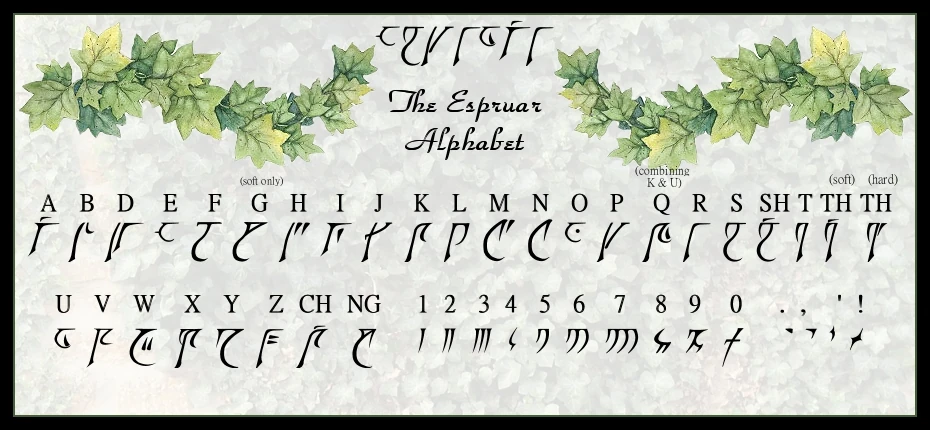
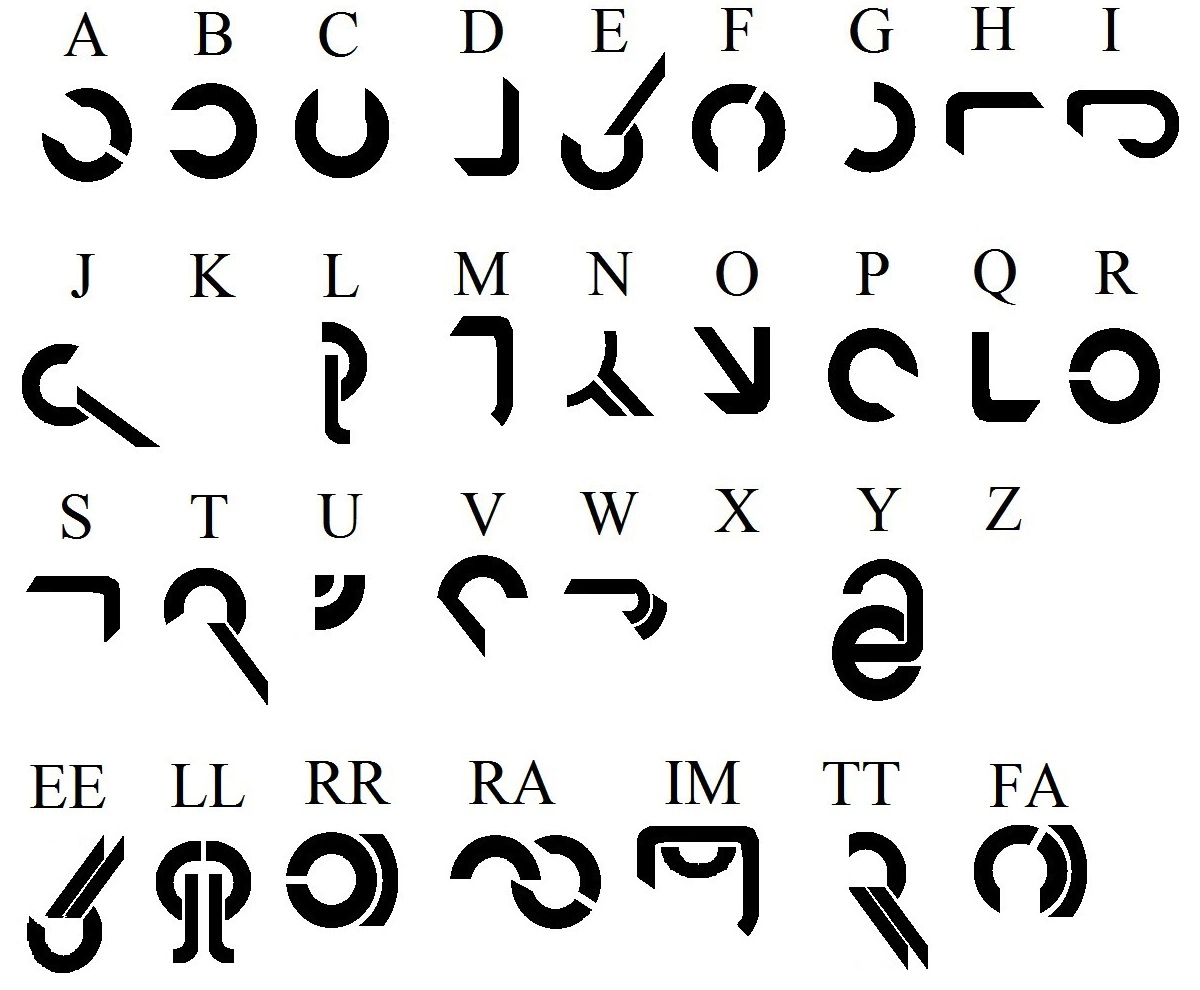
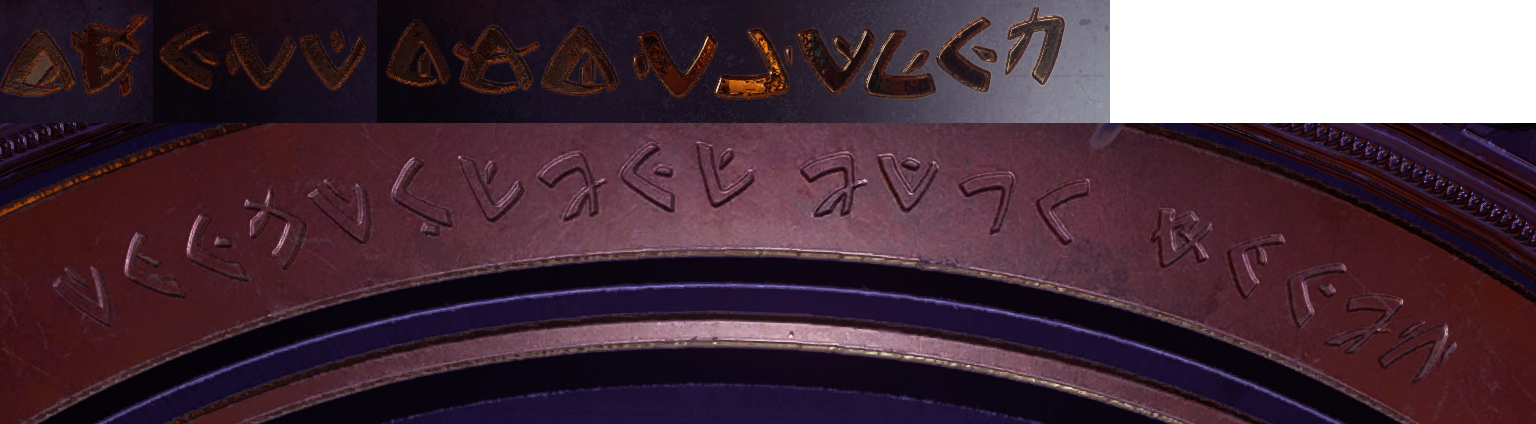
- Man it's hard to come up with a Dwarven script that looks as good as my Elven script (if I say so myself). Took me forever to figure out what shape I wanted it to be based on (I use a "theme" shape in most of my nonhuman scripts). Was thinking triangles, maybe use some element from the Covenant alphabet from Halo. My Elven draws inspiration from the 3e rework of Espruar and the Eliksni script from Destiny.
Eventually decided, my Dwarven combines the Covenant script with the "cat-pupil shape" that Rellanic, the 4–5e Elven, uses. See, I realized, dwarves aren't carving their script into rock with a chisel or wood with a knife. They're engraving it in metal with a burin (which burin is a single one of their mushrooms, metallized and with a sharpened tip). And you can get insanely florid with a burin engraving, so I actually have complete freedom in letter forms! - My Ogrish (based on Dwarven) retains more elements of the original, Covenant-like triangle script, but is more of a cursive form of it, like the version that you can find in signs and stuff on Sanghelios, in Halo 5.
- Decided that the best way to do my games at the actual table was to get a cheap (something like $250) flatscreen, hook a laptop to it, and then use a map program like Megasploot's Dungeondraft to make a dungeon map, to scale. You put a cover (we got a special one eventually but the first time we just used carefully arranged overhead-projector transparency films), and just move your miniatures, pawns, etc., around on it. Given the prices of poster printing, it pays for itself by like the sixth map you use it for.
Of course this would all be somewhat moot (I keep having players have to telecommute, and have someone on my end point their camera at the map and stuff) if virtual tabletop programs like Foundry were easier to use (also apparently there are issues with how you host it?), and if Roll20 was not a terrible, terrible company, from being shockingly petty to critics of their business practices to obnoxious Corporate Woke™ grandstanding on Twitter and elsewhere. - I would say my view of Dungeons & Dragons: Honor Among Thieves does not even approach cautious optimism, but I am willing to be impressed. Kinda wish they would actually play things straight for ten seconds, though. Not every movie has to be the thing those "Marvel fans when The Batman doesn't…" memes were talking about. (Also I loathe, abominate, and revile the "fast-talking bard" archetype that shallow 5e fans seem enamored of.)
- It occurs to me that making my dwarves actually be gnomes, and therefore have roughly the same build as half-elves, will make the dwarf/gnome-based ogres and orcs be much more similar to goblins. Then again I suppose my elves and gnome/dwarves are big and little "fairies", so it kinda makes sense that the monster versions are similar to each other.
The culture is still very different, with goblins having strong personal loyalties and an obsession with fear and stealth, and ogres being very nearly a war of all against all, with a penchant for frontal attacks (which in no way means they won't stab each other in the back, though). Among other things, goblins get a Dexterity bonus, while ogres get a Strength bonus. - Very hard to figure out what to do with my Draconic, since too cuneiform-like will be too much like Dovahzul. Kinda wanna examine the Banished alphabet from Halo Infinite (which is in many ways the worst Halo, not least because the Banished suck as villains—Cortana would have been much better, but 343 has an amazing ability to utterly squander villains, see also the Ur-Didact and Jul 'Mdama). There's also Iokharic from D&D, which as I may have mentioned at some point shares letter-shapes with 3e Espruar.
Thinking I'll do something like the Naboo futhork from the Star Wars prequels, probably combined with vertically skinny letter-shapes reminiscent of Nüshu, an odd women-only script from part of China. Though with the letters grouped closer together (and words grouped into trios, in formal writing, like the tetrads in Classical Chinese).
Also reworked my "Sylvan", which in my setting has become the language of the araneas, formians, and thriae—bug people—that serve the law-spider outsiders. The previous script looked much too much like "Daedric" (really Dunmeris, with the other name being just what it was called in the Daggerfall game files). Went with, in contravention of my usual practice, a featural alphabet, since they're the minions of law-spirits; it wound up looking vaguely reminiscent of "Daedric" anyway. - Apparently Spelljammer in 5e, rather than bothering with ship's ratings (a table based on the level of a spellcaster sitting in the helm that would determine how fast the ship could move), has the thing go 10 miles per hour per level of the highest unspent spell-slot the spellcaster has. I take a couple issues with this (miles per hour do not tell you tactical speed intuitively—10 mph is a "normal move" of about 45 feet, or a "full-round move" of 90 feet—and I liked the major-minor helm distinction, though I suppose the latter does also affect the largest ship you can move via the helm in question), but it does streamline things. Might use it for my airships, or some of them, since I think Wizards has the basic Spelljammer rules (such as how helms work) as OGL.
- A search of le blogue suggests I have not mentioned the problems with Stranger Things? Probably the more fundamental but also the simpler is that it allowed the shills at Hasbro to market the game by the most shallow methods imaginable, flooding us with bandwagon-jumping bounders with no respect for the hobby (that invasion really took off with Critical Role but Stranger Things began it).
More complex, probably less important but more emotionally visceral, is how they have warped a generation's understanding of the names they have the characters drop. Demogorgon has two baboon heads and tentacles for arms (also that thing is a damned gug). A mind flayer…you know what a mind flayer is, and you probably know the thing in Stranger Things is nothing like one. And Vecna is an archlich.
Of course, D&D itself visited upon us the ludicrous idea that Vecna could lay siege to Sigil. Right, because She Who Flays, who can impose terms on entire pantheons, would need adventurers' help against an attack by one lich-god.
Showing posts with label TV. Show all posts
Showing posts with label TV. Show all posts
2022/07/31
Playing with Fantasy XXXV
More icosahedral fantasy thoughts.

2021/11/29
Mélange VIII
Random thoughts, only 5/8ths about icosahedral amusements. None of them reference Dune because I hate Dune (much like the Warhammer 40,000 setting it heavily influenced, it's better as a source of memes than actually engaged with seriously).
- Realized probably the simplest way to turn kytons into goblin ancestor-gods, which I'm calling "barghests", is to swap out a few powers here and there (because they're pure fear, not torture) and then apply, basically, the lycanthrope template, but with my version of worgs as the "base animal". I actually have to swap a lot fewer things than one would think, because kytons run almost as much on fear as on pain, and many of their mutilation-y things will still fly given how much influence from Predator my goblins have.
- Arcane is good. Really, really good. My brother has the bizarre idea that Silco having a cause, the independence of Zaun, makes him better than the other gang leaders of the Lanes, who operate purely from self-interest. But the other gang-leaders didn't spread Shimmer around or come very close to a losing war with Piltover largely out of nationalistic pride.
In the immortal words of Daeran Arendae, violence in a good cause is indeed different: it's much more bloody, and is done with pinkies out.
If I had another complaint, it would be that "Get Jinxed" plays at one point (albeit diagetically, when Jinx is listening to the radio while working—"you're listening to your own image song? don't be that guy"), but "Here Comes Vi" never does. Shameful, shameful oversight. Admittedly she isn't a Piltover enforcer yet, maybe that's it? - Golly bob howdy but Pathfinder is weirdly light on items for storing and preserving food, and cooking it. I mean you can use a cauldron of brewing in camp as well as in the alchemy lab, but other than that? I don't think there are any magical storehouses or anything.
I also think there need to be more low-level magical traps, let your rogues earn their keep earlier on. I mean, since a summon monster VI trap is CR 7, isn't a summon monster I trap CR 2? And maybe summon minor monster as CR 1? 1d3 fiendish-template animals sounds like a CR 1 hazard to me. - Ghostbusters Afterlife is a fitting conclusion to the franchise. The two main kids are extremely believable as Egon's grandchildren (the girl especially is adorable—not just her looks and mannerisms but how her shirt is often buttoned wrong), and everything else is good to excellent. (It does have the weakness of being much more interesting before the big ghost stuff starts happening, but that was also true of the original.)
Critics have mostly panned it in the stupidest manner imaginable, seemingly to punish it for being what the fans wanted, because the critics wanted the 2016 one to be well-received. Which was never going to happen; you can't try to reboot one of the tightest-written movies ever made as a piece of crappy improv, no matter what 1986 Fundamentalist "everything in pop culture is satanic" moral payload you attach to try to shame people into liking it.
Sorry but the 2016 one was fourth-rate improv consisting very largely of fart jokes, extended painfully-stupid dancing sequences, and a running gag where the protagonist is obnoxious to a Chinese-takeout delivery guy. Can't imagine why people didn't like it. - The seven deadly sins are drastically overdone, in fiction. Decided instead that my setting's blasphemous warlockery will run off the Four Sins Crying to Heaven for Vengeance: perversion (the sin of Sodom), betrayal (denial of wages to workers), oppression (of widows and orphans), and murder. Of course, a game-setting is more PG-13, so the main form perversion takes (aside from the decadent witch culture having some sibling marriages) is cannibalism—sexual appetites aren't the only ones that can be perverted. Helps the royal caste of the modern thalassocratic Valyrians are dhampirs.
Also decided that the non-fiend evil gods basically want to use the witch-power of the fiends against fiends, like using the One Ring against Sauron, or using Stasis against the Darkness (huh funny how one of those examples understands what a bad idea it is, Eris). They mostly take the form of murder (i.e. human[oid] sacrifice), although the ogres and orcs are tyrants and cannibals and the dark elves and dwarves are tyrants. (Both go in for a certain amount of backstabbing but you can't encourage that and still maintain a society, any more than you can permit most versions of perversion.) - Decided that the elves' panthers age relative to lions as elves age relative to humans: maturity 2/3 later (elves in my setting are adults at 25 to humans' 15), then age 12 times slower. Which means that, as lions are adults at 3 years, the panthers are at 5; lions get to be middle-aged at 8, so the panthers reach it at 96.
From there though we apply the game-rule aging system where "venerable" is twice middle age (70 for humans, who hit it at 35), so 192 for the panthers. Then "old" is halfway between the two, 144 for the panthers. Lions only live about 19 years in the wild, which makes the panthers' maximum lifespan 228 years. - Thinking I'll redo my Draconic alphabet, since the old one was pretty much just Persian cuneiform upside-down and with the phonological values assigned at random. Thinking I'll take some cues from the Covenant alphabet, but with the strokes inside the triangles rather than as the triangle. But also from how Ugaritic is actually a cuneiform version of Phoenician (e.g. all the signs that incorporate an O shape, the ones that in Greek or Latin are O, Θ, or Q, replace the O shape with a <-type thing).
Specifically how I think I'll have it work (I need to figure out all the nitty-gritty still) is take letters like something in a standard alphabet, convert them to cuneiform-esque shapes, and then convert those cuneiform-esque shapes to triangles. Specifically upward-pointing ones: Draconic is written bottom to top, by a dragon perched above whatever hard surface they're scratching letters into (hence the cuneiform, they're claw marks). - HBO Max has a bunch of DC stuff, and while the fourth season of Young Justice is even more painfully terrible than the third, at least there's a bunch of movies. I particularly like Superman/Batman: Apocalypse and Superman Unbound—I really like Supergirl when she's not being desecrated by the CW (and by current DC writers, of course). Also the fight in Apocalypse with Wonder Woman and Barda against the Female Furies, is one of the best fights in all of animation.
There's also The Batman, in many ways the most underrated DC show (and it's pretty highly regarded, just not highly-regarded enough given it's close to as good as Batman the Animated Series). I wonder why Krypton isn't on there, though, unless it's a licensing issue with Syfy or Universal—tell me the thing with Sig-El's grandfather's Fortress of Solitude, and the camera pulls out to show the El crest, and the Superman theme plays, doesn't stir you deep inside.
2021/09/28
Mélange VII
Random thoughts, only about half of them about RPGs!
- Been playing Wrath of the Righteous a lot. The elf witch, Ember, is, unfortunately, a child (specifically a 91-year-old sixth grader), but Arueshalae, the reformed succubus, is romanceable. The part when you're in the lab of the Architect of the Worldwound and see your companions' innermost dreams, and you discover Ember just wants to play with other kids, was, um…not okay, guys, I needed that heart for other purposes.
It's kinda neat how not only does Ember bring out my fatherly impulses, but even brings out the older-brotherly inclinations of Daeran Arendae, the neutral evil narcissist hedonist. In her first companion quest he starts to make a joke about her having to apologize to a demon lord for her purehearted tears shattering his unholy altar, and then he stops and says, "No, never mind, not even I can joke about this. Ember! Some people don't deserve apologies even if you hurt them!" - My brother said, and he's quite correct, that Star Wars Visions is better than basically everything Disney has ever done with the franchise, even the good things. The band one, the black and white one, and the Astro Boy one are just mediocre, but the other six are genuinely good—a ratio almost unthinkable in Disney Star Wars or in anime based on western properties (cf. The Animatrix and Halo Legends). I dunno, maybe the two kinds of badness cancel out. I particularly like the first of the two Trigger ones, with the twins. Though the best Star Wars thing involving Sith twins will always be that one trailer for a SW:TOR expansion.
The subtitles are pretty questionable, though, since they're the closed-captioning of the English dub. Like for example how in "Lop and Ochō" they don't mention that he's not just "Boss Yasaburō" but is specifically referred to by the term that usually describes yakuza bosses, and that the duty their clan has inherited along with their lightsaber is jingi—the name for the yakuza code. (Neighborhood yakuza, like "neighborhood gangs" all over the world, are a lot less evil than big-time yakuza. Basically this is a classic yakuza-movie plot where a neighborhood gang is being forced to capitulate to a bigger one, and comes into conflict with them when their more amoral, profit-driven ways threaten the security that neighborhood gangs exist to protect.) - An interesting idea Wrath brings up that I immediately realized I had to incorporate in my own stuff: paladins' fear immunity means they are also immune to PTSD. They can still worry about things—Seelah is very insecure after what happens with the League of the Inspiring Cart—but presumably in a fundamentally different way from people who still feel fear.
It also unavoidably made me think of the Adeptus Astartes: "They are my Space Marines and they shall know no fear." But Iomedae the Inheritor is worthier of the service of such beings than the Corpse on the Golden Throne. (Although Aroden was basically him. I've talked about the "ascended human" form of non-infringing Jesus, and why it doesn't work.) - The new Netflix He-Man—not Masters of the Universe: Revelation, the one with "He-Man" actually in the title and actually made by people who don't hate fans of the franchise—is really good. Mostly because it's made to entertain kids and parents rather than to win the approval of twenty-somethings from Portland who spend too much time on Twitter.
The thing in this iteration where Adam shares the Power of Grayskull (the Masters of the Universe always seemed like a bunch of randos in both prior versions, so the old-school fans' complaint there is mostly groundless) was interesting, coming out as it does at the same time as Wrath, in which your character shares mythic power with his companions. - Strong Legend of Zelda vibes in Wrath. If you take the Azata mythic path, or even just help the Desnans escape the paranoid inquisitor (who, as the game says, has pretty good excuses for being paranoid), you learn a song from Desna.
When you sing it for Aruashelae in the Drezen prison, she sings it too, then the soundtrack takes it up non-diagetically. Which is right out of Ocarina of Time. (Also Arueshalae's voice actress kinda sounds like Cortana does in Halo 3, when she's been imprisoned and tortured by the Gravemind.) - I'm pretty sure that Rifftrax, not seasons 11 and 12, is the real heir of MST3K. I didn't like that show just to see movies get riffed on, I liked it because I like Kevin and Mike and Bill. Also you get Mary Jo and Bridget doing some of them, and Trace and Frank in at least one.
- My current playthrough of Wrath I'm an elf bloodrager (with one level in eldritch scion magus) who worships Calistria, goddess of lust and revenge. He's chaotic good, and I'm pursuing the Azata mythic path (because baby dragon companion, because ore no
yomemusume da), but it's interesting how they actually make things different depending on your deity. E.g. you can swear revenge on Minagho in Calistria's name, after she beats you the first time, and then when you fight again in Drezen if you bring it up, a wasp (Calistria's animal) crawls down your arm, a sign she favors your vengeance, and your party gets surrounded by swarms of wasps that attack anyone who gets close.
In Kingmaker I liked to play elf paladins of Sarenrae, goddess of redemption, so the contrast between that and a Calistrian is interesting—the duality ofmanelf. In Wrath there's a cool scene where Sosiel, the cleric of Shelyn, discovers that a necromancer who reanimated other Shelyn worshipers was a guy his temple took in while he was wounded. It was all a plot to turn him against Shelyn's worship, because she doesn't allow killing defeated enemies. So I told him it's not worth breaking his vows, and killed the necromancer myself—the Eternal Rose might forbid it, but the Savored Sting don't care. Just in general the Owlcat Pathfinder games give you genuine opportunities for real roleplaying that I've never seen in any computer game before. - Strongly considering reworking my setting's spellcasters, making clerics originate with humans, druids with dwarves, oracles with gnomes…and witches with elves. Since witch is a divine caster, ish, that casts off Intelligence. Unfortunately a lot of my naming comes from the assumption dwarves have clerics and elves have druids (fortunately only the surnames in both cases), and the courtesy-names used by the elite of the thalassocratic Valyrian society are derived from witch-patron themes and possible witch bonds (familiars, mirror-witch mirror, etc.). I also have a lot of "fluff" about specifically witches. But I can redo that in terms of the "witchcraft", possibly renamed, being any evil divine caster, give them witches, druids, clerics, and oracles. About the one difficulty is that then I still have the dark elves, goblins, ogres, and dark dwarves hating witches despite being evil, but I can still make it work, the way that plenty of cultures that practiced human sacrifice still tabooed stuff like cannibalism.
The one major issue is that I should rethink at least some of the characters in the stories set in my setting, in terms of their class affiliation. Not all the thalassocratic Valyrian people's priests need to be witches, now; I could for example replace a gravewalker witch character with an undead lord cleric (but I won't, because the gravewalker's creepy doll is super important to the scene). I think I will replace another witch with a blight druid, though. Basically now I think their priesthoods will all be corruptions of the other races' ones, and their evil witches be based on elves' good ones (I imagine elves have a lot of positive-energy hex channelers…and dwarves get their channeling primarily from paladins). Maybe I'll change "witchcraft" to "blasphemy"? That's what witchcraft in the anthropological sense basically is, after all. Come to think of it, not calling it "witchcraft" would have the advantage, when I actually publish, of not running afoul of the fools who don't know "witch" never doesn't mean evil, in the real world.
2020/06/25
Playing with Fantasy XVIII
Yet more fantasy RPG thoughts. One is about a White Wolf urban fantasy game, or specifically an upcoming CRPG based on one.
- Decided that my wood elves, specifically their druids, act as agricultural providers for the city 'high' elves. Apparently deer can have a population density of 30 or even 35 per square mile and not overpopulate their environment; reindeer farmers apparently have an "equilibrium" slaughter-rate of 55 percent (deer get to reproductive age a lot faster than cattle, I think is why, plus they usually have two offspring at once—since the rate for cattle is only a bit over 9 percent). That comes to 16½ to 19¼ deer slaughtered per square mile. And the "ideal" meat yield of a deer (which elves are presumably capable of usually achieving) is 83 pounds of meat, which brings the total to 1,369½ to 1,597¾ pounds of meat per square mile.
Meat is about as good a source of calories as grain, and a human being (or an elf) requires 37½ pounds of grain (or meat) per month. That comes to 36.52 to 42.61 person-months per square mile—or in other words, 3 to 3½ elves supported for a year per square mile of forest. That means a Pathfinder small city of 5,000 to 10,000 elves can be supported by a forest of 1,429 to 3,334 square miles, and a large city of 10,000 to 25,000 elves can be supported by 2,858 to 8,334 square miles of forest. For some perspective, the Coconino National Forest is 2,900 square miles; the largest taiga in Russia is 4,633,226 square miles. And that's if the city lives solely on the deer the wood elves provide; they would also import other foods, and also raise their own, like poultry.
All my nonhumans are actually generalist carnivores, like wolves, so they can also live on high-protein vegetable foods like nuts and legumes, and on dairy products (I think my elves buy a lot of cheese from humans). - If you look at it just right, Pathfinder includes rules for falling from grace and becoming something one would have once loathed with all one's being, à la Arthas or Anakin. You just retrain as the new "evil" class, using the retraining rules found in Ultimate Campaign. (It has specific rules for an Arthas or Anakin-type character ceasing to be a paladin and becoming an antipaladin, but what about a good adept who becomes an evil witch, say, after watching their tribe slaughtered by orcs?)
- Worked out my nonhumans' skin colorings. Elves do indeed have bluish skin, sometimes turned greenish by yellow carotenoid pigment, except the dark elves instead have bluish skin sometimes turned purplish by red anthocyanins (they're generally not any darker-colored than other elves, it's not a physical descriptor). Goblins also have blue-gray faces, becoming bluer the higher caste they are till bugbears have fully bright blue faces (like golden snub-nosed monkeys getting bluer skin the higher-ranked they are—basically the better-fed they are the better their complexion is). Dark elven hair has red anthocyanin pigment, blue- and green-haired elves have blue anthocyanin (with the green hair also having yellow carotenoid), and goblins have brazen yellow hair with just the carotenoid, and green fur all over most of their bodies with both blue anthocyanin and the carotenoid. Normal elves' orange or yellow eyes are carotenoid, while dark elves' blue-white eyes are just very light blue anthocyanin, and goblins' bright crimson eyes are orange carotenoids combined with red anthocyanin.
Dwarves have red or black phycoerythrin in their hair, except white dwarves, and ogres, who have phycocyanin as well as yellow phycoerythrin; all have yellow-brown phycoerythrin in their skins, giving them a "yellow ochre" skin-tone. All dwarves and ogres have the same color eyes as hair (meaning white dwarves only have pupils). Gnomes have melanin in their skin, making them walnut- to chestnut colored, but in their lavender or pink hair they have purple to magenta betacyanins. Gnomes with lavender hair have violet eyes, while gnomes with pink hair have blue eyes. Had been going to say gnomes and elves have sclera the same color as their irises because, with their +2 to Perception, they can keep track of each other's gaze without needing obvious "whites of their eyes", and then maybe dwarves' +2 to Wisdom, an effective +1 to Perception, was sufficient. But then I realized you probably can't see "whites of their eyes" in darkvision anyway, so the issue of being able to see where each other was looking never actually comes up for people who have it. - There's this elaborate article about how to do an Avatar: The Last Airbender-based campaign in D&D 5e. Meanwhile, in Pathfinder… And yes, that is clearly what they're going for; the illustration for the blood kineticist in Occult Adventures is even dressed like an Eskimo, albeit her anorak isn't dyed blue (must be a mollusc dye, since there presumably aren't many dye plants at the poles). What you do to make kineticists correspond directly to Avatar is restrict everyone to only one element, when they would normally be allowed to take extra ones at higher levels, and don't allow most composite effects, but you stick electric in fire instead of air and make it and metal more level-restricted (and don't have aether).
- Decided that apprentice sorcerers (and leyline guardian witches), "know" three zeroth-level spells, rather than being able to prepare two like wizard ones. (I should've specified they can prepare two per day, and cast them an infinite number of times per day, like all primary casters, rather than saying they can "cast" two per day—though there are two a day that they can cast.) Other witch apprentices, of course, should use the same rules as wizards, since witch spellcasting tracks with that of wizards.
So presumably, too, apprentice maguses work like apprentice wizards, and apprentice bards like apprentice sorcerers, since at first level those classes work pretty much like the equivalent primary casters. And novice clerics and druids would also work like wizard apprentices, and oracles like sorcerers.
Inquisitors work like bards (or sorcerers), as do summoners (which I don't think I'll ever use, since they're a huge hassle). I don't know exactly how to have apprentice alchemists work; maybe they can use Alchemy and Brew Potion but not bombs or extracts. And then maybe they can make a sort of "practice" mutagen that only gives half the AC and ability-score bonuses—but maybe full penalties? Seems thematically appropriate anyway. Remember that apprentices should normally be NPCs not players, so "would anyone want to play that?" is less of a factor. - I keep going back and forth on whether my goblin subgroups (goblin, hobgoblin, bugbear) are different ethnicities of one species, or are just castes within one ethnicity. Like, maybe if you feed a goblin enough it becomes a hobgoblin, and a really well-fed hobgoblin can become a bugbear. I suppose I can split the difference, since I'd already had all three be goblin-sized at birth (this allows male hobgoblins and bugbears to have goblin wives without risking their health). Being raised in a family of hobgoblins or bugbears, with their access to food, will always make a child grow up to be that size, while a grown goblin or hobgoblin is usually locked into the size of their race, and wouldn't get as big as a bugbear even if they were to get as much food as one (since male bugbears do have hobgoblin and even goblin wives, who don't become as big as them); and a hobgoblin or bugbear who falls on hard times certainly won't shrink…but might starve.
- I got Ultimate Intrigue for my birthday, and…damn. This is how you make a d20 game something other than a hack-and-slash fest; the verbal duels and research rules make it almost the "home game" version of Phoenix Wright: Ace Attorney and Miles Edgeworth: Ace Investigations, respectively (I don't know about your players but mine would almost certainly say "objection!" and "hold it!" constantly while doing verbal duels). I had thought the only major things it had to offer were the vigilante base class and some new archetypes, but it actually has a lot of at least potentially useful stuff.
The social conflict rules seem to (I haven't actually learned them yet and I might be wrong) allow you to do intrigues and social-based campaigns almost as well as a White Wolf game would (or, as a White Wolf game is supposed to, given that White Wolf games very often devolved into "I use my three dots in Shitblowupification" or "I go Crinos and bite his head off"). And expanded rules for chases (where you can also make slow, careful tracking-down fun to run, not just an actual physical pursuit of a quarry you can actually see), and a system for establishing nemeses for the PCs, are two ideas whose time had come a long time ago.
The intrigue rules and heist rules also let you do things the d20 system has historically handled fairly fumblingly. Have I mentioned how impressive I find Pathfinder as a ruleset? Because it's amazing. - Speaking of White Wolf, planning to get Werewolf: The Apocalypse—Earthblood, so my XBone has something to do before Halo Infinite comes out
for its successor(Earthblood seems to be due out in July). It looks pretty cool; I am of course girding my loins for having to wade through eco-radical ranting that might be too heavyhanded for Captain Planet. I.e., yes, I am familiar with Werewolf: The Apocalypse. Still kinda wish it didn't lock you into playing one character—the Vampire: The Masquerade video games let you pick your clan and I think even faction, though there's only the one protagonist faction in Werewolf—because while the Fianna are among the less obnoxious tribes, I'd much rather be a Shadow Lord ("werewolf Starscream"). I'd also like to pick my breed and auspice, because Metis are cool (the fact their name is…"problematic"…to one side) and I like Theurges.
2020/03/14
Sierra Foxtrot 17
SF thoughts.
- Apparently the specific energy of carbon nanotube springs is actually 7.2 megajoules per kilogram, not 0.3. Which probably doesn't mean that of boron nitride nanotube springs is 72 megajoules, not 3, since boron nitride nanotubes are more massive than carbon ones, averaging 2 grams per cubic centimeter rather than 1.35. But since I think a spring's energy is linear with respect to the mass, we can conclude that the difference of their densities (1.35/2=.675), times the difference of their stiffness (tenfold) produces the difference of their specific energy, 6.75. Which still means that the BNNT spring has a specific energy of 48.6 megajoules per kilogram, compared to gasoline's 46.4. (Though I think I, or my source, transposed some digits, because gasoline's energy density is 34.2 gigajoules per cubic meter, not 32.4. Which still means BNNT springs are competitive with gasoline.)
What that means is that the zled equivalent of a UH-60 Black Hawk, using electric motors instead of internal-combustion ones, with the equivalent of 2766 kilos of jet fuel (specific energy 43 megajoules per kilogram, energy density 35 gigajoules per cubic meter) taken up by BNNT springs, has a range of 11,296 kilometers, compared to the Black Hawk's 2,221—first because its two 1410-kilowatt internal combustion motors become two 402.857-kilowatt electric ones (electric aircraft motors being 3.5 times as efficient), and second (less importantly) because BNNT springs require 11.5% less fuel mass. And if zledo had something like the JetPack Aviation JB-10 jetpack, which they wouldn't because jetpacks are deathtraps irrespective of what powers them, they'd be able to get a hair under four times (395.58%) its eight-minute flight time, over half an hour, from the same mass of power-supply.
Electric cars (or tanks) are slightly less impressive; electric car engines are only twice as efficient as internal-combustion, instead of three and a half times like electric aircraft, and gasoline is only 4.5% less efficient (as a function of mass) than BNNT springs rather than 11.5% (diesel is 6.6% less). But that still lets a HMMWV with an equivalent mass of spring to its gas supply have 2.13 times the range of diesel or 2.09 times the range of gasoline, and lets an M1 have those range-improvements over gasoline or diesel, or 2.26 times its range on jet fuel. All of which is just assuming the vehicles are made of the same aerospace or automotive alloys as now, which they aren't; the frames are made of far lighter microlattice and the armor (on the tank) is replaced with far lighter metallic foam. - For humans, lithium-air batteries—specific energy 40.1 megajoules per kilogram, energy density 37.8 gigajoules per cubic meter—are slightly inferior to fossil fuels, but the superiority of electric motors makes up the difference. A Black Hawk with electric motors powered by lithium-air batteries the same size as its fuel capacity has a range of 7,249 kilometers, and a JB-10 (which, again, they'd never use, because deathtrap), it'd get 3.26 times the range of the jet-fuel powered one. A lithium-air powered HMMWV gets 1.759 times the range of a diesel one, 1.728 times a gasoline one; a lithium-air powered M1 Abrams has those improvements to its range over the gas and diesel ones, and 1.865 times the range of one powered by jet fuel.
- I think the main artificial birth-control of the humans in my setting involves interfering at either the primary or secondary phase of ovarian folliculogenesis, probably with medical nanobots, but also artificially stimulating the hormone glands (with other medical nanobots) so that the fluctuation that's normally associated with ovulation can still happen. It's not perfect, of course, but it's less disruptive than modern hormone-based contraception. Presumably the nanobots use metadata from each other to ensure a normal hormonal cycle.
Another thing they do, while interfering in the development of ovarian follicles, is perform gene-therapy to ensure that the DNA-repair genes involved in homologous recombinational repair don't get depleted, so that people who, with 24th-century medicine, are quite able to have children up into their eighties (the average age of menopause in my setting is 82, because human lifespan is 130 years) are actually able to do it. (Or at least, that's what they do for the well-informed and wealthy; it's sorta darkly ironic to suggest medical professionals would do that for ordinary people.)
Actually come to think of it the main side-effects might be from that gene-therapy, what with gene-therapy being accomplished by infecting the patient with a modified retrovirus. Fortunately ovarian aging isn't something that has to be counteracted with every dose of the treatment; it's probably a "once or twice a year" kind of thing. Actually yeah, I can work with that; there's another gene-therapy in my plot, maybe I'll have the character say she's not used to gene-therapy side effects, since she isn't rich enough for the ovarian anti-aging treatments. - Lot of possibilities for aliens in the fact puffins have photoluminscent beaks and some chameleons and frogs have glowing bones.
- It's fascinating how post-Abrams Trek doesn't so much hate science, as deny that there is such a thing. Now, it's nonsense when fans (entirely justifiably complaining about how bad Picard and Discovery are) say that the older shows were semi-plausible. They were nonsense; anyone with a high-school level understanding of science should know they're nonsense. But this new crap makes them look absolutely diamond-hard. Star Trek always had a tendency to conflate science and technology with magic, but at least it was internally consistent magic, like in a serious fantasy story for adults; post-Abrams Trek, on the other hand, is treating it like magic in a children's fantasy, like early Harry Potter.
- It seems there is an Earthly parallel to the khângây concept of ever-increasing circles of solidarity, multiple degrees of kin then compatriots than foreign allies. Anyway the term for it is asabiyya, the Arab group solidarity concept, but without the "amoral familism" that plagues Arab culture.
Where the Arab saying is "I against my brother; my brother and I against my cousin; I, my brother, and my cousin against the stranger", the khângây would instead say "I help myself; I help my brother; my brother and I help my cousin; my brother, my cousin and I help our compatriot; my kin, my compatriot, and I help our ally; my kin, my compatriot, my ally, and I help the stranger". Rather than only ceasing to fight who's nearest when someone further off comes along, it's who takes priority in terms of aid.
As the khângây develop into a "world government" system, they add a layer for "the whole species", and then, after first contact, "sapient life"—though their first contact was with the thoikh, so they probably actually waited till first contact with zledo, who turned out not to be dangerous and crazy. - Searching the blog thinks I haven't mentioned it, but birds don't have blood-types. Nope. They can receive blood from exactly any bird, and the only issue is that you have to do the transfusions more often the less related the birds are—you can even do different species, genera, and so on, probably even unto paleognaths and neognaths (at which point you're probably going to have to transfuse really often, though). Decided the same goes for zledo, so character profiles will all list "N/A" for blood type.
Incidentally a lot of nonhuman mammals appear to lack either universal-recipient or universal-donor blood-types, with only dogs having both (DEA 1.1 positive and negative, respectively). (Well and chimps, but they have mostly the same blood-groups as us.) Cats don't have a universal donor; horses don't have a universal recipient. Rabbits, not in that article, don't have a universal recipient either. (Rabbit blood-types, by the way, are A, B, O, S—or rather Š/Ш, they were first described in the Eastern Bloc—and L.) - Another difference between birds and mammals is they don't get respiratory viruses, apart from bird flu, very much; most of what looks like a cold, in birds, is bacterial infections. The issue there is that they don't go away on their own, but need antibiotics. (They can also reinfect with the same illness, unlike with a cold virus. Find a good bird vet, if you have pet birds, clearly.)
Zledo, I decided, do get illnesses comparable to colds, caused by a virus(-analogue) rather than a microbe (or maybe even by a prion), but with flu-like symptoms, because their pneumatized body cavity means that sinus congestion results not only in headaches but in aches throughout the whole body. (Something similar seems to happen in birds with aspergillosis, a fungal infection. Find a bird vet!) - Discovered this researching my Pathfinder setting's dragons, but turns out, birds don't have beaks to save weight. Nope. They have beaks to save time, specifically while in the egg. Teeth take a while to form—dinosaurs spent three to six months in the egg, compared to most birds' one-and-a-half to four weeks—whereas the keratin sheath on a beak is much faster. (Though beaks are also lighter—mercifully I don't have to recalculate my dragons' mass—but that doesn't explain why ground-bound dinosaurs sometimes developed them.)
2020/02/07
De romanicorum theoriarum XVI
Speculative fiction thoughts, fewer of them about Pathfinder.
- The reason marine mammals have flat tails and swim up-and-down rather than side-to-side like fish, is that mammals evolved a different gait—a dolphin or whale is essentially doing with its torso what the torso of a dog or rabbit does when they run. That's why ichthyosaurs (whose taxonomic relations are far from clear) had fish-like rather than dolphin-like tails: reptiles still use the ancestral, fish-like side-to-side motion, when they run. (Dinosaurs didn't, but in between they evolved bipedalism—the ancestor of all dinosaurs was a biped, with some lineages later dropping back to all fours. You can see it in how different the forefeet are from hindfeet, obviously in hadrosaurs but even in ceratopsians, sauropods, and thyreophorans—they're all modified hands.)
Bipedal dinosaurs did not modify the orientation of their forelimbs from those of the ancestral reptiles, although they did move them to face in front of their bodies. Like a lizard, the palms of a bipedal dinosaur like a dromaeosaur face out when the arms are spread, and each other when the hands are put toward each other: because palms that face each other are better for grabbing. The default position of a dinosaur's hands, when it has hands, is not with the thumbs toward each other and the palms toward the ground, like yours are (relax and let your hands fall, and you'll see this). It's with the palms toward each other and the thumbs pointing up, because a bipedal dinosaur is not a modified quadruped like you are—a quadrupedal dinosaur is a modified biped. - Searching the blog claims I haven't mentioned it here, even though I could swear I did, but the smart birds, all of which are psittacopasserines (the songbird-and-parrot superorder), took a different route to intelligence from primates. We got smart and then learned to talk, but they learned to talk and then got smart. What I mean is, the reason corvid and parrot brains got so advanced, is the need for processing power for ever more complex song. They then became able to handle other kinds of cognitive task. Whereas we got smart for those cognitive tasks, and then developed language.
But it occurred to me, maybe a further justification of zled intelligence despite their being more powerful than humans, aside from their world being as scary as the Mesozoic, is that they had a sort of evolutionary feedback loop like birds did, for boosting their intelligence. Maybe they descend from something like a predatory howler-monkey, but with a far more complex repertoire of calls, like a songbird or parrot (and, y' know, roaring rather than hooting, birdsong, or mimicry), and the processing led to their ancestors increasing in intelligence before tool-use was a factor.
The main interspecies reason their ancestors would've roared would be to warn potential predators that gangs of arboreal jackal-baboons are around and would take a dim view of preying on their young, while the intraspecies reason would be the same as the one for wolves howling and lions roaring, announcing to conspecifics "if you can hear this, you're in our territory". (The complex calls would, of course, be mainly for the latter purpose.) - Realized the best choice for making the elemental outsider-race in my setting would be to repurpose divs, as "neutral, chaotic neutral, or lawful neutral" outsiders. Only with mephits, with the "young" template to turn them tiny and knock a point off their CR, instead of doru divs. Of course I gave the divs a variable elemental affinity/immunity, rather than fire, and change their cultures to be more like normal genies (Pathfinder divs are corrupted genies—though their ultimate origin is the daevas of Zoroastrianism). Also gave them, as I said, pterosaur wings. Which they can use as legs, giving them the Bull Rush resistance of something like a centaur. (The reason pterosaurs, even giant azhdarchids, could take off in a leap, despite being bigger than any bird let alone any bat that ever was, is their wings were still forelegs, and the massive muscles for flapping them were also available for pushing off with.)
I had said that all nonevil humans become agathions, in my setting, and elves become azatas. I think I also mentioned dwarves become inevitables (but with no axiomites to command them)? Well I decided nonevil gnomes become kami, and nonevil giants become asuras (but not evil). I went down the list of outsiders that constitute races, planeborne as we knew them in my day—aeon, agathion, angel, archon, asura, azata, daemon, demodand, demon, devil, div, elemental, inevitable, kami, kyton, oni, protean, psychopomp, qlippoth, rakshasa, titan—and figured out which ones were the best fit to be the "petitioners" of my humanoid races. I also still have elementals, they're just the div-types' spirits channeled into elemental matter temporarily; the rest of them just aren't there, any more than the fey are. I think my setting's dragons will just reincarnate? - I've said that skeptics often seem to be magicians and special-effects people, i.e. professional fakers—their skepticism turns out to be merely projection. So I'm not exactly surprised that James Randi's "challenge" was rigged, requiring a far higher standard than science normally does, and potentially requiring far more resources to produce the tests than the prize-money could cover—and isn't really epistemically or scientifically valid anyway. Conmen always assume everyone else is dishonest.
- They're putting the X-Men in the MCU—starting with the New Mutants, because we totally care about them. Also the movie about them seems to be a horror movie? Maybe it's just one of those cases where the advertisers criminally misrepresent the work in question, like how they always make kids' movies look gratingly obnoxious. Anyway, though, if Marvel could try to put its craniorectal inversion into remission for a moment, they have a chance to do something cool, and introduce diversity in a justifiable way that doesn't utterly gut characterization, but actually updates it in a meaningful way.
Namely, Magneto would be around 90 this year, if he was in his early teens (the age mutant powers usually manifest, and the age he's depicted as having been) in 1944. So instead, have him be Rwandan. Change his name to Érique and find a Tutsi surname that sounds like "magnet". Then have his flashback be to turning Hutu machetes into curlicues. (They can also make Xavier be black, too—played by Lance Reddick or someone—since Cameroon, Cape Verde, and Brazil are all more likely to have "Xavier" as a surname than anywhere in Europe.)
Yes that complicates Wanda and Pietro, two clearly not-Lance-Reddick's-children people, but it's not like Marvel doesn't have a peckish Anti-Monitor worth of plotholes at the best of times. - Henceforth Star Trek: Picard shall be known as The Normandylorian, and the bioroid girl, Dahj, shall be known as Baby Data.

- Occurs to me I can just have the aquatic eldritch abominations of my setting be "sea snake" nagas. Also thought I'd make them the main one of the subterranean world. This reduces me to two, nagas and araneas. Which is a Jim Stafford song. 'Course, there are three kinds of evil naga (dark, deep, and spirit)—I'm pointedly ignoring slime nagas—and only one kind of aranea.
Maybe repurpose proteans and qlippoths into, respectively, nagas and araneas? The former are various kinds of snake; the latter often have more than a few spider aspects. I never actually called them "araneas" or "nagas" in my setting—they're "silk lords" and "serpent lords". I don't think I need too much stat-shifting, though I'll probably have to use some other CR 20 outsider's special attack in place of the iathavos qlippoth's abyssal transformation power—since spiders by definition do not swallow their prey.
Still going to have the serpentfolk ("snake people") and ettercaps, though I gave the latter back their hands (don't know why Pathfinder changed them to having sickle-hands; they're not mantises, they're spiders. Of course, a mantis actually still has a tarsus on the end of its arm; the claw is actually the preceding joint, the tibia. A mantis's claws are really on its frontmost heels. - Ooh, actually I like that; if the snake-spirit creatures have all the scaly servants—serpentfolk, lizardfolk, sahuagin—maybe the spider ones should have the chitinous ones, like formians and thriae. Maybe some treaty keeps them from also creating crab or lobster servants and encroaching on the snakes' aquatic territory? Yeah, sea for snakes, surface for spiders, and underground for whichever can get it, works. Ooh, instead of ettercaps, still have araneas, but as the equivalent not of the nagas but of the serpentfolk.
- Actually watched The Witcher. It's…not shit gravy. I like how subtly Slavic everything is; not only the curious cheerful pessimism, but also, I've got a nagging suspicion about half the seemingly fantastical wordplay is actually just ordinary Polish figures of speech. You get the feeling that you're reading subtitles and the dialogue is really in Polish, even though it isn't. I also like how most of the cast of both sexes are actually attractive, particularly after the homely-as-a-mud-fence, seemingly-selected-for-dumpiness cast of The Mandalorian (though Henry Cavill is a bit too much of a pretty-boy for Geralt, who's supposed to be a lot more grizzled). And it gets bonus points for much better armor design than Game of Thrones, though. Finally, I was pleasantly surprised that Nilfgaard actually seems to be more the Soviets than the Northern "Crusade" (which was never preached as such by any competent ecclesiastic authority). Even if Nilfgaard had been the Romantic Nationalist version of the Teutonic Knights, at least Sapkowski isn't Czech, so we're spared the fantasy version of the Romantic Nationalist (read "laughable unhistoric self-serving propaganda") conception of the Hussites.
Still, though, really not much more than my initial assessment of "Warhammer Fantasy Roleplay with the VIN numbers melted off"—albeit executed pretty well. It's got far too much subscription-TV T&A and gore, and is just generally a little too sordid to take seriously even as dark fantasy. It's not quite unwatchably grimdark, unlike Game of Thrones. It also made me realize: fantasy worlds should be places where most "superstitions" are as accurate as the average person's understanding of science, in our world. There'd be common misconceptions, but the basic rules should actually be known. Because this is information you can actually go out and find for yourself, in these worlds. I deduct significant points for the "demihumans"-as-oppressed-minority thing, also seen in Dragon Age (I also deduct them for snooty bigoted elves, so we're clear): Find. Another. Angle. The half-elves being deformed is somewhat interesting, but it would be more interesting if the deformities were modeled on real-world interspecies hybrids, rather than just having random normal-human deformities (I'm not only saying that because their idea is similar to mine; mine is cooler).

2019/12/18
Mélange VI
Random thoughts.
- Watching And You Thought There Is Never a Girl Online? reminded me of real MMOs with a marriage mechanic (e.g.). Seems super awkward. Maybe it's just because I play Destiny with my sister, but unless you're playing with your actual girl-/boyfriend (in which case you can go to hell), it seems like it would either be very uncomfortable, or just too much of a metagame thing, doing it just for the mechanical bonus.
Seems like it might be better to have the spouse as a person-shaped "non-combat pet"; presumably works best in games like ESO where you can acquire real-estate, since having your spouse follow you around adventuring would be very odd. (Huh, is ESO a community-property setting, concerning homes and other assets owned by one half of a Ritual of Mara pairing?) Maybe if you sleep at home you get a bonus for the next few hours or character levels, like the "Lover's Comfort" rest bonus in Skyrim? (Or an aisai bentô item you can use later, like Skyrim's "Homecooked Meal".)
Actually an option to sleep with your character's spouse in the euphemistic as well as literal sense (no need to actually be graphic about it, of course) could allow the creation of other "non-combat pet" NPCs: namely children. Rather than being like Skyrim where practically every single child except Jarl Balgruuf's kids and Hadvar's cousin Dorthe is adopted (I guess making Redguard children for the Redguard couples was too hard). That could be a kinda cool mechanic, and would make the world feel a lot realer (if done right, a big "if" in game-design). - Thinking of how the Clone Wars were just to keep the Jedi from seeing Order 66 coming, made me realize that Lucas is actually really good at plot, and theme. Now I wonder if Yoda actually meant his warning to Luke in The Empire Strikes Back, that going to save his friends at Bespin would really undo his training and doom them all. Now it seems like that was actually a test, to see whether Luke would fall into the same errors the Jedi Order of old had, of forsaking attachment—the whole point of the fall of the Jedi Order was that the Jedi had forgotten that one attachment, to other sentient beings, was the whole reason their order existed in the first place.
Basically you can view Star Wars, before it was Taken by Disney, as being the Mahayana Buddhist version of Narnia. The old Jedi Order can be compared to Theravada Buddhism, pursuing the path of the arhat, concerned only with releasing oneself but not others from the Cycle of Rebirth. What Luke does, first at Bespin and then with Vader, is the bodhisattva path: of replacing the final desire to be extinguished, desire for Nirvana, with the desire to bring others to Nirvana, and vowing not to enter Nirvana till others do. While attachment to others cannot come at the expense of other goods—that was the path to Anakin's downfall—it's that same attachment to others that can result in their salvation. Including Anakin's.
Indeed it was the whole attempt to do away with attachment that led to Anakin's excessive attachment, and his pathological fear. The thought you try to put away from yourself becomes the thought that you cannot put away. - Got the Pathfinder Monster Codex, and decided my campaign will have boggards, though not called that since that's actually a synonym for bugbear. While their constant cannibalism is indeed how many frogs behave, that's because most frogs are stupid creatures that jump on and devour anything that moves, not something intrinsic to their nature if they were intelligent enough to talk. After all, boggards are not described as being exceedingly likely to engage in necrophilia, but the same stupidity that makes frogs eat each other, also totally routinely makes them try to mate with dead frogs.
Personally, since my setting takes place during an Ice Age, I think it'd make more sense to have them behave like the viviparous toad, Nimaphrynoides occidentalis, since live birth means you aren't dependent on the availability of standing water to reproduce. Oddly parental care in frogs seems to be more typically the male rather than the female, with the tree-frogs that exhibit care by both parents having evolved it as modified male care. (I assume the relative infrequency of cannibalism in toads is just that most toads are toothless.) Intelligent frogs can still regard you as food without this "constantly eating each other" nonsense.
(Unlike in core Pathfinder none of my races eat their own, and far fewer—only ogres/orcs, hyena people, lizard people, frog people, and maybe some cat people—eat other intelligent beings. Goblins hunt other humanoids for Predator-style trophies, but taboo eating intelligent beings.) - All the idiots saying "if Baby Yoda is 50, then 900-year-old Yoda is in his mid-30s": first off, they never said Baby Yoda was specifically two. Second off, he's about a foot and a half tall, being as long as Mando's forearm. Yoda is 2.2 feet tall, according to the official sources. 1.5 divided by 2.2, times the average height of an adult male human, yields 3 feet 11 inches—the average height for a six-and-a-half-year-old, according to the CDC. Which is still quite a young little child, and probably easy to mistake for a toddler (he's not really a baby) if you're not familiar with the relative sizes involved. And if he's six and a half, Yoda's 900 becomes 117. (Yes the child has that hover-stroller thing, but we put children who can walk in those all the time, because their legs are short and they get tired, not some age cutoff. Yoda is shorter as an adult than the 3rd pecentile of American two-year-olds.)
- Redoing some things about my setting's scripts. Decided the giants will be the ones who have the "increasingly complex zigzags" numerical notation, since it makes sense with their octal numbers, which can use the zigzag's corner as a representation of the space between fingers; think the main human script will use the Hebrew or Greek type of numerals, since they have 27 letters. Then they just repurposed the first nine as digits, and maybe use a space for zero, like Chinese rod-numerals did?
Also thinking I'll actually have the Thalassocratic Valyrians' script be the one that gets the Etro script treatment, something like cuneiform since they have more than a little influence from Mesopotamia; the other human scripts will be uncial, blackletter, and runic versions of theirs. And then the Tainish Egyptians on the other side of the world will have something similar to the symbols on the Lantern of Osiris in the current "season" of Destiny 2, which also appear on the thing Osiris used in the first expansion to navigate the Infinite Forest. (Is that Vex writing? I think it's Vex writing.)
I realized my Dwarven had words that end on vowels (which was going to cause trouble for their script), a -ka suffix that marked nouns as feminine (like the -t suffix in most Afro-Asiatic languages), but I changed it to an -ok suffix. Also the pronouns—the only non-triliteral words in the entire language—had ended in vowels, and their roots still do in every case except the unmarked nominative; in the nominative, though, they switch vowel and consonant, so the word doesn't end on a vowel. - Can we talk for a minute about how Frozen and Frozen II are unworthy to scrub the toilets of Tangled and Rapunzel's Tangled Adventure? Tangled had very probably the best Disney princess since Aurora, and the best Disney prince period. Mother Gothel is one of the best villains in all media—someone pointed out, watch how she uses touch, and its withdrawal, to manipulate Rapunzel. And Rapunzel's Tangled Adventure is the best fantasy outside a video game in the English language. It's a better expansion on the original than the Aladdin animated series, high praise indeed, although unfortunately I can't give you a link to the best example without spoiling an incredible twist that you need to see.
Frozen, meanwhile, is a Frankenstein's monster sewn together out of the corpses of more drafts than the David Lynch Dune, any one of which would've been a better movie. Its villain, who has absolutely no reason to exist and is not necessary for the plot, is not only the only person in a position of power who actually lifts a finger to help the people of their kingdom, he also makes his own plan more difficult (let that guy shoot Elsa and he just has to worry about finding and wooing Anna, which'll be easier she's grieving), just to fake out an audience he isn't supposed to know he has. It's also based on a story from the 1840s where a girl saves a boy, helped almost entirely by female characters, but sure Disney, keep pretending you improved on the source material.
Frozen II is a sequel that nobody over the age of ten actually wanted, and its theme is hilarious hypocrisy considering Disney's concurrent pusillanimity RE: Hong Kong and the live-action Mulan (also Xinjiang but the Mulan star hasn't actually endorsed the Konzentrationslageraufseher there, like she did the HKPF's "fraternal assistance"). (One also wonders how it's received in, oh, say, Turkey, pretending for a moment that most Turks understand how that movie's theme could be relevant to them.) - Incidentally, Rapunzel's Tangled Adventure has characters who quite neatly slot into Pathfinder classes. Eugene's a rogue, of course, as are most of his social circle, but Lance is a bard (see the third season); Cass is a cavalier, Varian is an alchemist (duh), Adira is probably a cavalier too, Lord Demanitus was a wizard or possibly a summoner, and of course Mother Gothel is a witch. Rapunzel is a cleric, with the power of her hair being her channel energy ability; the Moonstone Opal is an artifact that switches her channel ability from positive to negative energy whether she wants it to or not. (I judge the quality of a fantasy show partly by whether it makes me want to play a tabletop game.)
- Watching Bokutachi wa Benkyô ga Dekinai (whose title means "We Can't Study" not "We Never Learn"), specifically the episode where Ururaka and Kirisu-sensei have that conversation in the locker-room about how Ururaka shouldn't worry about feeling nervous in her swim-meets, because she always will (Kirisu speaking from experience, having been a figure-skater), revealed something. Namely, though the Bechdel test is absolutely worthless for most purposes, it's actually a very valuable tool in evaluating, of all things, harem series. If a harem series doesn't pass the Bechdel test, it's probably too purely wish-fulfillment to be worth the time.
The "test's" relevance to other genres is more variable, because the female characters may have other reasons for never having conversations about something else—if, for example, the major female characters know each other because their boyfriends/husbands are friends, they're not all that likely to talk about anything else. E.g. Kaya and Miho in Bakuman happen to have been school-friends before they got married, but if they weren't they would only know each other through their husbands; even as it is most of their conversations afterwards probably involve the topic of their husbands in heavy rotation, since almost every major event in both their lives has been related to those two and their manga careers. But in a harem series, where it's a given that the girls are there for the harem, if they can't have any other conversation then there probably isn't enough work put in.
Also…does anyone apply a reverse Bechdel test to works for a female audience? (If you don't think it's an issue—that and a female version of everything feminists complain about in supposedly male-centered media—go read some shojo manga. Or josei. And then we can remind you of the only-qualified value of the test, because something like Dolls by Naked Ape passes the reverse-Bechdel with flying colors…because it's deliberate slash-ship bait. Just like how every yuri manga, for an audience so pathetic their masculinity is threatened by having a fictional dude be the POV-character who gets their wish-fulfillment harem, passes the original version.) - I decided that the modern human witch-nation in my setting, as opposed to Evil Atlantis/Thalassocratic Valyrians, are actual witches (as in as a character-class), but the dark elves aren't; they're just scary druid-archetypes. Their goddess is not a fiend and doesn't deal with fiends, any more than the goblin or ogre gods do, she just has utilitarian evils and blood-sacrifice of speaking beings, but not deliberate taboo-breaking. (There isn't much to pick between Rome and Carthage in practice, even if the Romans don't pretend their infanticide is holy.)
I think the modern witch-nation will still have clerics but they use the same mechanic as the witches, which mechanic I haven't entirely worked out; I think the clerics use a deliberately twisted version of their god's iconography, and specifically pervert their dearest taboos (infanticide for the guardian-mother goddess, necromancy for the death god, etc.)—and all really draw power from the ape-goddess. The very word for "ape" in many Indo-European languages has an implication of undesirable mimicry, e.g. simia and "similar" have the same first two syllables for a reason, and the verb "to ape" means what it does for the same reason.
2019/12/03
Sierra and Two Foxtrots VI
SF and fantasy thoughts. None tabletop RPG-related!
- Mandalorians are severely oversold. In Karen Traviss's works, of course, but even outside them. In reality, the idea these guys were a credible threat to the Jedi is ludicrous. Even without using the Force to enhance his perceptions, a human Jedi can focus on up to eight objects (all humans can). Humans can also continue to perceive objects up to 17,500 meters per second, 0.5% the speed of light (though not necessarily to actually notice, or otherwise begin to focus on, an object moving anywhere near that fast; you're quite likely to never see a bullet in flight, for instance, which is why Jedi use precognition to block shots with their lightsabers).
Since "size matters not", neither does inertia, so a Jedi can move something—say, a Mandalorian's helmet—at any speed they can still perceive, i.e. up to 0.5% the speed of light. Anything that impacts anything else at that speed does so with the force of a quarter its weight in TNT. If a Mandalorian helmet weighs the same as a modern riot helmet, a quarter its weight is about 12 ounces of dynamite. And even at a minuscule fraction of that theoretical maximum, their heads can still be made to impact the ground so hard their heads and helmets crush like overripe grapes wrapped in foil. One unarmed Jedi can kill eight Mandalorians in less than a second.
That fact is why Palpatine went to all the trouble of starting a war and playing half the galaxy against the other half, to put enough death and malice into the Force that Order 66 would get lost in the shuffle and the Jedi wouldn't see it coming. - Which is of course not to say that The Mandalorian is not the best thing Disney has done with Star Wars since getting their grubby paws on it, because it is (well, second-best); it's just important to remember that Mandalorians are something of a paper tiger. (At the very least they should've had—in Clone Wars or Rebels, say—a Sith do the helmet-smash thing, and then inform them that the only reason they were ever able to fight the Jedi is the Jedi were going easy on them.)
- Dragon Prince is mostly pretty good, except that you would never let a deaf lady be a soldier (maybe a behind-the-lines officer). Even if she weren't ambush bait and incapable of doing guard-duty, and she is, enemies with spyglasses would be able to see her signing.
But there is one huge flaw in the worldbuilding: how is it only now, and only Callum, that figured out how to do magic as a human? And how is Esran's ability to talk to animals not magic? Humans were so desperate to get magic that they decided to call out to the Deep and live as death and devastation. Nobody tried Callum's method before? Or noticed people who can talk to animals? Bullshit.
I do also deduct a significant number of points automatically for there being no major male elf protagonist. (Seriously, someone needs to tell people who produce fantasy, particularly fantasy art, that the elf species has a male half.) - Come to think of it, the existence of male elves is something that Warhammer Fantasy did actually grasp (but guess what the playable elf in Vermintide isn't). Pity they tore the setting apart in the stupidest way possible and then sewed the pieces of its corpse together into "Age of Sigmar". (The dumbest of the decisions in question being Malekith being the true Phoenix King all along.)
Usually when someone guts an IP and hangs themselves with its entrails, it's ideologically motivated—Disney Star Wars, Star Trek Discovery, Marvel Comics. But in the case of Warhammer Endtimes, it was simple greed: Fantasy Battle wasn't selling as well as 40K, so they decided to destroy it and make something more like 40K. Apparently the fact they could retool their generic fantasy races into things that could be copyrighted was a big part of the decision. Unfortunately it seems people are still buying the minis and playing the game, but the funny thing is you can basically never find any actual fans defending it as anything but a pis aller.
Another shameless cash-grab own-goal by Games Workshop would be Warhammer Adventures, which are middle-grade novels set in the 40K and Age of Sigmar universes. At the point where I run out of fingers counting the reasons that each child in the 40K branch of the series would be executed by their own government, it is officially not a kid-appropriate setting. - So the real theme of Elder Scrolls Online is probably "Beauty of Dawn"—which is basically a sampler of references to Elder Scrolls lore. "Days and nights of venom and blood" is a quote from Brief History of the Empire, describing the post-Reman dynasty anarchy of the Second Era. The Serpent is of course one of the signs of the Tamrielic zodiac. "Beauty of dawn" is what "Tamriel" means in Ayleidoon. And, of course, there's a reference to the White-Gold Tower.
- Between Granblue Fantasy and Cerberus, for some inexplicable reason anime based on phone games are actually often really good. Chain Chronicle: The Light of Haecceitas might be too, if it didn't start in the middle and thus make it very hard to give a damn about anything that happens; I give it bonus points for including the Scholastic term for "individual identity" (literally "thisness").
If you also consider stuff like Sengoku Basara (except for End of Judgment, which was absolutely phoned in), Tales of Zestiria, and of course Ace Attorney, it's clear anime can just in general buck the curse that plagues adaptations of video games. Probably because the people making the adaptations actually give a shit about the games and their stories. - Related to that issue with Chain Chronicle, the anime of To the Abandoned Sacred Beasts is an absolute train-wreck, and a monkey could see why. They front-load the backstory, rather than us only finding out about it when Nancy does like in the manga. It'd be like if Trigun (which really needs to get the Fullmetal Alchemist: Brotherhood treatment) had had its first episode be Vash and Knives on the ship.
Just in general, if your anime is about a drifter with a dark past and some ordinary person cast into contact with them, you have to keep the past "dark" in the other sense or you'll strangle all narrative tension. First give us a chance to see how the character is perceived; then make us suspect that there's more to them than meets the eye; and only then show us the backstory. You can't do it out of order. - It occurs to me, the mechanic of the Altars of Sorrow, in Shadowkeep, where killing Hive enemies adds time back to your clock, is not just a game mechanic. It's actually a direct aspect of the story and setting. It's the Sword Logic. The Hive give you additional opportunities to thwart their dealings with the Darkness, when they die—because the Sword Logic says that they deserve to be thwarted if they die instead of killing. (Of course the Darkness says that those who cannot claim and hold existence might as well never have existed…while talking to someone who was returned to existence by the Traveler.)
2019/08/08
Welterfindung Drei
Worldbuilding.
- I had thought I'd need to specify something else, rather than gold, for the black-market medium of exchange, in my setting. Gold is 47.74 times as abundant in the Solar System at large (I like that number), as it is in the Earth's crust, .148 parts per million to .0031; assuming all other things being equal, that drops its value down from $45,644.41 per kilo ($1,419.69 per troy ounce) to $956.10—$29.73 per troy ounce, gold's price somewhere between 1933 and 1934. But reading stuff about post-Civil War bimetallism leads me to think the really old numbers aren't adjusted for inflation? If not, we're actually talking $585.78 per troy ounce or $18,838.33 per kilogram, its value in April of 2006. So maybe never mind?
- This was brought to my attention by the blithering idiocy of Malthusian ignoramuses and their apocryphal population apocalypses, and their incredible rudeness to people who have more than two children, but the fact a "replacement" fertility-rate is 2.1 children per woman, means that every tenth woman needs to have three kids. Every woman who only has one child, however, means every fifth woman needs to have three, or every tenth one to have four; every woman who has no children means that three women in ten have to have three, or every fifth to have three and every other one of those, to have four, or every tenth to have five. So you can see the utter imbecility of freaking out every time someone has more than two kids: you need them to have that many, especially with your modern-Western welfare state (which needs the tax-rolls to stay large to remain funded), even if infrastructure and innovation was not very largely a function of population.
When a significant proportion of your society's females choose not to have children, whether by becoming nuns or choosing to have marriages or other sexual relationships that are childless, your society needs a certain portion of its people to have large families. If you can't understand that, congratulations, you know less about how these things work than Robert Heinlein and Josef Stalin, i.e. less than a braindead ideologue and a shortsightedly amoral monster. (Stalin, like Bismarck but unlike Hitler, kept the fourthcrackpropaganda commandment, and never got high on his own supply. Though the Nazis did understand that aspect of these matters; it was things like "strategy is about more than taking important cities" that they didn't understand. Stalin's famine was almost certainly at least as much a deliberate pacification-measure—same as the Irish potato one—as it was incompetent policy; he wasn't Mao.)
Speaking of famines, Churchill's half-Holocaust in Bengal was explicitly based on Malthusian malarkey. He actually said, while refusing no-strings-attached, free-of-charge food aid, that the Bengalis had brought it on themselves by "breeding like rabbits". - Decided to move the main city and cosmodrome (with space elevator) on Mars, in my book. I had had it at Tuscaloosa Crater, right at 0° latitude, and name it Nergal City (Nergal being the Sumerian god they associated with Mars). But decided, no, it'll be at Endeavour Crater, and be named Opportunity City. Because Oppy rocked. Endeavour Crater is still within the 10° of the equator required for you to put a space-elevator there, being at 2°16′48″ S, 5°13′48″ W. You can make the crater into a sweet lake to put seaplane entry vehicles on.
At first I was worried I wouldn't get to use the Mars variant of the Groucho joke ("because in Alabama the Tuscaloosa"), but then I discovered I had not actually written that joke in the dialogue—I come up with a lot of ideas for material that I then forget to actually use. Maybe I'll have them make a joke about not using Tuscaloosa Crater because of something to do with that. Like, say, that they couldn't keep the crews organized ("task are looser"). - Relevant to worldbuilding, sort of, but a thing I was thinking about: I read this thing by a deaf special-ed teacher complaining that their hearing coworkers would straight-up refuse to sign during off-hours, because they didn't want to have to "think about communication". Dick move, but it occurred to me that rustic villagers, who supposedly hate and fear anyone different from them, would never do that. Most modern sign language developed from "village sign", a recognized classification in the linguistics of sign languages, e.g. ASL is specifically from villages in New England. Villagers may think in terms of "us" vs. "them", but if you're a deaf villager, guess what? You're "us", not "them".
- You often see idiot libertarian SF fans who
thinkbelieve, in real life or in worldbuilding, that legalizing prostitution makes human-trafficking go away. It doesn't. Germany and Netherlands are neck and neck for highest rate of human-trafficking in Europe, not only despite both having legalized prostitution but after they legalized prostitution.
Why does legalizing prostitution not reduce trafficking, but appear to increase it? Legalization increases demand (a lot more people "demand" something if they won't go to prison for getting it), and it also lets traffickers operate more openly. Which is harder to cover up, a whole brothel, or the fact the workers in the brothel aren't there willingly?
On sexual matters, libertarians are naive hippies who think people are basically good, just like socialists. - Was reading a review of the game Stellaris, and the thing it says about "sectors"—"Paradox figured the name 'sector' sounds spacey enough, and they're right. The Such-and-such Sector. It has a nice ring to it. You can imagine a starship captain telling his navigator to go there."—reminded me that I hate that kind of thing. What the hell is a sector and why would that be a meaningful unit of a space-government? Most of a "sector" is going to be empty space, for one. More importantly, the idea of an entire, meaningful subdivision of interstellar territory dedicated to the kinds of things sub-planetary governments get from particular regions ("Ukraine grows most of the USSR's grain"; "the US gets most of its copper from the Four Corners") is ludicrous. It's goofy and bizarre for one star system, let alone an entire chunk of interstellar space containing multiple star systems.
You'd much more likely divide an interstellar government into individual star-systems, and then administer each planet within the system (you'd also have regions of the planets administered by descending levels of government, down to at least the level of a single county or municipality). Whether you'd admin the system itself separately from the planets, or have whoever governs the most significant planet also govern the system as a whole, is up to you, depending partly on how important planets are to your setting's space-colonization methods. You might then have certain star-systems combined under some higher-level administrator, but they wouldn't be anything as regular-sounding as a "sector". A "region", maybe, but it wouldn't exist as the kind of economic unit a region of a continent does, unless one is the only place where a resource is produced. But that's still not the whole region.
It also occurs to me you could do something interesting with people or activities taking place in interstellar space, something like (the fictional version of) international waters, and then some—though the energy costs of actually living there are pretty steep if you don't periodically raid or trade with the people who live closer to the starlight. - A bunch of people claim that robots-being-oppressed stories make no sense, because people treat Roombas like pets, but here's the thing: people also treat pets like pets. But consider how they treat other people. Pets don't make the kinds of demands on you that actual people do—or that strong AIs would. Roombas do not "need to be taught their place" because they can't get "uppity" in the first place. Strong AIs could and would. We commodify other people all the time, treat them like appliances or industrial products; people who are actually industrial products would get it even worse.
- It is often remarked—I might've done it here at some point—that it's dumb how Star Trek describes all wars on one planet or within a species as "civil wars", even when the planets don't have world governments. But…is it? A civil war isn't just a war within one state; the US Civil War in fact was not one, but only a secession attempt. No; a civil war requires something else: war over control of the central government.
So possibly, what Star Trek calls "civil wars" are wars where people are fighting not over the usual things nations fight over, but specifically over control of the central government…of the planet. Or, to establish a central government over the planet—wars of world conquest. Maybe each of the "civil wars" the Enterprise gets involved in (because the Prime Directive is a quantum event) is fomented by that planet's equivalent of Khan. - I noticed this watching Krypton, which is mostly pretty cool (Superman theme for the win), but: make sure, in your setting, that your characters' social mores reflect their society's values. E.g. in some of the second-season flashbacks about Seg-El and Lyta Zod, it's implied that there is some concern over her being unfaithful to her eugenically arranged marriage, if she hooks up with him. But…why would there be? Kryptonians are clearly a super-decadent semi-transhuman society with a more or less perpetual sexual free-for-all—and they aren't fertile. They breed by test-tube.
Adultery taboos are so strong largely because uncertainty as to parentage screws up successions; since your heirs are only going to be artificially produced in the first place, thus there are no succession concerns, you wouldn't care who your spouse goes to bed with. (That was part of why homosexuality was valued in Greece and China—though their misogyny was a bigger concern—and the main reason it was, among the Maya. Homosexual relationships let the adolescent sons of the aristocracy fool around with the help, without siring bastards who might complicate their alliance-marriages.)
2019/07/04
De fabularum mirabilium VII
Fantasy thoughts.
- Decided to add some human civilizations to my Pathfinder setting, from the other side of the world—they warred with the ancient "Atlantis" analogue (so, Mu/Lemuria, I guess, except I think they're not also a fallen civilization). I already used Valyrian as a model for the evil Atlanteans' language (and Númenorean as the basis of the other human languages); I had thought I might model it on Marc Okrand's Atlantean ("Adlantisag"), from
the Disney animated StargateAtlantis: The Lost Empire, but then I thought no, Tainish from Unsounded (which has orthography decisions that make hanyu pinyin look intuitive). Obviously I need other human societies for the other side of the planet, but it's super hard to find conlangs for fictional humans. I could possibly use something from Earthsea as a model (yech)? Maybe Edgar Rice Burroughs's stuff? - Thought I might give 'em an Egyptian feel, make 'em super proud and more than a little warlike but not witches (I wonder what the Egyptians thought of Carthage, given they didn't even like Greco-Roman pragmatic infanticide?). Maybe some Incan or Mound-Builder elements, too. (Though those both did practice human sacrifice—the Inca one mainly of children. The Inca were just generally a deceptively unpleasant society, the more you research them.) The evil Atlanteans are kinda more like Sumer and the rest of Mesopotamia, with some Chinese (especially Neoconfucian) elements.
Not sure how the people on the other side of the world will look; maybe Australian Aboriginal facial features and hair texture with brown hair and amber eyes? (On the first hemisphere they're African—thinking specifically Sudanese?—facial features and hair texture with red hair, ivory to terra-cotta skin, and green eyes, and Asian/Native American faces and hair with blond hair, alabaster to dusky skin, and blue eyes—though the two are now often intermixed.) I'd had the first hemisphere have brown hair and amber eyes as variations of the blond-blue group, but no reason I can't change it.
It's not weird to have everyone have one main phenotype in a whole hemisphere; the New World does, after all. - I find the reactions to the ending of Game of Thrones absolutely hilarious. For eight seasons they crowed about how this was a show with "no heroes", where "anyone can die", and looked down their noses at any work of fiction with characters who weren't either psychopaths or ineffectual, or whose story did something other than "subvert expectations" (never mind things are usually the "expectation" because they are the most narratively satisfying and make the most internal story-sense). Then Daenerys started sacking cities, and they whined that she was supposed to be a hero; she got shanked and they whined that she wasn't supposed to die. Like…wasn't this what you liked?
- Maybe, in keeping with using Valyrian for a villainous society because I hate George Rape-Rape, I should have the culture that speaks something based on Old Speech be evil somehow. (Okay so Le Guin is just pompous, miseducated, and overrated, as opposed to Martin's utterly disgusting. Though some have recently reinterpreted "Those Who Walk Away From Omelas" as a rationalization of fandom's conspiracy of silence about child predators like Walter Breen and Marion Zimmer Bradley. Nevertheless.) Maybe Sea Peoples/Hyksos, if the Tainish-based guys are Egyptians?
That would be an interesting parallelism to the first continent, since there, the ancient civilization is evil and it's the people who began as "barbarians" on its margins who are the protagonists. The Egyptian idea is also interesting in view of the fact the planet's in an Ice Age: maybe they're tundra Egyptians rather than "normal" desert, and their calendar is organized around a fertile period caused by glacial runoff? (Ancient Egypt's calendar had three seasons, inundation, growing, and harvest.) I'll have to research some more about ice-age climates. - People complain about "homogeneous" nonhuman races in fantasy settings, but it's a "justified trope" in the case of many of them. They live many times a human's lifespan, if not forever, so why would their culture shift? E.g. in my setting, where elves live twelve times as long as humans: the time separating us from the late form of Proto-Indo-European, about 10,000 years, is only the equivalent of the time since English replaced its dative and instrumental cases with prepositions. (And most languages don't undergo a Great Vowel Shift; the 12th-century version of most languages would be fairly comprehensible to their modern speakers.)
Even the time separating the elves from their ancestors who left the moons is only the time separating the modern Hellenic Republic from the lifetime of Pericles and Democritus. And unlike Greeks or Englishmen in almost all of that time-period, elves are not only all literate, but have the magical equivalent of multimedia recording, so their speech, dress, and other habits will change a lot less than humans have in similar periods. (Our dress and social mores shifted since the introduction of recording media, but those changes have to do with external factors; our speech has certainly changed much less than it would've without recordings.) - I recently got about three-quarters of the way through Ordination, first book of the "Paladin Trilogy" by Daniel M. Ford. I stopped because I suddenly realized I didn't give a damn about the story. There were two issues.
The first is the aggressive genericness of the setting. It reads like D&D tie-in fiction, carefully purged of anything that would make a D&D setting worthwhile. There isn't anything particularly unique or interesting about any of the three main locations. The fortress the protagonist leaves at the beginning, the muddy-gritty port city he tracks the enslaved villagers to, or the dirt-farm village he takes them back to, all feel like generic locales from an RPG.
The second, though, is the religion the protagonist is tasked with (re)founding. Ford is at such utter pains to assure us that it won't offend our modern Western secular sensibilities that he makes it in no way interesting. And the blinded monks are just ridiculous, an ugly caricature of asceticism. Actually I guess these are just one issue: shallowness. Shallow generic setting, shallow stereotyped religions—come to think of it the characters are pretty one-note too. - Remember how, on the basis of "twentyscore", I said you might (and my dwarves and elves do) call 1728X/1000XII "twelvegross"? You can (they do) also call, say, 36X/30XII "threedozen". Gotta leave 288X/200XII as "two gross", though, since "two hundred" isn't one word. (3456X/2000XII would likewise be "two twelvegross".) I also realized that 8000X/1000XX can just be "onescore twentyscore", the way 1000 is (sometimes) "ten hundred". Still have no earthly idea how they'd say 160,000X/10,000XX, though. "Twentyscore twentyscore"? You could call, say, 3 million "three thousand thousand", though normally "thousand thousand" is only poetic.
- A trope in fantasy that I do not care for, particularly, is the "ancient things are better" trope. Ironically it's the Renaissance in a nutshell: "forget your cutting-edge warship design, we're just going with a reconstructed Roman quinquereme". You don't get that in the actual Middle Ages; though the medievals rightly admired Roman roads and aqueducts, and their pop culture depicted Vergil as a wizard, they didn't restrict themselves to Roman knowledge in things like agriculture, manufacturing, or building stone chimneys instead of open firepits in the middle of wooden houses. (Nor in philosophy, medicine, what we'd call "science", or law.)
Especially common with swords, in fantasy, and I can see it when the sword is both historically significant and magical, like Narsil-Andúril. But something mundane, like "Valyrian steel", would be mostly Valyrian rust by just a few centuries later, if not very, very carefully maintained anyway. The medievals not only didn't bother trying to use Late Imperial spathae, they didn't even copy them. They innovated, changing the design of the fuller (e.g. stopping it several inches short of the tip, to improve its strength for stabbing), the taper of the blade, the proportions of the hilt and the shape of the guard, the angle the cutting-edge was sharpened to.
And while I love me some "sealed ancient evil awakens" plots, you could change things up once in a while. Like, have some wizard's new research be the plot driver. (IIRC Warcraft strikes a good balance there.) Always remember, "modern progress" is a medieval concept. - An idea I had is to have the cities of the elves, dwarves, and gnomes in my setting have something a bit like a mythal from Forgotten Realms, and a bit like a Superintendent AI from Halo: but have it be a celestial. I'm thinking have it be one with a CR equal to a character who can cast the highest level spell available in the settlement in question (e.g. a CR 15 celestial, or a CR 16 one like a planetar anyway, for a "metropolis" where 8th-level spells are available). Like the city's priests bargain with the celestial, à la the "Binding Outsiders" rules from Ultimate Magic, and it becomes something like the tutelary spirit for the city. I'll have to work out the specific game-mechanic effects.
2019/05/24
De fabularum mirabilium VI
Fantasy thoughts. Two in a day, yo.
- Both Skyrim and Kingmaker have this trope where you go to a place—Avanchnzel and Labyrinthian in Skyrim, the Abandoned Hut the Stag Lord used to live in in Kingmaker—and a bunch of spectral apparitions re-enact the place's past, without a word of explanation as to why this happens. (I'll make an allowance for when you see Nyrissa's past in Kingmaker, because "it's Fairyland" is an adequate explanation. You could probably make the case that Nyrissa is showing you the Stag Lord's, too, but that's fudging the Author's Saving Throw for him.)
In general it's just very lazy. Much better is the Resident Evil, finding journals everywhere, approach. You could easily find journals of Savos Aren's friends in Labyrinthian, the way you find those of the Nchuan-Zel expedition in Markarth; or those of Watches-the-Roots, From-Deepest-Fathoms, Breya, and Drennen in Avanchnzel; or the Stag Lord and his father. You even do find some scraps of the latter's journals. It's even easier if it's some kind of ancient thing—fill in the backstory in monumental bas reliefs as the characters explore a ruin. (You get a bit of that in Vordakai's tomb.)
If you must do it in visions, have it be in a dream as they camp out near the ruins. Come on. (Also games should make "having to sleep" a thing again.) - In George "Rape-Rape" Martin's continuing quest to do exactly everything wrong, his dragon-eggs have scales. You know, like how bird eggs have feathers. And shark eggs are covered in denticles. And Gila monster eggs are beaded. Right? I had thought it was one of the many stupidities of the show (like its "keyboard on demo-mode" opening theme), but nope, that's in the book. I really ought to have known; the prop people, like the costume people and David Peterson in his capacity as conlang people, actually do their jobs. It's the writing and music people who are phoning it in, and the former are constrained by the source material.
It occurred to me, though, that I kinda want my dragon eggs to be something weird. I considered something like shark eggs (or rather egg-cases), but shark egg-cases are such weird shapes due to being laid underwater. But it occurred to me, what if my dragon eggs are transparent, like many mollusc eggs are, but with a hard shell made of a gem-mineral? D&D dragons, after all, eat gems, so they can probably also put gem-mineral shells around their eggs. Maybe color-coded, with the wholly transparent shells being ice-dragons, the ruby ones being the fire-dragons, etc. (I don't exactly have chromatic dragons, in my setting.) - I realized that I can get a subjunctive into my Elven language by just adding a prefix to another prefix. And since my Elven verbs, like Tibetan ones, are marked for volitionality, the subjunctive-as-order can be readily distinguished from the subjunctive-as-wish. (I think the volitionality also gives something like a passive voice, which most ergative languages haven't got—though Mayan ones do. That's certainly one of its functions in Tibetan, the other main one being distinguishing something like "hear" from "listen" or "get X killed" from "kill X".)
- There was another silliness in Game of Thrones. (The show; I don't know about the book but I wouldn't be surprised given Martin was shocked how high a 500-foot wall is, when he saw it in the show. Meaning he never looked at a 500-foot building in a photo, and drew lines to see what it'd look like as a wall.) Anyway, the silliness in at least the show, is that (people have crunched the numbers) the only way a certain scene of shooting down dragons would work, given the depicted ranges, is if the ballistae had a "muzzle" velocity of 2000 meters per second.
I did some digging. The bolts of the kind of siege-engine that shoots bolts typically weigh about 2.4 kilos. (They also usually have a "muzzle velocity" of 60-150 meters per second.) One of those, at 2000 meters per second, is a "muzzle energy" of 4.8 megajoules. Given recoil force is 10% of "muzzle energy", that means every bolt launched from the device subjects it to 480 kilojoules of recoil—the equivalent of 114.7 grams of TNT, or, basically, two hand-grenades, set off inside the ballista (or whatever), every single time it's used. The thing would explode into splinters with one shot.
Incidentally, 150 meters per second is an energy of 27 kilojoules—almost exactly half again the muzzle-energy of a .50 BMG round. - It occurs to me that a good way to explain the alignments, in D&D, is not so much "law vs. chaos" (a stupid idea unreflectively ganked from Moorcock) but "law vs. charter"—that is, whether the individual or society views things in terms of obligations, or in terms of rights. And then "good vs. evil" is simply whether they're going to use their rights or obligations, toward their proper ends, or abuse them, for their own gain. (Or respect others' rights and keep their obligations toward others, vs. ignoring others' rights or exploiting others' obligations.)
Then ethical neutrality comes down to favoring neither rights and obligations (whether respected or exploited), but respecting or exploiting either as seems most prudent. Moral neutrality would be neither taking pains to respect rights or obligations, nor specifically exploiting or ignoring them—or possibly doing both in (roughly) equal measure. - Ballistae actually aren't tension weapons at all—they aren't giant crossbows. They're torsion weapons. Their two arms are separate, each sitting in the middle of two big twisted springs, and their "bowstring" is just suspended between the arms to hold the projectile in place. Interestingly a lot of ballista variants (e.g. the scorpio and the onager—though apparently the onager is considered a kind of scorpio) often shot catapult stones, not bolts. Then there was the polybolos, a repeating ballista that also holds the distinction of being the first use of the chain-drive. (Though not quite the first repeating missile weapon, that honor going to the Chinese repeating crossbow, invented in the 4th century BC—its association with Zhuge Liang, 181-234 AD, notwithstanding—whereas the polybolos was 3rd century BC.) China actually did use giant crossbows—repeating ones, in fact—as artillery, though.
- Thinking I might change the settled rural culture's weapon familiarities from heavy pick, lance, and whip-as-martial to longsword, lance, and whip-as-martial. Though the heavy pick is a great cavalry weapon, in Pathfinder (for some dumb reason) it's not bludgeoning-or-piercing, it's only piercing. And the only thing the pick has going for it is a high critical multiplier.
(Also the two main kinds of undead mook, zombies and skeletons, have their damage reduction defeated by slashing and bludgeoning, respectively; no undead mook loses its damage reduction to piercing, only rakshasas do, and they're not in my setting.)
Might give the heavy pick to the nomadic horse culture, actually, since it's somewhat similar to Plains cultures' "war clubs" (which were really hammers), and replace the hooked lance. I'd had their main melee weapon be regular clubs and greatclubs, but those are simple weapons, so almost all of them will know how to use them anyway. - I considered using the spiritualist emotional focuses (anger, dedication, despair, fear, hatred, jealousy, and zeal), from Occult Adventures, as the names of days of the week; the rationale for such odd weekdays being that the serpentfolk named them, as they named the months after the creature subtypes—I decided to have some of the barely-humanoid humanoids (serpentfolk, araneas, sahuagin) use psychic magic, instead of normal divine or arcane magic.
But then I realized I can go with the energy types—acid, cold, electricity, fire, force, negative, positive, sonic—and just combine negative and positive into one day. Obviously they'd be named something other than "Acidday"; I'm thinking the English translations would be something like "Vitriol, Frost, Lightning, Flame, Distortion, Life, Ringing". But I'll probably translate them into my Common for my actual calendar, the way the Elder Scrolls setting does.
Subscribe to:
Posts (Atom)